. 2009 Apr;191(8):2431-46.
doi: 10.1128/JB.01759-08. Epub 2009 Feb 6.

A conserved alpha-helix essential for a type VI secretion-like system of Francisella tularensis

Affiliations

A conserved alpha-helix essential for a type VI secretion-like system of Francisella tularensis

Jeanette E Bröms et al. J Bacteriol. 2009 Apr.

Abstract

Francisella tularensis harbors genes with similarity to genes encoding components of a type VI secretion system (T6SS) recently identified in several gram-negative bacteria. These genes include iglA and iglB encoding IglA and IglB, homologues of which are conserved in most T6SSs. We used a yeast two-hybrid system to study the interaction of the Igl proteins of F. tularensis LVS. We identified a region of IglA, encompassing residues 33 to 132, necessary for efficient binding to IglB, as well as for IglAB protein stability and intramacrophage growth. In particular, residues 103 to 122, overlapping a highly conserved alpha-helix, played an absolutely essential role. Point mutations within this domain caused modest defects in IglA-IglB binding in the yeast Saccharomyces cerevisiae but markedly impaired intramacrophage replication and phagosomal escape, resulting in severe attenuation of LVS in mice. Thus, IglA-IglB complex formation is clearly crucial for Francisella pathogenicity. This interaction may be universal to type VI secretion, since IglAB homologues of Yersinia pseudotuberculosis, Pseudomonas aeruginosa, Vibrio cholerae, Salmonella enterica serovar Typhimurium, and Escherichia coli were also shown to interact in yeast, and the interaction was dependent on preservation of the same alpha-helix. Heterologous interactions between nonnative IglAB proteins further supported the notion of a conserved binding site. Thus, IglA-IglB complex formation is clearly crucial for Francisella pathogenicity, and the same interaction is conserved in other human pathogens.


Figures
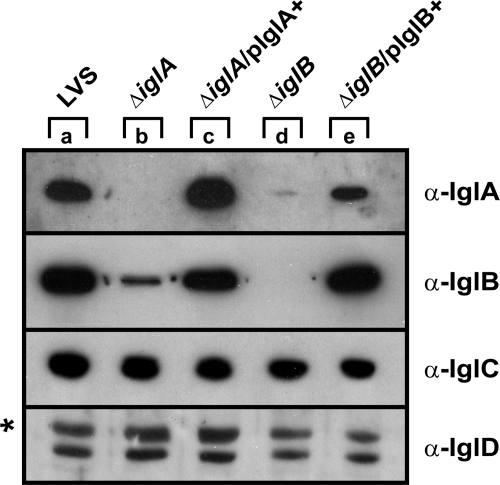
FIG. 1.
FIG. 1.
Analysis of Igl protein synthesis by F. tularensis strains. Igl proteins in the pellet fraction were separated by sodium dodecyl sulfate-polyacrylamide gel electrophoresis and identified by immunoblotting using antiserum specific for IglA, IglB, IglC, or IglD. Lane a, wild-type strain LVS; lane b, ΔiglA null mutant; lane c, complemented ΔiglA mutant (pJEB415); lane d, ΔiglB null mutant; lane e, complemented ΔiglB mutant (pJEB416). The asterisk indicates a protein band that cross-reacts with the anti-IglD antiserum. The experiment was repeated at least three times, and the results of a representative experiment are shown. α-IglA, anti-IglA; α-IglB, anti-IglB; α-IglC, anti-IglC; α-IglD, anti-IglD.
FIG. 2.
FIG. 2.
Intrabacterial stability of IglA and IglB in strains of F. tularensis. The intrabacterial stability of IglB produced by LVS, the ΔiglA mutant, and the ΔiglA mutant complemented in trans (pJEB415) (upper panel) and the intrabacterial stability of IglA produced by LVS, the ΔiglB mutant, and the ΔiglB mutant complemented in trans (pJEB416) grown in Chamberlain's medium (lower panel) were examined. At time zero, chloramphenicol was added to stop protein synthesis. Samples of pelleted bacteria were taken at different times, and the amount of proteins was detected by Western blotting. The experiment was repeated at least two times, and the results of a representative experiment are shown. α-IglA, anti-IglA; α-IglB, anti-IglB.
FIG. 3.
FIG. 3.
Schematic representation of the IglA in-frame deletions (A) and point mutants (B) fused to the GAL4 activation domain of plasmid pGADT7. All constructs were cotransformed with IglB in the GAL4 DNA-binding domain plasmid pGBKT7 into the S. cerevisiae two-hybrid system reporter strain AH109. The ability of each mutant to bind IglB was recorded as the degree of activation of two independent reporter genes, ADE2 and HIS3, that permitted growth of the yeast on minimal medium devoid of adenine and histidine, respectively, after day 5 with incubation at 30°C, which was expressed using a scale from ++++ (wild-type growth) to − (no growth). The results reflect the trends in growth based on three independent experiments in which several individual transformants were tested on each occasion. To measure activation of the lacZ reporter, constructs were introduced into the S. cerevisiae reporter strain Y187. The mean ± standard deviation β-galactosidase (β-gal) activities produced by mutants compared to wild-type IglA in two independent experiments in which several transformants were tested on each occasion are indicated. In panel A the relative positions in the full-length IglA construct of the four α-helices, H1 (amino acids 62 to 68), H2 (amino acids 102 to 128), H3 (amino acids 133 to 143), and H4 (amino acids 146 to 157), are indicated. In panel B the amino acid sequence for residues 102 to 128 predicted to form α-helix H2 is shown. Amino acids that were replaced with alanine are indicated by filled triangles.
FIG. 4.
FIG. 4.
Analysis of Igl protein synthesis for an iglA null mutant expressing wild-type or mutated IglA in trans. Igl proteins in the pellet fraction were separated by sodium dodecyl sulfate-polyacrylamide gel electrophoresis and identified by immunoblotting using antiserum specific for IglA, IglB, or IglC. (A) Expression profiles for IglA deletions mutants, divided into three phenotypic groups (strong, poor, or abolished) based on their ability to interact with IglB in yeast. (B) Expression profiles for alanine substitution mutants. Mutants with more pronounced defects in IglB binding are indicated by an asterisk. The experiment was repeated at least two times, and the results of a representative experiment are shown. α-IglA, anti-IglA; α-IglB, anti-IglB; α-IglC, anti-IglC.
FIG. 5.
FIG. 5.
Intracellular growth of strains of F. tularensis. J774 cells were infected with various strains of F. tularensis at a multiplicity of infection of 200 for 2 h. After gentamicin treatment, cells were allowed to recover for 30 min, after which they were lysed immediately (corresponding to 0 h) (gray bars) or after 24 h (black bars) with a phosphate-buffered saline-buffered 0.1% sodium deoxycholate solution and plated to determine the number of viable bacteria (log10). All infections were repeated three times with triplicate data sets. The results of a representative experiment are shown. The bars indicate the means, and the error bars indicate the standard deviations.
FIG. 6.
FIG. 6.
Colocalization of GFP-expressing F. tularensis strains and LAMP-1. J774 cells were infected for 2 h with F. tularensis strains expressing GFP at a multiplicity of infection of 200 or with green fluorescent latex beads (LB) at a multiplicity of infection of 10 and, after washing, incubated for 3 h. Fixed specimens were labeled for the late endosomal and lysosomal marker LAMP-1. Confocal images were acquired with a Leica SP2 confocal microscope (Leica Microsystems, Bensheim, Germany) and were assembled using Adobe Photoshop CS2 (Adobe Systems, San Jose, CA). In the representative images shown, green indicates bacteria or latex beads and red indicates the endocytic marker.

References

    1. Berger, H., J. Hacker, A. Juarez, C. Hughes, and W. Goebel. 1982. Cloning of the chromosomal determinants encoding hemolysin production and mannose-resistant hemagglutination in Escherichia coli. J. Bacteriol. 1521241-1247. - PMC - PubMed
    1. Bingle, L. E., C. M. Bailey, and M. J. Pallen. 2008. Type VI secretion: a beginner's guide. Curr. Opin. Microbiol. 113-8. - PubMed
    1. Bönquist, L., H. Lindgren, I. Golovliov, T. Guina, and A. Sjöstedt. 2008. MglA and Igl proteins contribute to the modulation of Francisella tularensis live vaccine strain-containing phagosomes in murine macrophages. Infect. Immun. 763502-3510. - PMC - PubMed
    1. Brotcke, A., D. S. Weiss, C. C. Kim, P. Chain, S. Malfatti, E. Garcia, and D. M. Monack. 2006. Identification of MglA-regulated genes reveals novel virulence factors in Francisella tularensis. Infect. Immun. 746642-6655. - PMC - PubMed
    1. Brzuszkiewicz, E., H. Bruggemann, H. Liesegang, M. Emmerth, T. Olschlager, G. Nagy, K. Albermann, C. Wagner, C. Buchrieser, L. Emody, G. Gottschalk, J. Hacker, and U. Dobrindt. 2006. How to become a uropathogen: comparative genomic analysis of extraintestinal pathogenic Escherichia coli strains. Proc. Natl. Acad. Sci. USA 10312879-12884. - PMC - PubMed

Publication types

MeSH terms

Substances

LinkOut - more resources
