


Prevalence and characterization of salmonellae in commercial ground beef in the United States
- PMID: 19201965
- PMCID: PMC2663200
- DOI: 10.1128/AEM.02530-08
Prevalence and characterization of salmonellae in commercial ground beef in the United States
Abstract
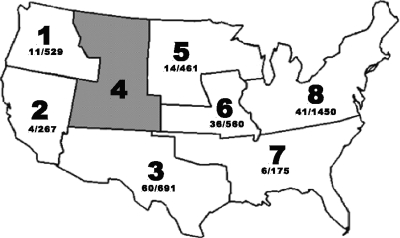
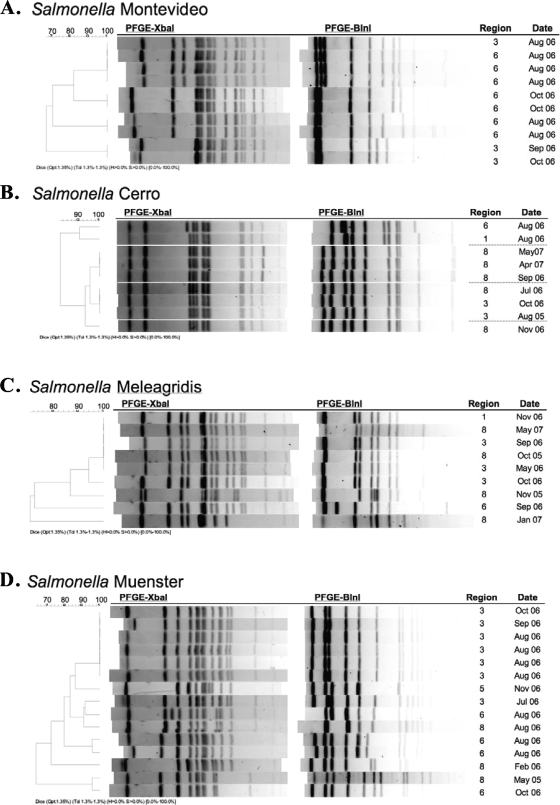
Commercially produced ground beef samples (n = 4,136) were collected from seven regions of the United States over a 24-month period (July 2005 to June 2007) and analyzed for the presence of Salmonella enterica by using methods that concurrently provided total prevalence and enumerable levels. The overall prevalence of Salmonella strains was 4.2%. Enumeration showed that 94.2% were present at levels below 2 CFU/g. Regional monthly prevalences of Salmonella strains varied from 1.8% to 6.5% but were not statistically different (P > 0.05). All Salmonella isolates were serotyped and their antibiotic susceptibilities determined and analyzed by pulsed-field gel electrophoresis (PFGE). The most common serotypes identified were Salmonella enterica serotypes Montevideo, Anatum, Muenster, and Mbandaka, with these accounting for one-half of the isolates obtained. The prevalence of multidrug-resistant (MDR) Salmonella was determined to be 0.6%. The most common MDR serotypes were Salmonella enterica serotypes Dublin, Reading, and Typhimurium. MDR strains had resistance to between 2 and 10 antibiotics. There were no regional differences in prevalence of MDR Salmonella. PFGE analysis revealed that indistinguishable XbaI and AvrII restriction digest patterns (RDPs) could be observed in isolates of the same serotype found in different regions and months of sampling. The RDPs of 19 Salmonella strains were compared to RDPs in the PulseNet USA database. Thirteen were indistinguishable from existing patterns, and the number of records for each ranged from 1 to 478. These data show that Salmonella prevalence in commercial ground beef is low and suggest that attempts to identify sources contributing to Salmonella in ground beef by serotype, antibiogram, and PFGE cannot be made without additional documented evidence.
Figures
References
-
- Andrews, W. H., and T. Hammack. 2008. Chapter 5, Salmonella. In Bacteriological analytical manual, 8th ed., revision A, 1998. U.S. Food and Drug Administration, Silver Spring, MD. http://www.cfsan.fda.gov/∼ebam/bam-5.html. Accessed 21 January 2009.
-
- Anonymous. 2008. Microbiology laboratory guidebook. U.S. Department of Agriculture, Washington, DC. http://www.fsis.usda.gov/Science/Microbiological_Lab_Guidebook/. Accessed 5 November 2008.
-
- Anonymous. 2008. Progress report on Salmonella testing of raw meat and poultry products, 1998-2007. U.S. Department of Agriculture, Washington, DC. http://www.fsis.usda.gov/science/progress_report_salmonella_testing/inde.... Accessed 5 November 2008.
-
- Anonymous. 2007. Serotypes profile of Salmonella isolates from meat and poultry products: January 1998 through December 2006. U.S. Department of Agriculture, Washington, DC. http://www.fsis.usda.gov/Science/Serotypes_Profile_Salmonella_Isolates/i.... Accessed 5 November 2008.
-
- Anonymous. 2008. Bad bug book: foodborne pathogenic microorganisms and natural toxins handbook. U.S. Food and Drug Administration, Silver Spring, MD. http://www.cfsan.fda.gov/∼mow/chap1.html. Accessed 5 November 2008.
MeSH terms
Substances
LinkOut - more resources
Full Text Sources
Other Literature Sources
