


The Rap80-BRCC36 de-ubiquitinating enzyme complex antagonizes RNF8-Ubc13-dependent ubiquitination events at DNA double strand breaks
- PMID: 19202061
- PMCID: PMC2651241
- DOI: 10.1073/pnas.0807485106
The Rap80-BRCC36 de-ubiquitinating enzyme complex antagonizes RNF8-Ubc13-dependent ubiquitination events at DNA double strand breaks
Abstract
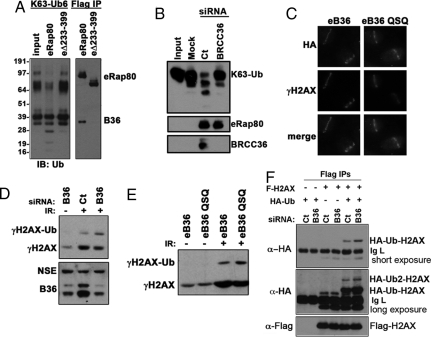
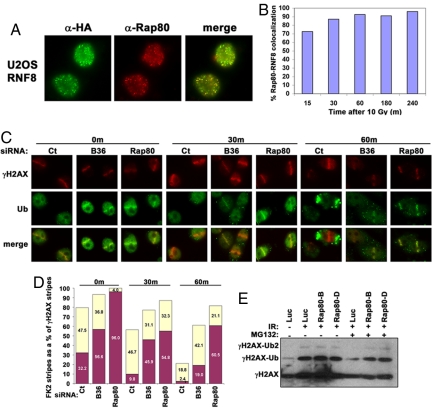
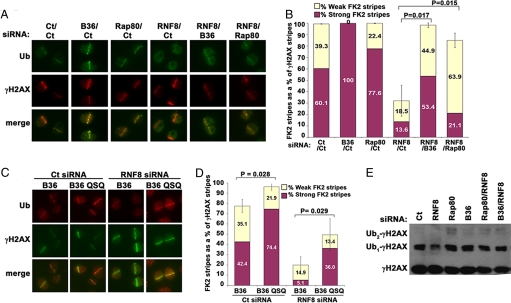
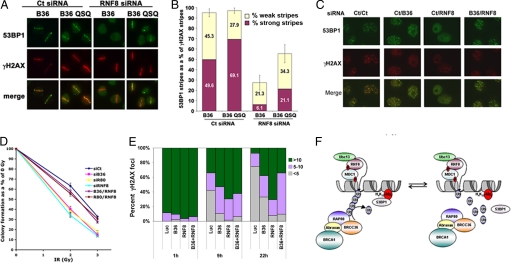
DNA double strand breaks (DSBs) initiate reversible cellular checkpoint and repair activities. Whereas many of the activating events at DSBs have recently been elucidated, the mechanisms used to terminate responses at these sites are largely undefined. Here we report a pathway required to reverse RNF8-Ubc13 dependent ubiquitination events on chromatin flanking DSBs. Inhibition of the Rap80-BRCC36 de-ubiquitinating enzyme complex partially restored DSB-associated ubiquitin levels following RNF8 knockdown or proteasome inhibition. Similarly, BRCC36 knockdown or expression of a BRCC36 de-ubiquitinating enzyme-inactive mutant rescued both 53BP1 recruitment to DSBs and ionizing radiation-induced gammaH2AX ubiquitination following RNF8 depletion, and mitigated ionizing radiation sensitivity resulting from RNF8 deficiency. Thus, concomitant and opposing RNF8-Ubc13 ubiquitin ligase and Rap80-BRCC36 ubiquitin hydrolysis activities are responsible for determining steady-state ubiquitin levels at DNA DSBs. These findings reveal a Rap80-BRCC36 dependent pathway that is required for appropriate DSB recruitment and repair responses.
Conflict of interest statement
The authors declare no conflict of interest.
Figures
References
-
- Celeste A, et al. Histone H2AX phosphorylation is dispensable for the initial recognition of DNA breaks. Nat Cell Biol. 2003;5:675–679. - PubMed
-
- Lisby M, Barlow JH, Burgess RC, Rothstein R. Choreography of the DNA damage response: spatiotemporal relationships among checkpoint and repair proteins. Cell. 2004;118:699–713. - PubMed
-
- Lukas C, Falck J, Bartkova J, Bartek J, Lukas J. Distinct spatiotemporal dynamics of mammalian checkpoint regulators induced by DNA damage. Nat Cell Biol. 2003;5:255–260. - PubMed
Publication types
MeSH terms
Substances
Grants and funding
LinkOut - more resources
Full Text Sources
Other Literature Sources
Molecular Biology Databases
Miscellaneous
