


Reduction of scale invariance of activity fluctuations with aging and Alzheimer's disease: Involvement of the circadian pacemaker
- PMID: 19202078
- PMCID: PMC2650290
- DOI: 10.1073/pnas.0806087106
Reduction of scale invariance of activity fluctuations with aging and Alzheimer's disease: Involvement of the circadian pacemaker
Abstract
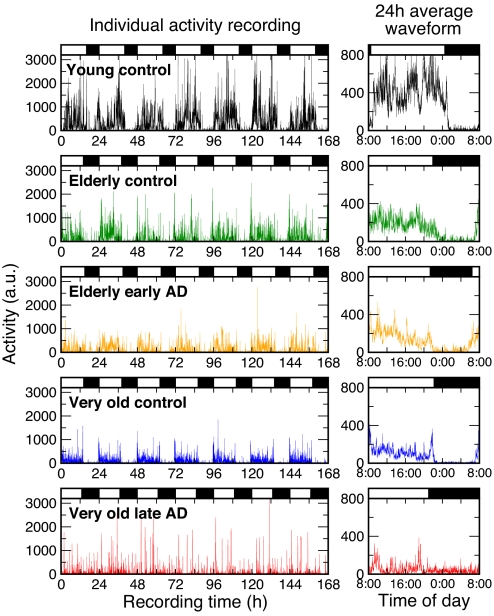
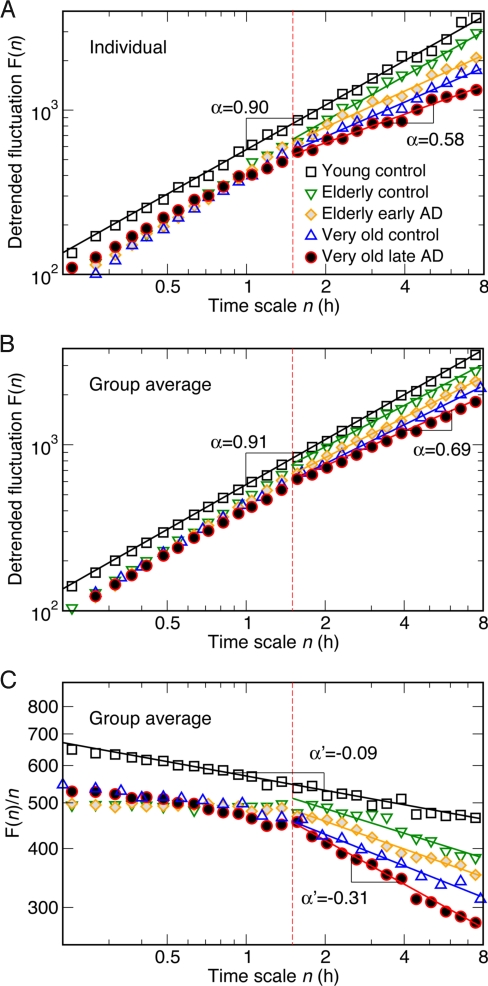
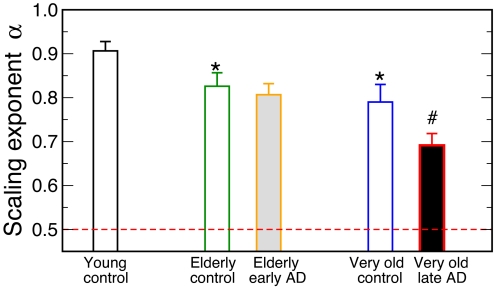
Human motor control systems orchestrate complex scale-invariant patterns of activity over a wide range of time scales (minutes to hours). The neural mechanisms underlying scale-invariance are unknown in humans. In rats, the master circadian pacemaker [suprachiasmatic nucleus (SCN)] is crucially involved in scale-invariant activity fluctuations over multiple time scales from minutes to 24 h. Aging and Alzheimer's disease (AD) are associated with progressive dysfunction of the SCN. Thus, if the SCN is responsible for the scale-invariant activity fluctuations in humans, we predict disturbances of scale-invariant activity fluctuations in elderly humans and even more pronounced disturbances in elderly humans with AD. To test these hypotheses, we studied spontaneous daytime activity patterns in 13 young adults (mean +/- SD: 25.5 +/- 6.1 y); 13 elderly people with early-stage AD (68.5 +/- 6.1 y) matched with 13 elderly controls (68.6 +/- 6.1 y); and 14 very old people with late-stage AD (83.9 +/- 6.7 y) matched with 12 very old controls (80.8 +/- 8.6 y). In young adults, activity exhibited robust scale-invariant correlations across all tested time scales (minutes to 8 h). The scale-invariant correlations at 1.5-8 h declined with age (P = 0.01) and were significantly reduced in the elderly (P = 0.04) and very old controls (P = 0.02). Remarkably, an age-independent AD effect further reduced the scale-invariant correlations at 1.5-8 h (P = 0.04), leading to the greatest reduction of the scale-invariant correlations in very old people with late-stage AD-resembling closely the loss of correlations at large time scales in SCN-lesioned animals. Thus, aging and AD significantly attenuate the scale invariance of activity fluctuations over multiple time scales. This attenuation may reflect functional changes of the SCN.
Conflict of interest statement
The authors declare no conflict of interest.
Figures
References
-
- Swaab DF, Fliers E, Partiman TS. The suprachiasmatic nucleus of the human brain in relation to sex, age and senile dementia. Brain Res. 1985;342:37–44. - PubMed
-
- Zhou JN, Hofman MA, Swaab DF. VIP neurons in the human SCN in relation to sex, age, and Alzheimer's disease. Neurobiol Aging. 1995;16:571–576. - PubMed
-
- Liu RY, et al. Decreased vasopressin gene expression in the biological clock of Alzheimer disease patients with and without depression. J Neuropathol Exp Neurol. 2000;59:314–322. - PubMed
Publication types
MeSH terms
Grants and funding
LinkOut - more resources
Full Text Sources
Medical
