


Mitochondria targeted peptides protect against 1-methyl-4-phenyl-1,2,3,6-tetrahydropyridine neurotoxicity
- PMID: 19203217
- PMCID: PMC2819801
- DOI: 10.1089/ars.2009.2445
Mitochondria targeted peptides protect against 1-methyl-4-phenyl-1,2,3,6-tetrahydropyridine neurotoxicity
Abstract
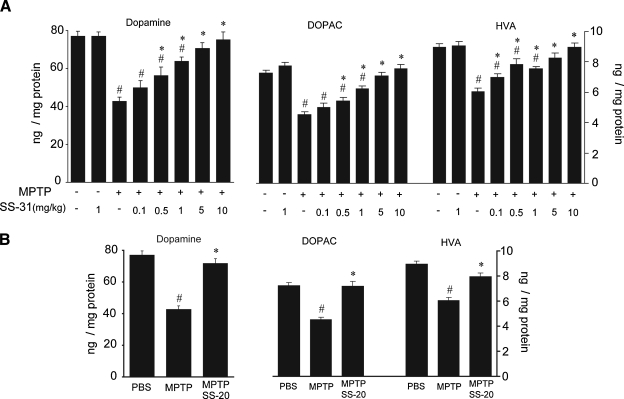
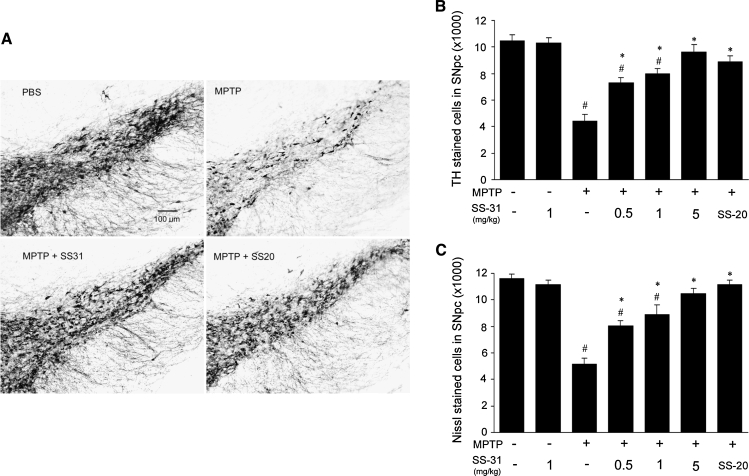
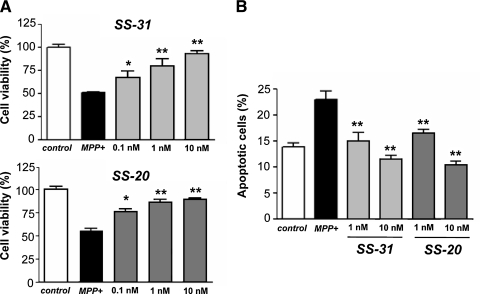
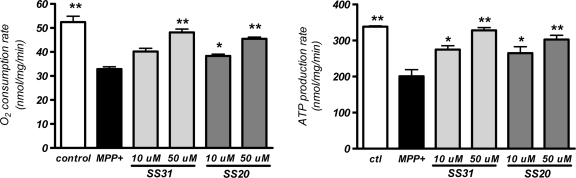
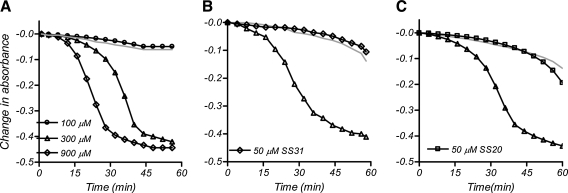
A large body of evidence suggests that mitochondrial dysfunction and oxidative damage play a role in the pathogenesis of Parkinson's disease (PD). A number of antioxidants have been effective in animal models of PD. We have developed a family of mitochondria-targeted peptides that can protect against mitochondrial swelling and apoptosis (SS peptides). In this study, we examined the ability of two peptides, SS-31 and SS-20, to protect against 1-methyl-4-phenyl-1,2,3,6-tetrahydropyridine (MPTP) neurotoxicity in mice. SS-31 produced dose-dependent complete protection against loss of dopamine and its metabolites in striatum, as well as loss of tyrosine hydroxylase immunoreactive neurons in substantia nigra pars compacta. SS-20, which does not possess intrinsic ability in scavenging reactive oxygen species, also demonstrated significant neuroprotective effects on dopaminergic neurons of MPTP-treated mice. Both SS-31 and SS-20 were very potent (nM) in preventing MPP+ (1-methyl-4-phenylpyridinium)-induced cell death in cultured dopamine cells (SN4741). Studies with isolated mitochondria showed that both SS-31 and SS-20 prevented MPP+-induced inhibition of oxygen consumption and ATP production, and mitochondrial swelling. These findings provide strong evidence that these neuroprotective peptides, which target both mitochondrial dysfunction and oxidative damage, are a promising approach for the treatment of PD.
Figures
References
-
- Adams JD., Jr. Klaidman LK. Leung AC. MPP+ and MPDP+ induced oxygen radical formation with mitochondrial enzymes. Free Radic Biol Med. 1993;15:181–186. - PubMed
-
- Bates TE. Heales SJ. Davies SE. Boakye P. Clark JB. Effects of 1-methyl-4-phenylpyridinium on isolated rat brain mitochondria: Evidence for a primary involvement of energy depletion. J Neurochem. 1994;63:640–648. - PubMed
-
- Beal MF. Matthews RT. Tieleman A. Shults CW. Coenzyme Q10 attenuates the 1-methyl-4-phenyl-1,2,3,tetrahydropyridine (MPTP) induced loss of striatal dopamine and dopaminergic axons in aged mice. Brain Res. 1998;783:109–114. - PubMed
-
- Betarbet R. Sherer TB. MacKenzie G. Garcia–Osuna M. Panov AV. Greenamyre JT. Chronic systemic pesticide exposure reproduces features of Parkinson's disease. Nat Neurosci. 2000;3:1301–1306. - PubMed
-
- Canet–Aviles RM. Wilson MA. Miller DW. Ahmad R. McLendon C. Bandyopadhyay S. Baptista MJ. Ringe D. Petsko GA. Cookson MR. The Parkinson's disease protein DJ-1 is neuroprotective due to cysteine-sulfinic acid-driven mitochondrial localization. Proc Natl Acad Sci USA. 2004;101:9103–9108. - PMC - PubMed
Publication types
MeSH terms
Substances
Grants and funding
LinkOut - more resources
Full Text Sources
Other Literature Sources
Miscellaneous
