


Preclinical development of the green tea catechin, epigallocatechin gallate, as an HIV-1 therapy
- PMID: 19203663
- PMCID: PMC2665796
- DOI: 10.1016/j.jaci.2008.12.024
Preclinical development of the green tea catechin, epigallocatechin gallate, as an HIV-1 therapy
Abstract
Background: Previously, we presented evidence that at physiologic concentrations the green tea catechin, epigallocatechin gallate (EGCG), inhibited attachment of HIV-1 glycoprotein 120 to the CD4 molecule on T cells, but the downstream effects of EGCG on HIV-1 infectivity were not determined.
Objective: To evaluate the inhibition of HIV-1 infectivity by EGCG and begin preclinical development of EGCG as a possible therapy.
Methods: PBMCs, CD4(+) T cells, and macrophages were isolated from blood of HIV-1-uninfected donors. HIV-1 infectivity was assessed by an HIV-1 p24 ELISA. Cell survival was assessed by cell viability by Trypan blue exclusion assay, cell growth by thymidine incorporation, and apoptosis by flow-cytometric analysis of annexin-V binding.
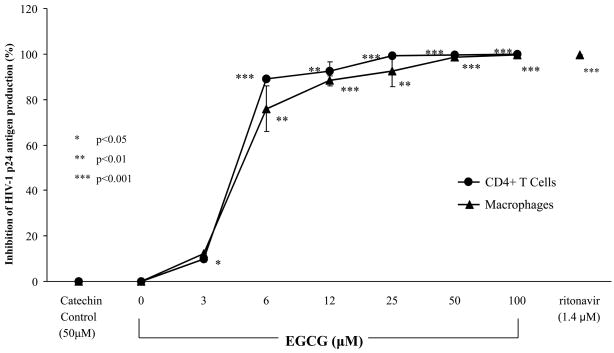
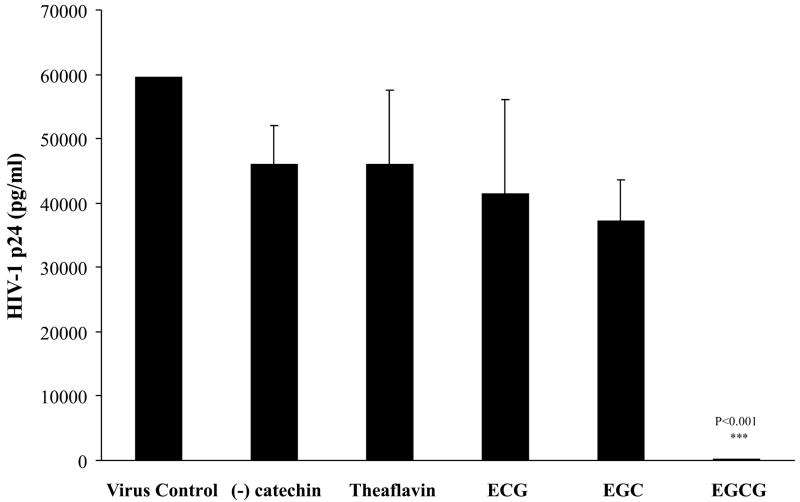
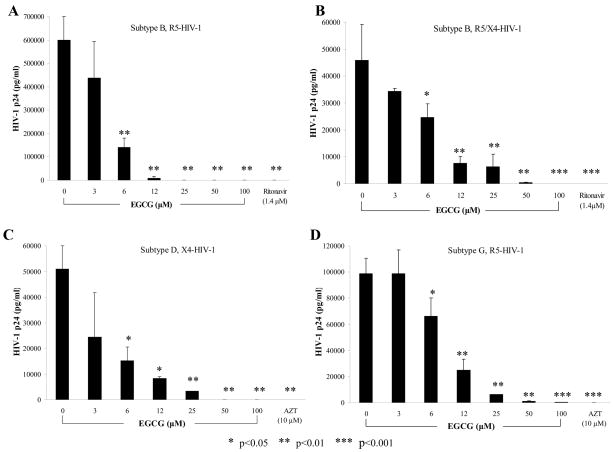
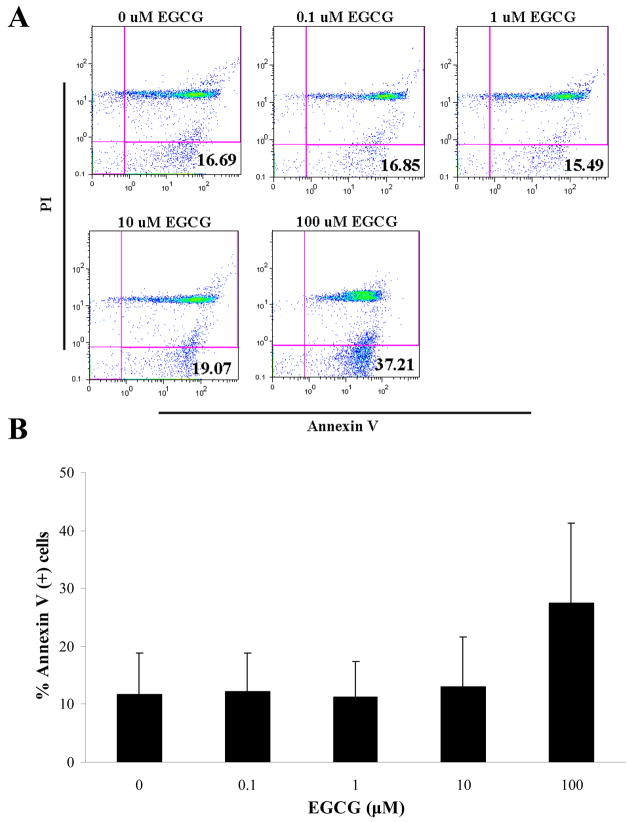
Results: Epigallocatechin gallate inhibited HIV-1 infectivity on human CD4(+) T cells and macrophages in a dose-dependent manner. At a physiologic concentration of 6 mumol/L, EGCG significantly inhibited HIV-1 p24 antigen production across a broad spectrum of both HIV-1 clinical isolates and laboratory-adapted subtypes (B [P < .001], C, D, and G [P < .01]). The specificity of the EGCG-induced inhibition was substantiated by the failure of EGCG derivatives lacking galloyl and/or pyrogallol side groups to alter HIV-1 p24 levels. EGCG-induced inhibition of HV-1 infectivity was not a result of cytotoxicity, cell growth inhibition, or apoptosis.
Conclusion: We conclude that by preventing the attachment of HIV-1-glycoprotein 120 to the CD4 molecule, EGCG inhibits HIV-1 infectivity. Because this inhibition can be achieved at physiologic concentrations, the natural anti-HIV agent EGCG is a candidate as an alternative therapy in HIV-1 therapy.
Figures
References
-
- Wang R, Gu Q, Wang Y, Zhang X, Yang L, zhou J, et al. Anti-HIV-1 activities of compounds isolated from the medicinal plant Rhus chinensis. Journal of Ethnopharmacology. 2008;117(2):249–56. - PubMed
-
- Wu J, Wang X, Yi Y, Lee K. Anti-AIDS agents 54. A potent anti-HIV chalcone and flavonoids from genus Desmos. Bioorg Med Chem Lett. 2003a;13:1813–5. - PubMed
Publication types
MeSH terms
Substances
Grants and funding
LinkOut - more resources
Full Text Sources
Other Literature Sources
Medical
Research Materials
