


Leptin affects system A amino acid transport activity in the human placenta: evidence for STAT3 dependent mechanisms
- PMID: 19203792
- PMCID: PMC2675556
- DOI: 10.1016/j.placenta.2009.01.004
Leptin affects system A amino acid transport activity in the human placenta: evidence for STAT3 dependent mechanisms
Abstract
Background: Amino acids are important nutrients during fetal development, and the activity of placental amino acid transporters is crucial in the regulation of fetal growth. Leptin, an adipocyte- and placenta-derived hormone, has been proposed to act as a peripheral signal in reproduction in humans. Leptin is elevated during pregnancy and elevated further in pathologic pregnancies such as preeclampsia. However, the role of leptin in placental function has not been fully elucidated. We hypothesize that leptin plays a role in the regulation of placental amino acid transport by activation of the JAK-STAT pathway.
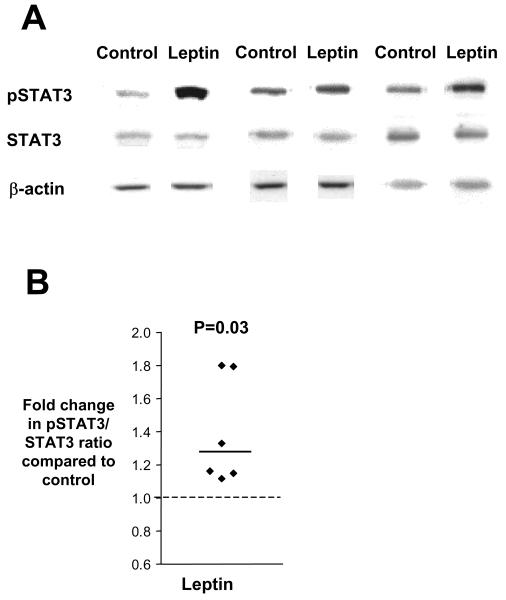
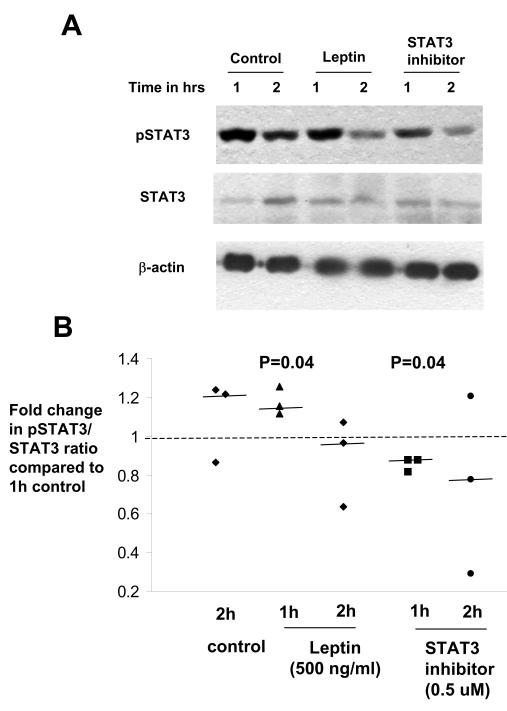
Methods: Placental amino acid transport, specifically system A transport was studied in placental villous fragments using the amino acid analog, methylaminoisobutyric acid (MeAIB). Specific inhibitors of the JAK-STAT signal transduction pathway were used to further elucidate their role in leptin-mediated effects on amino acid transport activity. Western blotting was performed to identify STAT3 phosphorylation as a measure of leptin receptor activation.
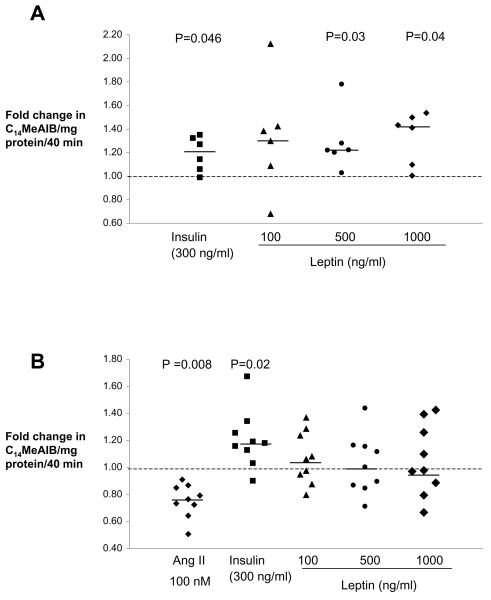
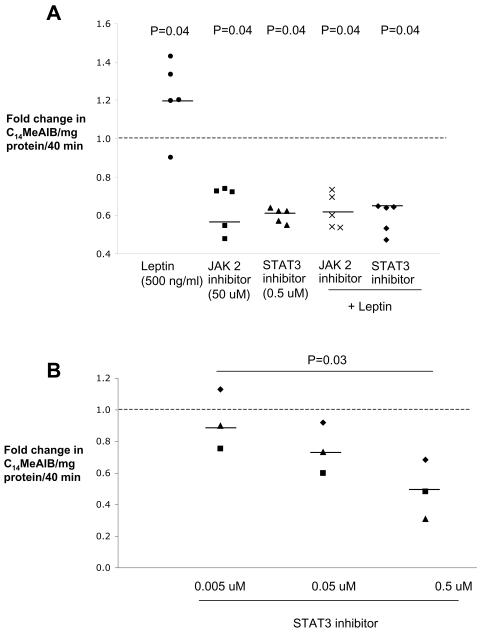
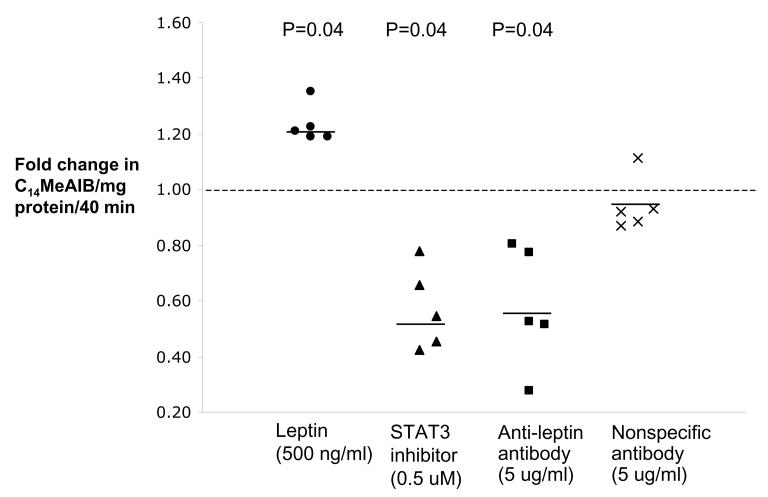
Results: Leptin significantly increased system A amino acid transporter activity by 22-42% after 1h of incubation. Leptin activated JAK-STAT signaling pathway as evidenced by STAT3 phosphorylation, and inhibition of STAT3 or JAK2 resulted in 36-45% reduction in system A amino acid transporter activity. Furthermore, blocking endogenously produced leptin also decreased system A transport by 45% comparable to STAT3 inhibition.
Conclusions: These data demonstrate that leptin stimulates system A by JAK-STAT dependent pathway in placental villous fragments. Our findings support the autocrine/paracrine role of leptin in regulating amino acid transport in the human placenta.
Figures
References
-
- Moe AJ. Placental amino acid transport. American Journal of Physiology. 1995;268:C1321–1331. - PubMed
-
- Regnault TR, Friedman JE, Wilkening RB, Anthony RV, Hay WW., Jr Fetoplacental transport and utilization of amino acids in IUGR--a review. Placenta. 2005;26(Suppl A):S52–62. - PubMed
-
- Bauer MK, Harding JE, Bassett NS, Breier BH, Oliver MH, Gallaher BH, Evans PC, Woodall SM, Gluckman PD. Fetal growth and placental function. Molecular & Cellular Endocrinology. 1998;140:115–120. - PubMed
-
- Cetin I, Corbetta C, Sereni LP, Marconi AM, Bozzetti P, Pardi G, Battaglia FC. Umbilical amino acid concentrations in normal and growth-retarded fetuses sampled in utero by cordocentesis. American Journal of Obstetrics & Gynecology. 1990;162:253–261. - PubMed
-
- Bajoria R, Sooranna SR, Ward S, D'Souza S, Hancock M. Placental transport rather than maternal concentration of amino acids regulates fetal growth in monochorionic twins: implications for fetal origin hypothesis. American Journal of Obstetrics & Gynecology. 2001;185:1239–1246. - PubMed
Publication types
MeSH terms
Substances
Grants and funding
LinkOut - more resources
Full Text Sources
Miscellaneous
