


Orienting to threat: faster localization of fearful facial expressions and body postures revealed by saccadic eye movements
- PMID: 19203922
- PMCID: PMC2660988
- DOI: 10.1098/rspb.2008.1744
Orienting to threat: faster localization of fearful facial expressions and body postures revealed by saccadic eye movements
Abstract
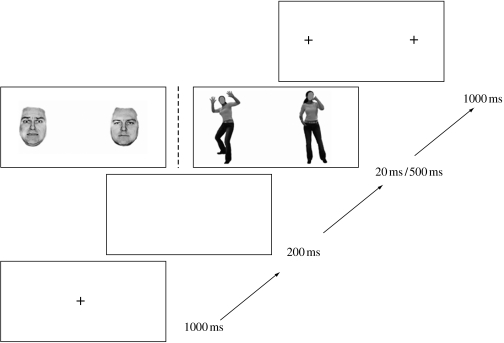
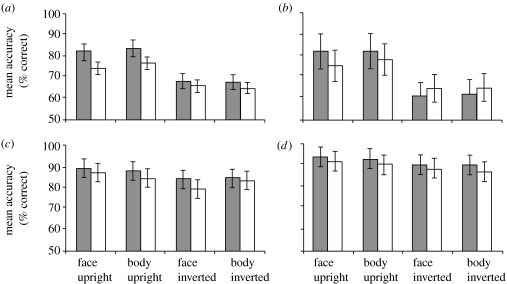
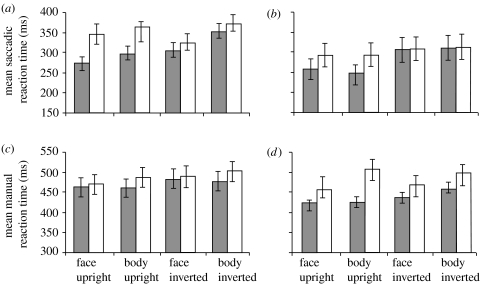
Most studies investigating speeded orientation towards threat have used manual responses. By measuring orienting behaviour using eye movements a more direct and ecologically valid measure of attention can be made. Here, we used a forced-choice saccadic and manual localization task to investigate the speed of discrimination for fearful and neutral body and face images. Fearful/neutral body or face pairs were bilaterally presented for either 20 or 500 ms. Results showed faster saccadic orienting to fearful body and face emotions compared with neutral only at the shortest presentation time (20 ms). For manual responses, faster discrimination of fearful bodies and faces was observed only at the longest duration (500 ms). More errors were made when localizing neutral targets, suggesting that fearful bodies and faces may have captured attention automatically. Results were not attributable to low-level image properties as no threat bias, in terms of reaction time or accuracy, was observed for inverted presentation. Taken together, the results suggest faster localization of threat conveyed both by the face and the body within the oculomotor system. In addition, enhanced detection of fearful body postures suggests that we can readily recognize threat-related information conveyed by body postures in the absence of any face cues.
Figures
References
-
- Bannerman, R. L., Milders, M. & Sahraie, A. In press. Processing emotion: comparison of saccadic and manual choice-reaction times. Cogn. Emot. (doi:10.1080/02699930802243303) - DOI
-
- Batty M., Taylor M.J. Early processing of the six basic facial emotional expressions. Brain. Res. Cogn. Brain. Res. 2003;17:613–620. doi:10.1016/S0926-6410(03)00174-5 - DOI - PubMed
-
- Bradley B.P., Mogg K., Falla S., Hamilton L.R. Attentional bias for threatening facial expressions in anxiety: manipulations of stimulus duration. Cogn. Emot. 1998;12:737–753. doi:10.1080/026999398379411 - DOI
-
- Bradley B.P., Mogg K., Millar N.H. Covert and overt orientation of attention to emotional faces in anxiety. Cogn. Emot. 2000;14:789–808. doi:10.1080/02699930050156636 - DOI
-
- Calvo M.G., Lang P.J. Gaze patterns when looking at emotional pictures: motivationally biased attention. Motiv. Emot. 2004;28:221–243. doi:10.1023/B:MOEM.0000040153.26156.ed - DOI
Publication types
MeSH terms
LinkOut - more resources
Full Text Sources
Medical
