


Salivary sex hormone measurement in a national, population-based study of older adults
- PMID: 19204073
- PMCID: PMC2763516
- DOI: 10.1093/geronb/gbn028
Salivary sex hormone measurement in a national, population-based study of older adults
Abstract
Objectives: To describe the methods used for, correlates of cooperation with, and validity of in-home salivary specimens collected from older adults.
Methods: Salivary specimens were collected between 2005 and 2006 during in-home interviews with a probability sample of 3,005 U.S. men and women, ages 57-85 years. Sex hormone levels were assessed by enzyme-linked immunoassay conducted at Salimetrics, LLC (State College, PA). Mean salivary sex hormone concentrations were compared by gender and in relation to medication use and health conditions.
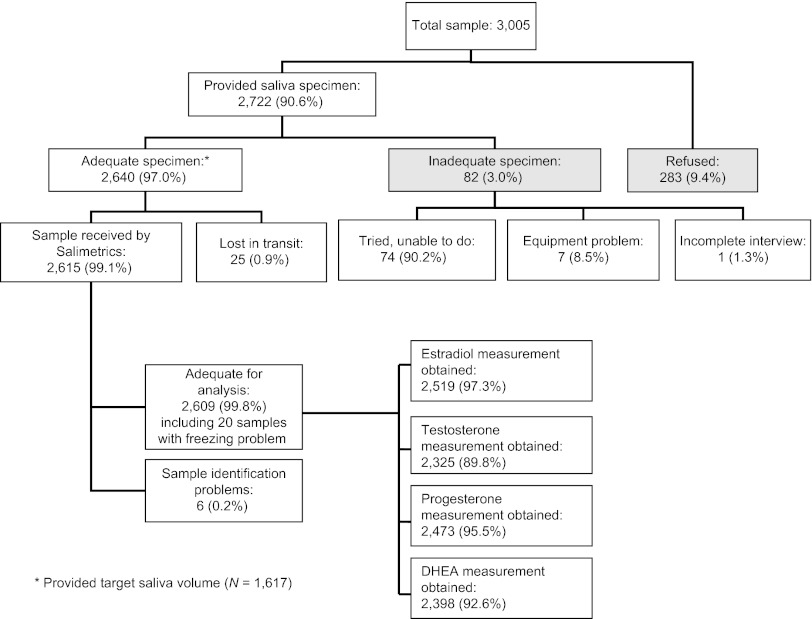
Results: Self-collected saliva specimens were provided by 2,722 (90.6%) individuals; 95.8% of these were adequate for analysis. Black participants were significantly less likely than individuals of other racial/ethnic groups to provide a salivary specimen; age, gender, education, and self-rated health were not associated with participation. Mean testosterone levels were higher in men compared with women, and estradiol levels were higher in women using estrogens. Salivary hormone measurements obtained in the National Social Life, Health, and Aging Project (NSHAP) and other studies are of similar magnitude.
Conclusion: NSHAP is the first large, population-based study of older adults to measure salivary estradiol, progesterone, dehydroepiandrosterone (DHEA), and, in women, testosterone. These data demonstrate a high cooperation rate with in-home salivary specimen collection from older adults and good validity of sex hormone measurements.
Figures
References
-
- Adashi EY. The climacteric ovary as a functional gonadotropin-driven androgen-producing gland. Fertility and Sterility. 1994;62:20–27. - PubMed
-
- Akhmedkhanov A, Zeleniuch-Jacquotte A, Toniolo P. Role of exogenous and endogenous hormones in endometrial cancer—Review of the evidence and research perspectives. In: Bulletti C, de Ziegler D, Guller S, LevitzHuman M, editors. 2001. Fertility and Reproduction: the Oocyte, the Embryo, and the Uterus, Annals of the New York Academy of Sciences. 943, 296–315. - PubMed
-
- Alexandersen P, Haarbo J, Christiansen C. The relationship of natural androgens to coronary heart disease in males: A review. Atherosclerosis. 1996;125:1–13. - PubMed
-
- Allan CA, Strauss BJ, Burger HG, Forbes EA, McLachlan RI. The association between obesity and the diagnosis of androgen deficiency in symptomatic ageing men. Medical Journal of Australia. 2006;185:424–427. - PubMed
Publication types
MeSH terms
Substances
Grants and funding
LinkOut - more resources
Full Text Sources
Other Literature Sources
Medical
