Transcriptional regulation and stabilization of left-right neuronal identity in C. elegans
- PMID: 19204119
- PMCID: PMC2648548
- DOI: 10.1101/gad.1763509
Transcriptional regulation and stabilization of left-right neuronal identity in C. elegans
Abstract
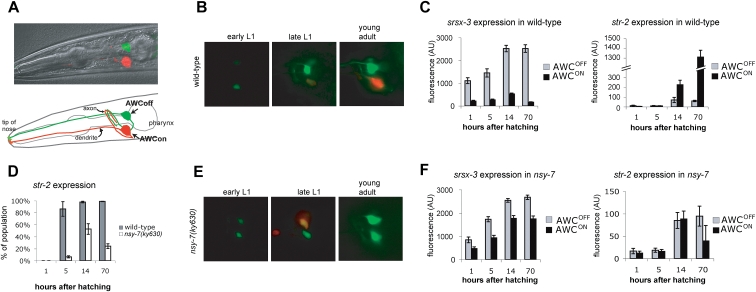
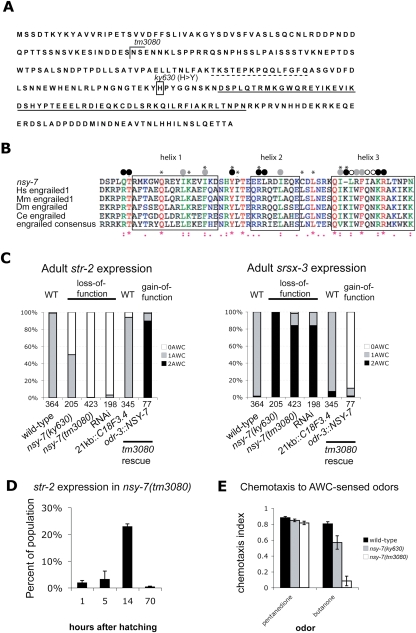
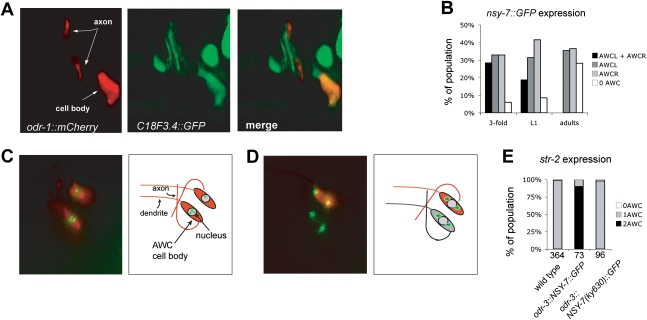
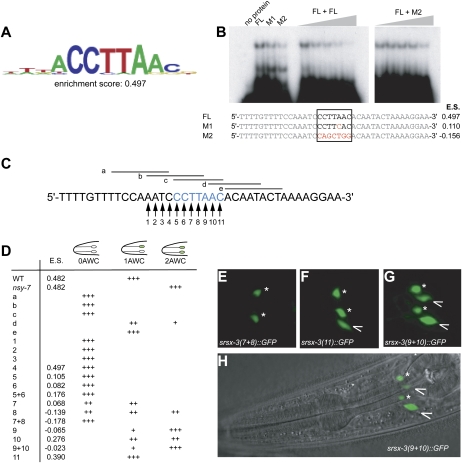
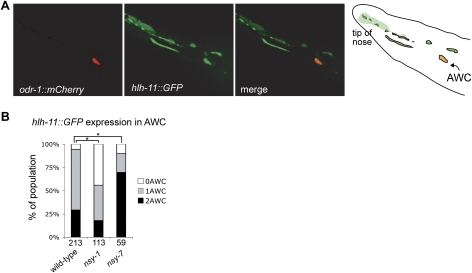
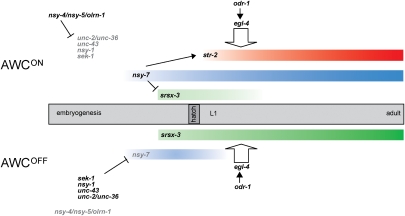
At discrete points in development, transient signals are transformed into long-lasting cell fates. For example, the asymmetric identities of two Caenorhabditis elegans olfactory neurons called AWC(ON) and AWC(OFF) are specified by an embryonic signaling pathway, but maintained throughout the life of an animal. Here we show that the DNA-binding protein NSY-7 acts to convert a transient, partially differentiated state into a stable AWC(ON) identity. Expression of an AWC(ON) marker is initiated in nsy-7 loss-of-function mutants, but subsequently lost, so that most adult animals have two AWC(OFF) neurons and no AWC(ON) neurons. nsy-7 encodes a protein with distant similarity to a homeodomain. It is expressed in AWC(ON), and is an early transcriptional target of the embryonic signaling pathway that specifies AWC(ON) and AWC(OFF); its expression anticipates future AWC asymmetry. The NSY-7 protein binds a specific optimal DNA sequence that was identified through a complete biochemical survey of 8-mer DNA sequences. This sequence is present in the promoter of an AWC(OFF) marker and essential for its asymmetric expression. An 11-base-pair (bp) sequence required for AWC(OFF) expression has two activities: One region activates expression in both AWCs, and the overlapping NSY-7-binding site inhibits expression in AWC(ON). Our results suggest that NSY-7 responds to transient embryonic signaling by repressing AWC(OFF) genes in AWC(ON), thus acting as a transcriptional selector for a randomly specified neuronal identity.
Figures
Comment in
-
Maintaining a stochastic neuronal cell fate decision.Genes Dev. 2009 Feb 15;23(4):385-90. doi: 10.1101/gad.1780509. Genes Dev. 2009. PMID: 19240127 Free PMC article.
References
-
- Bargmann C.I., Hartwieg E., Horvitz H.R. Odorant-selective genes and neurons mediate olfaction in C. elegans. Cell. 1993;74:515–527. - PubMed
-
- Bauer Huang S.L., Saheki Y., VanHoven M.K., Torayama I., Ishihara T., Katsura I., van der Linden A., Sengupta P., Bargmann C.I. Left–right olfactory asymmetry results from antagonistic functions of voltage-activated calcium channels and the Raw repeat protein OLRN-1 in C. elegans. Neural Develop. 2007;2:24. doi: 10.1186/1749-8104-2-24. - DOI - PMC - PubMed
Publication types
MeSH terms
Substances
Grants and funding
LinkOut - more resources
Full Text Sources
Molecular Biology Databases
Research Materials
Miscellaneous