


Volume of exercise and fitness nonresponse in sedentary, postmenopausal women
- PMID: 19204597
- PMCID: PMC2669311
- DOI: 10.1249/MSS.0b013e3181896c4e
Volume of exercise and fitness nonresponse in sedentary, postmenopausal women
Abstract
There is a wide individual heterogeneity in the maximal aerobic fitness (V x O 2max) response to exercise training.
Purpose: To examine predictors of V x O 2max nonresponse after aerobic exercise training in postmenopausal women.
Methods: The Dose Response to Exercise in Women (DREW) study was a randomized, controlled trial examining the effects of incremental training doses on sedentary postmenopausal women (45-75 yr). Participants were randomized to one of three exercise treatment groups (4, 8, or 12 kcal x kg(-1) x wk(-1)) for 6 months. Participants exercised 3-4 d x wk(-1) at 50% V x O 2max. Predictors of baseline V x O 2max were determined by ANOVA. We used a logistic regression analyses with categorical (ethnicity and treatment group) and standardized continuous variables (age, body mass index [BMI], and baseline V x O 2max) to determine predictors of nonresponse (Delta <or= 0 L x min(-1)). Our analysis included 310 women because the control group was excluded.
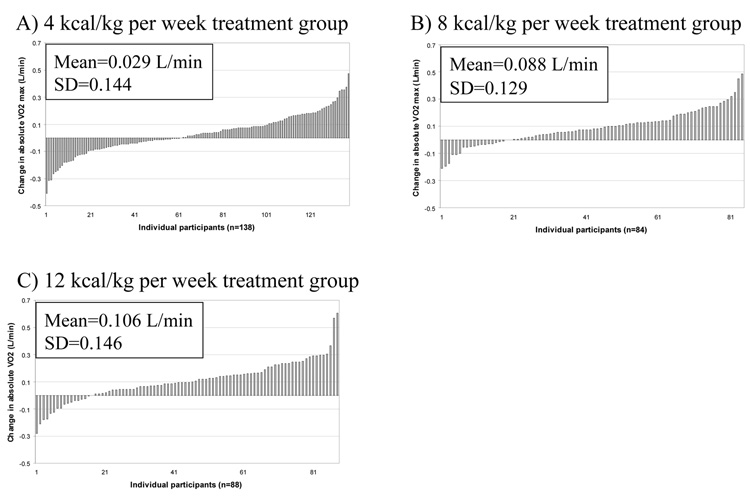
Results: A total of 44.9%, 23.8%, and 19.3% of the 4-, the 8-, and the 12-kcal x kg(-1) x wk(-1) treatment groups (P < 0.0001), respectively, were nonresponders. Maximal effort, BMI, age, and race significantly predicted baseline V x O 2max. Treatment group (8 and 12 kcal x kg(-1) x wk(-1) vs 4 kcal x kg(-1) x wk(-1); P = 0.0003), baseline V x O 2max (P < 0.0001), and age (P < 0.05) were significant predictors of nonresponse. Odds ratios and 95% confidence intervals were 2.13 (1.53-2.95) for baseline V x O 2max; 1.35 (1.00-1.83) for age; 0.45 (0.24-0.85) for the 8- versus the 4-kcal x kg(-1) x wk(-1) group; and 0.27 (0.13-0.53) for the 12- versus the 4-kcal x kg(-1) x wk(-1) group.
Conclusion: Women that were younger, less fit, or exercised more during the DREW trial had greater odds of improving their fitness with training. The most important finding of this study was that greater volumes of exercise were associated with a lower probability of being a nonresponder.
Figures
References
-
- Blair SN, Haskell WL, Ho P, Paffenbarger RS, Jr, Vranizan KM, Farquhar JW, Wood PD. Assessment of habitual physical activity by a seven-day recall in a community survey and controlled experiments. Am J Epidemiol. 1985;122:794–804. - PubMed
-
- Blair SN, Kampert JB, Kohl HW, 3rd, Barlow CE, Macera CA, Paffenbarger RS, Jr, Gibbons LW. Influences of cardiorespiratory fitness and other precursors on cardiovascular disease and all-cause mortality in men and women. Jama. 1996;276:205–210. - PubMed
-
- Blair SN, Kohl HW, 3rd, Barlow CE, Paffenbarger RS, Jr, Gibbons LW, Macera CA. Changes in physical fitness and all-cause mortality. A prospective study of healthy and unhealthy men. Jama. 1995;273:1093–1098. - PubMed
-
- Bouchard C. Human adaptability may have a genetic basis. In: Landry F, editor. Health risk estimation, risk reduction and health promotion; Proceedings of the 18th annual meeting of the Society of Prospective Medicine; Ottawa: Canadian Public Health Association; 1983. pp. 463–476.
-
- Bouchard C, An P, Rice T, Skinner JS, Wilmore JH, Gagnon J, Perusse L, Leon AS, Rao DC. Familial aggregation of VO(2max) response to exercise training: results from the HERITAGE Family Study. J Appl Physiol. 1999;87:1003–1008. - PubMed
Publication types
MeSH terms
Grants and funding
LinkOut - more resources
Full Text Sources
Medical
Miscellaneous
