


Transcriptome profiling of selectively bred Pacific oyster Crassostrea gigas families that differ in tolerance of heat shock
- PMID: 19205802
- PMCID: PMC2882249
- DOI: 10.1007/s10126-009-9181-6
Transcriptome profiling of selectively bred Pacific oyster Crassostrea gigas families that differ in tolerance of heat shock
Abstract
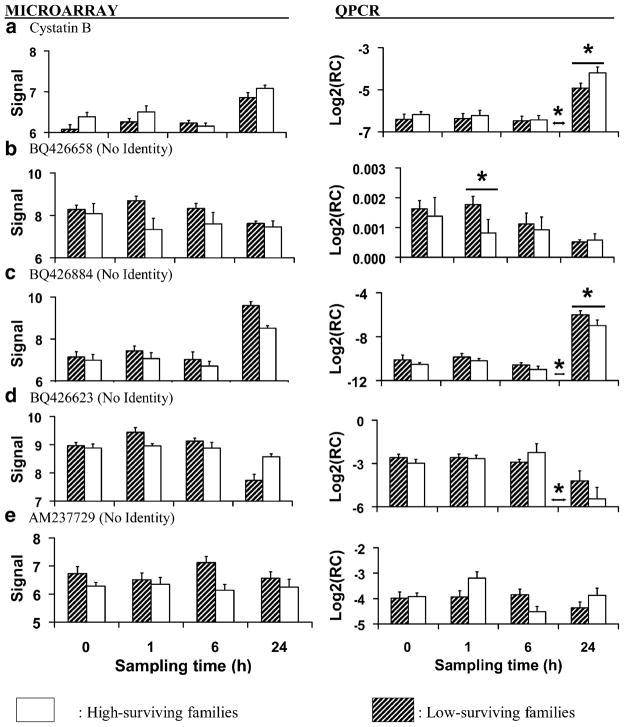
Sessile inhabitants of marine intertidal environments commonly face heat stress, an important component of summer mortality syndrome in the Pacific oyster Crassostrea gigas. Marker-aided selection programs would be useful for developing oyster strains that resist summer mortality; however, there is currently a need to identify candidate genes associated with stress tolerance and to develop molecular markers associated with those genes. To identify candidate genes for further study, we used cDNA microarrays to test the hypothesis that oyster families that had high (>64%) or low (<29%) survival of heat shock (43 degrees C, 1 h) differ in their transcriptional responses to stress. Based upon data generated by the microarray and by real-time quantitative PCR, we found that transcription after heat shock increased for genes putatively encoding heat shock proteins and genes for proteins that synthesize lipids, protect against bacterial infection, and regulate spawning, whereas transcription decreased for genes for proteins that mobilize lipids and detoxify reactive oxygen species. RNAs putatively identified as heat shock protein 27, collagen, peroxinectin, S-crystallin, and two genes with no match in Genbank had higher transcript concentrations in low-surviving families than in high-surviving families, whereas concentration of putative cystatin B mRNA was greater in high-surviving families. These ESTs should be studied further for use in marker-aided selection programs. Low survival of heat shock could result from a complex interaction of cell damage, opportunistic infection, and metabolic exhaustion.
Figures
References
-
- Abele D, Heise K, Pörtner HO, Puntarulo S. Temperature-dependence of mitochondrial function and production of reactive oxygen species in the intertidal mud clam Mya arenaria. J Exp Biol. 2002;205:1831–1841. - PubMed
-
- Alexander WS. Suppressors of cytokine signaling (SOCS) in the immune system. Nat Rev Immunol. 2002;6:410–416. - PubMed
-
- Benjamini Y, Hochberg Y. Controling the false discovery rate: a practical and powerful approach to multiple testing. J R Statist Soc B. 1995;57:289–300.
-
- Bengoechea-Alsono M, Ericcson J. SREBP in signal transduction: cholesterol metabolism and beyond. Curr Op Cell Biol. 2007;19:215–222. - PubMed
Publication types
MeSH terms
Grants and funding
LinkOut - more resources
Full Text Sources
Molecular Biology Databases
Research Materials