Postnatal development of sound pressure transformations by the head and pinnae of the cat: monaural characteristics
- PMID: 19206874
- PMCID: PMC2736725
- DOI: 10.1121/1.3058630
Postnatal development of sound pressure transformations by the head and pinnae of the cat: monaural characteristics
Abstract
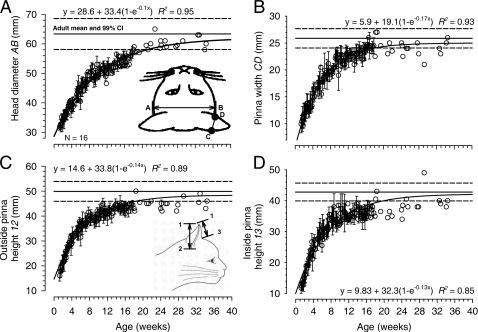
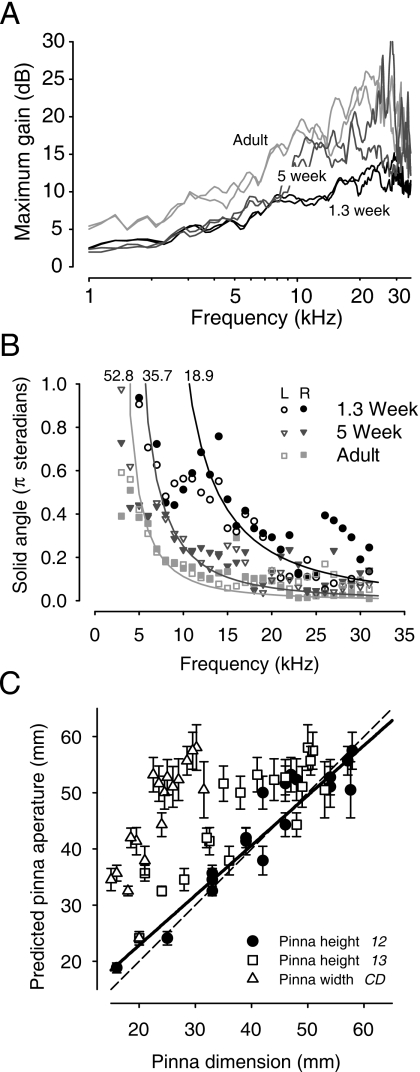
Although there have been many anatomical, physiological, and psychophysical studies of auditory development in cat, there have been no comparable studies of the development of the sound pressured transformations by the cat head and pinnae. Because the physical dimensions of the head and pinnae determine the spectral and temporal transformations of sound, as head and pinnae size increase during development, the magnitude and frequency ranges of these transformations are hypothesized to systematically change. This hypothesis was tested by measuring directional transfer functions (DTFs), the directional components of head-related transfer functions, and the linear dimensions of the head and pinnae in cats from the onset of hearing ( approximately 1.5 weeks) through adulthood. Head and pinnae dimensions increased by factors of approximately 2 and approximately 2.5, respectively, reaching adult values by approximately 23 and approximately 16 weeks, respectively. The development of the spectral notch cues to source location, the spatial- and frequency-dependent distributions of DTF amplitude gain (acoustic directionality), maximum gain, and the acoustic axis, and the resonance frequency and associated gain of the ear canal and concha were systematically related to the dimensions of the head and pinnae. These monaural acoustical properties of the head and pinnae in the cat are mature by 16 weeks.
Figures




References
-
- Carlile, S., and King, A. J. (1994). “Monaural and binaural spectrum level cues in the ferret: Acoustics and the neural representation of auditory space,” J. Neurophysiol. 71, 785–801. - PubMed
Publication types
MeSH terms
Grants and funding
LinkOut - more resources
Full Text Sources
Miscellaneous