


Modeling the genetic and environmental association between peer group deviance and cannabis use in male twins
- PMID: 19207350
- PMCID: PMC2844883
- DOI: 10.1111/j.1360-0443.2008.02457.x
Modeling the genetic and environmental association between peer group deviance and cannabis use in male twins
Abstract
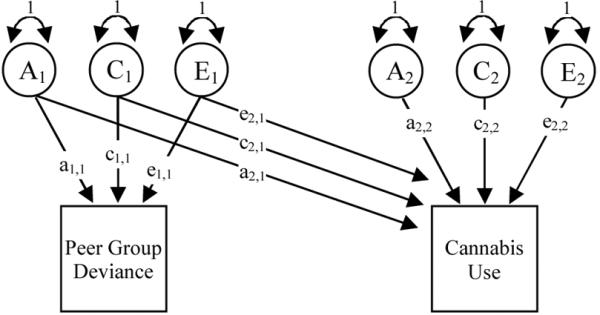
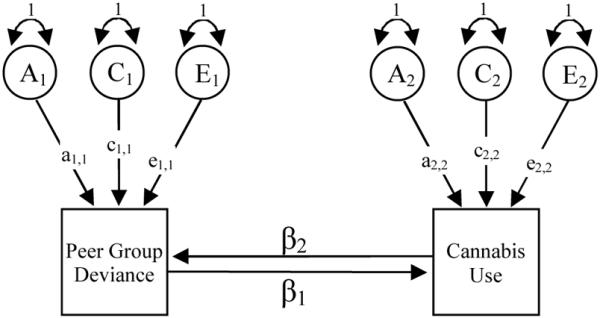
Background: Peer group deviance (PGD) is linked strongly to liability to drug use, including cannabis. Our aim was to model the genetic and environmental association, including direction of causation, between PGD and cannabis use (CU).
Method: Results were based on 1736 to 1765 adult males from the Mid-Atlantic Twin Registry with complete CU and PGD data measured retrospectively at three time-intervals between 15 and 25 years using a life-history calendar.
Results: At all ages, multivariate modeling showed that familial aggregation in PGD was explained by a combination of additive genetic and shared environmental effects. Moreover, the significant PGD-CU association was best explained by a CU-->PGD causal model in which large portions of the additive genetic (50-78%) and shared environmental variance (25-73%) in PGD were explained by CU.
Conclusions: Until recently PGD was assumed to be an environmental, upstream risk factor for CU. Our data are not consistent with this hypothesis. Rather, they suggest that the liability to affiliate with deviant peers is explained more clearly by a combination of genetic and environmental factors that are indexed by CU which sits as a 'risk indicator' in the causal pathway between genetic and environmental risks and the expression of PGD. This is consistent with a process of social selection by which the genetic and environmental risks in CU largely drive the propensity to affiliate with deviant peers.
Figures
Comment in
-
Genetically informative studies of 'environment'.Addiction. 2009 Mar;104(3):439-40. doi: 10.1111/j.1360-0443.2008.02512.x. Addiction. 2009. PMID: 19207352 Free PMC article. No abstract available.
References
-
- Patterson GR, DeBaryshe BD, Ramsey E. A developmental perspective on antisocial behavior. American Psychologist. 1989;44:329–335. - PubMed
-
- Petraitis J, Flay BR, Miller TQ, Torpy EJ, Greiner B. Illicit substance use among adolescents: a matrix of prospective predictors. Substance Use and Misuse. 1998;33:2561–2604. - PubMed
-
- Dishion TJ, Bullock BM, Granic I. Pragmatism in modeling peer influence: dynamics, outcomes, and change processes. Development and Psychopathology. 2002;14:969–981. - PubMed
-
- Patterson GR, Dishion TJ, Yoerger K. Adolescent growth in new forms of problem behavior: macro- and micro-peer dynamics. Prevention Science. 2000;1:3–13. - PubMed
-
- Granic I, Patterson GR. Toward a comprehensive model of antisocial development: a dynamic systems approach. Psychological Review. 2006;113:101–131. - PubMed
Publication types
MeSH terms
Grants and funding
LinkOut - more resources
Full Text Sources
Medical
Miscellaneous
