. 2009 Apr;47(4):234-45.
doi: 10.1002/dvg.20480.

Longitudinal analysis of mammogenesis using a novel tetracycline-inducible mouse model and in vivo imaging

Affiliations

Longitudinal analysis of mammogenesis using a novel tetracycline-inducible mouse model and in vivo imaging

Bradley A Creamer et al. Genesis. 2009 Apr.

Abstract

We generated a novel mouse model, which expresses the tetracycline-inducible transactivator under the regulation of the endogenous whey acidic protein gene. Using a tet-responsive luciferase reporter transgene, we demonstrated that the Wap-rtTA knockin allele allows a tightly controlled temporal and spatial expression of transgenes in the mammary gland in a ligand-inducible manner. The longitudinal analysis of individual females throughout their reproductive cycles using in vivo bioluminescence imaging confirmed that the expression of the Wap-rtTA knockin allele is highly upregulated during lactation. However, the extent of the transcriptional activation of the targeted Wap locus is dependent on the suckling stimulus and milk retrieval. In addition, we used WAP-rtTA/TetO-H2B-GFP double-transgenic females to monitor the presence of GFP-labeled parity-induced mammary epithelial cells (PI-MECs) during the postlactational involution period. The study shows that, unlike their progeny in mammary epithelial transplants as reported previously, PI-MECs themselves may not belong to the long-term label-retaining epithelial subtype.


Conflict of interest statement

The authors declare no conflict of interest.

Figures
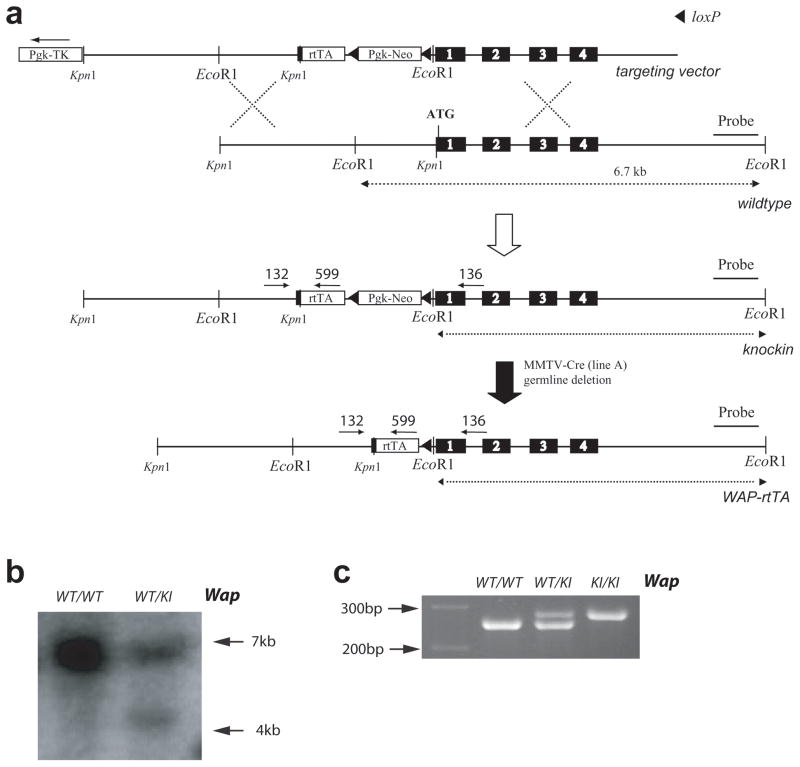
Fig. 1
Fig. 1
Targeted insertion of the rtTA into the endogenous Wap locus. (a) Strategy to knockin the rtTA coding sequence into the first exon of Wap using homologous recombination. The floxed PGK-Neo selectable marker was subsequently excised in the germline of MMTV-Cre females. (b) Southern blot analysis using an EcoR1 restriction digest in combination with a 3′ external probe to verify the correct targeted insertion of the rtTA into the Wap locus. (c) PCR analysis on genomic DNA of tail biopsies to determine the genotype of heterozygous (WT/KI) and homozygous (KI/KI) WAP-rtTA knockin mice as well as wildtype controls.
Fig. 2
Fig. 2
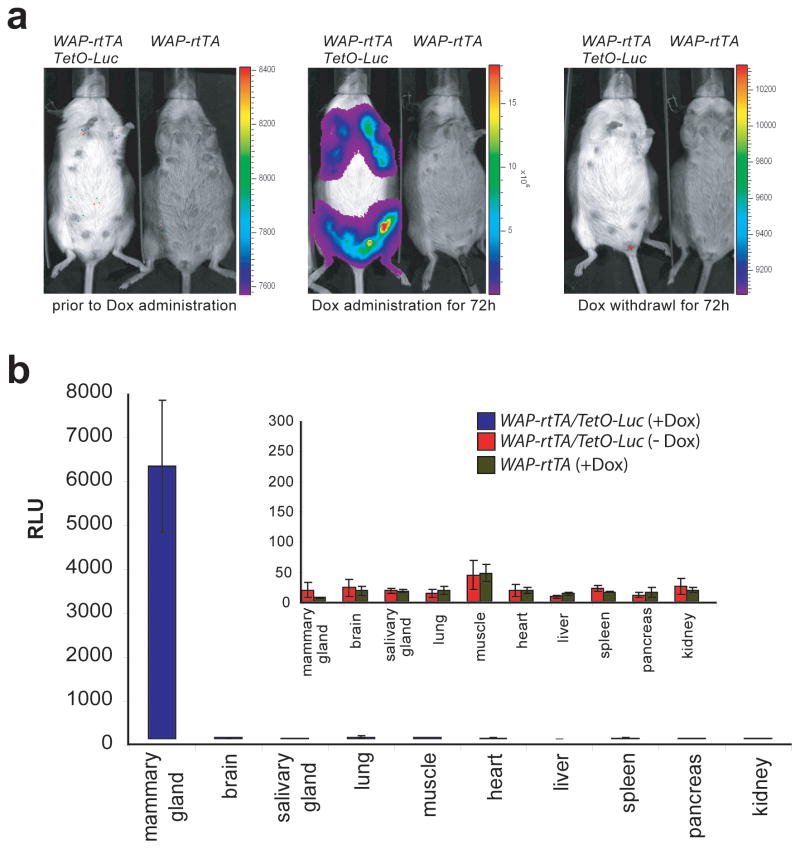
Mammary gland-specific expression of the Wap-rtTA allele. (a) In vivo bioluminescence imaging of the same lactating WAP-rtTA/TetO-Luc double transgenic female and her WAP-rtTA single transgenic control prior to and during doxycycline (Dox) administration (left and center) as well as 72h after Dox withdrawal (right). (b) Conventional luciferase assay to monitor the expression of the TetO-Luc reporter transgene in a panel of ten organs from lactating WAP-rtTA/TetO-Luc females (Dox treated and untreated) as well as WAP-rtTA single transgenic controls (N=3 of each genotype). RLU, relative light units corrected by the protein concentration, error bars represent +/− SEM.
Fig. 3
Fig. 3
Expression of the Wap-rtTA allele is confined to mammary epithelial cells. (a) Immunofluorescent staining of the luminal epithelial cell marker cytokeratin-8 (CK8) and the H2B-GFP fusion protein in lactating mammary glands of WAP-rtTA/TetO-H2B-GFP double transgenic females either treated or not treated with doxycycline (bar represents 50 μm). (b) Immunofluorescent staining of the basal cell marker cytokeratin-14 (CK14) and the H2B/GFP fusion protein in lactating mammary glands of WAP-rtTA/TetO-H2B-GFP females either treated or not treated with doxycycline (bar represents 50 μm).
Fig. 4
Fig. 4
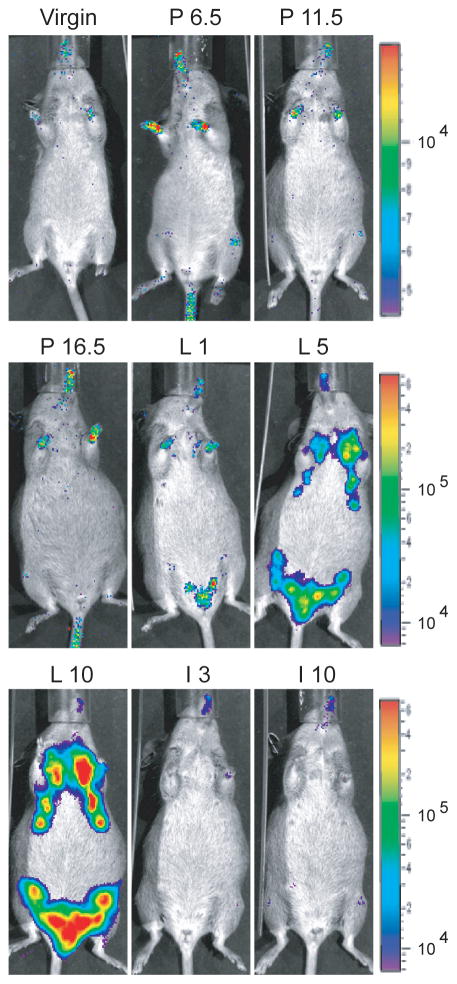
Longitudinal analysis of the Wap-rtTA-mediated activation of the TetO-Luc reporter transgene in the mammary gland at various stages of the first gestation cycle using in vivo bioluminescence imaging. The animal was fed doxycycline throughout this experiment. V, virgin; P6.5 through P16.5, pregnancy day 6.5 through day 16.5 post coitus; L1 through L10, lactation day 1 through day 10; I3 and I10, involution day 3 and day 10.
Fig. 5
Fig. 5
Transcriptional activation of the targeted Wap-rtTA locus and the wildtype Wap gene. (a) RT-PCR strategy. (b) RT-PCR assay to determine the transcriptional activation of the wildtype and targeted Wap-rtTA knockin loci in both heterozygous (WT/KI) and homozygous (KI/KI) knockin mice. A WAP-rtTA knockin mouse that still carries the neomycin cassette between the WAP promoter and the rtTA (neo/neo) was used as an additional control. (c) Immunofluorescence staining of the Wap protein (green) in lactating mammary glands of heterozygous and homozygous WAP-rtTA knockin mice. Conventional WAP knockout mice (KO/KO) served as negative controls. The histological sections were counterstained with DAPI (blue). Bar, 50 μm.
Fig. 6
Fig. 6
The transcriptional activation of the Wap locus is greatly modified by the extent of suckling and milk retrieval. (a) In vivo bioluminescence imaging on two WAP-rtTA/TetO-Luc females on lactation day 5 during their first two gestation cycles. The litter sizes of both females were adjusted for 8 and 3 pups, respectively. (b) Decline in milk protein gene expression in individual mammary glands in response to milk stasis. The nipples of the left #3, #4 and #5 mammary glands were sealed at day 10 of lactation. Bioluminescence images were taken immediately before closing the glands and 72 hours later.
Fig. 7
Fig. 7
A small subset of Wap-rtTA-expressing cells is retained in the involuting mammary gland. (a,b) Immunofluorescent staining of the H2B-GFP fusion protein (green) in lactating mammary tissue (L10 and L15) of WAP-rtTA/TetO-H2B-GFP females. DAPI (blue) was used as a counter stain. Bar, 50 μm. The timing of Dox treatment is illustrated in the upper panel (c) Analysis of nuclear H2B-GFP staining on freshly isolated mammary tissue using a fluorescence stereoscope. The female was treated with Dox during pregnancy until day 3 of lactation, followed by forced involution and Dox removal for 14 days. Bar, 50 μm.

References

    1. Andres AC, Schonenberger CA, Groner B, Hennighausen L, LeMeur M, Gerlinger P. Ha-ras oncogene expression directed by a milk protein gene promoter: tissue specificity, hormonal regulation, and tumor induction in transgenic mice. Proc Natl Acad Sci U S A. 1987;84:1299–1303. - PMC - PubMed
    1. Bayna EM, Rosen JM. Tissue-specific, high level expression of the rat whey acidic protein gene in transgenic mice. Nucleic Acids Res. 1990;18:2977–2985. - PMC - PubMed
    1. Blanpain C, Horsley V, Fuchs E. Epithelial stem cells: turning over new leaves. Cell. 2007;128:445–458. - PMC - PubMed
    1. Booth BW, Smith GH. Estrogen receptor-alpha and progesterone receptor are expressed in label-retaining mammary epithelial cells that divide asymmetrically and retain their template DNA strands. Breast Cancer Res. 2006;8:R49. - PMC - PubMed
    1. Brennand K, Huangfu D, Melton D. All beta Cells Contribute Equally to Islet Growth and Maintenance. PLoS Biol. 2007;5:1520–1529. - PMC - PubMed

Publication types

MeSH terms