Time trends in epidemiology and characteristics of psoriatic arthritis over 3 decades: a population-based study
- PMID: 19208565
- PMCID: PMC2717703
- DOI: 10.3899/jrheum.080691
Time trends in epidemiology and characteristics of psoriatic arthritis over 3 decades: a population-based study
Abstract
Objective: To determine time trends in incidence, prevalence, and clinical characteristics of psoriatic arthritis (PsA) over a 30-year period.
Methods: We identified a population-based incidence cohort of subjects aged 18 years or over who fulfilled ClASsification of Psoriatic ARthritis (CASPAR) criteria for PsA between January 1, 1970, and December 31, 1999, in Olmsted County, Minnesota, USA. PsA incidence date was defined as the diagnosis date of those who fulfilled CASPAR criteria. Age- and sex-specific incidence rates were estimated and age- and sex-adjusted to the 2000 US White population.
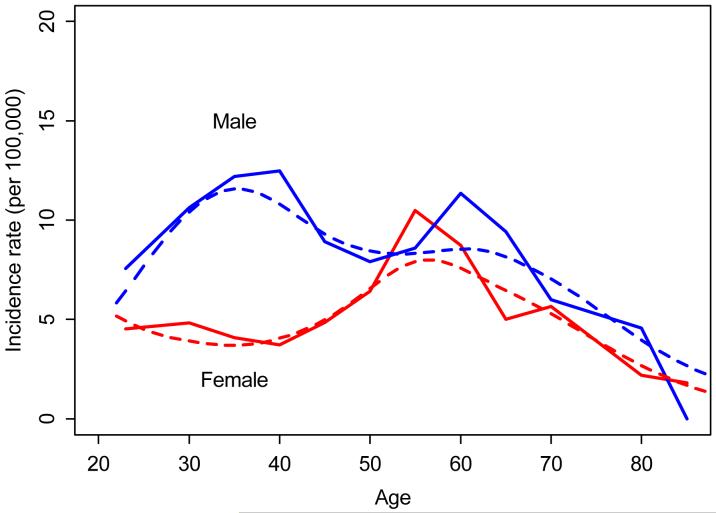
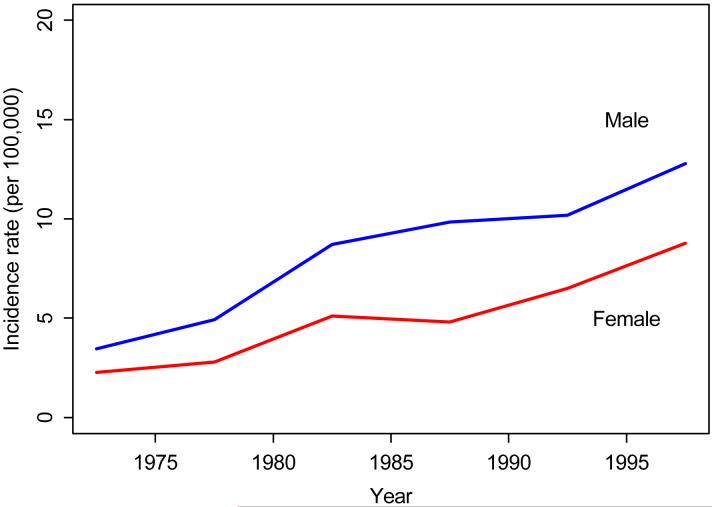
Results: The PsA incidence cohort comprised 147 adult subjects with a mean age of 42.7 years, and 61% were men. The overall age- and sex-adjusted annual incidence of PsA per 100,000 was 7.2 [95% confidence interval (CI) 6.0, 8.4] with a higher incidence in men (9.1, 95% CI 7.1, 11.0) than women (5.4, 95% CI 4.0, 6.9). The age- and sex-adjusted incidence of PsA per 100,000 increased from 3.6 (95% CI 2.0, 5.2) between 1970 and 1979 to 9.8 (95% CI 7.7, 11.9) between 1990 and 2000 (p for trend < 0.001). The point prevalence per 100,000 was 158 (95% CI 132, 185) in 2000, with a higher prevalence in men (193, 95% CI 150, 237) than women (127, 95% CI 94, 160). At incidence, most PsA subjects had oligoarticular involvement (49%) with enthesopathy (29%).
Conclusion: The incidence of PsA has been rising over 30 years in men and women. Reasons for the increase are unknown, but may be related to a true change in incidence or greater physician awareness of the diagnosis.
Figures
Comment in
-
Epidemiology of psoriatic arthritis.J Rheumatol. 2009 Feb;36(2):213-5. doi: 10.3899/jrheum.081242. J Rheumatol. 2009. PMID: 19208553 No abstract available.
References
-
- Alamanos Y, Voulgari PV, Drosos AA. Incidence and Prevalence of Psoriatic Arthritis: A Systematic Review. J Rheumatol. 2008 - PubMed
-
- Hellgren L. Association between rheumatoid arthritis and psoriasis in total populations. Acta Rheumatol Scand. 1969;15(4):316–26. - PubMed
-
- Shbeeb M, Uramoto KM, Gibson LE, O’Fallon WM, Gabriel SE. The epidemiology of psoriatic arthritis in Olmsted County, Minnesota, USA, 1982-1991. J Rheumatol. 2000;27(5):1247–50. - PubMed
-
- Savolainen E, Kaipiainen-Seppanen O, Kroger L, Luosujarvi R. Total incidence and distribution of inflammatory joint diseases in a defined population: results from the Kuopio 2000 arthritis survey. J Rheumatol. 2003;30(11):2460–8. - PubMed
Publication types
MeSH terms
Grants and funding
LinkOut - more resources
Full Text Sources
Medical
Research Materials
Miscellaneous