


Glucagon-mediated impairments in hepatic and peripheral tissue nutrient disposal are not aggravated by increased lipid availability
- PMID: 19208853
- PMCID: PMC2681308
- DOI: 10.1152/ajpendo.90821.2008
Glucagon-mediated impairments in hepatic and peripheral tissue nutrient disposal are not aggravated by increased lipid availability
Abstract
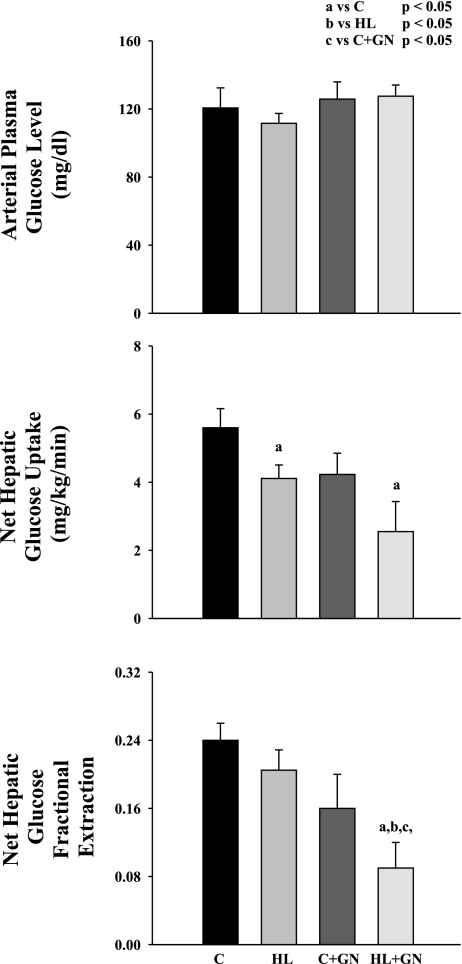
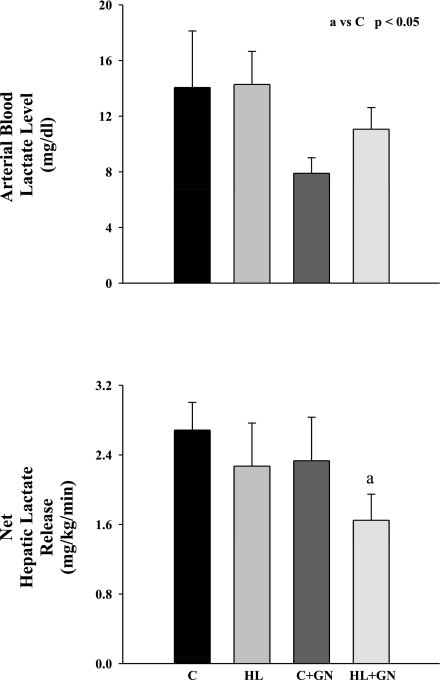
Glucose, fat, and glucagon availability are increased in diabetes. The normal response of the liver to chronic increases in glucose availability is to adapt to become a marked consumer of glucose. Yet this fails to occur in diabetes. The aim was to determine whether increased glucagon and lipid interact to impair the adaptation to increased glucose availability. Chronically catheterized well controlled depancreatized conscious dogs (n = 21) received 3 days of continuous parenteral nutrition (TPN) that was either high in glucose [C; 75% nonprotein calories (NPC)] or in lipid (HL; 75% NPC) in the presence or absence of a low dose (one-third basal) chronic intraportal infusion of glucagon (GN; 0.25 ng.kg(-1).min(-1)). During the 3 days of TPN, all groups received the same insulin algorithm; the total amount of glucose infused (GIR) was varied to maintain isoglycemia ( approximately 120 mg/dl). On day 3 of TPN, hepatic metabolism was assessed. Glucose and insulin levels were similar in all groups. GIR was decreased in HL and C + GN ( approximately 30%) and was further decreased in HL + GN (55%). Net hepatic glucose uptake was decreased approximately 15% in C + GN, and HL and was decreased approximately 50% in HL + GN. Lipid alone or combined with glucagon decreased glucose uptake by peripheral tissues. Despite impairing whole body glucose utilization, HL did not limit whole body energy disposal. In contrast, glucagon suppressed whole body energy disposal irrespective of the diet composition. In summary, failure to appropriately suppress glucagon secretion adds to the dietary fat-induced impairment in both hepatic and peripheral glucose disposal. In addition, unlike increasing the percentage of calories as fat, inappropriate glucagon secretion in the absence of compensatory hyperinsulinemia limits whole body nutrient disposition.
Figures
References
-
- Ahren B Reducing plasma free fatty acids by acipimox improves glucose tolerance in high-fat fed mice. Acta Physiol Scand 171: 161–167, 2001. - PubMed
-
- Bajaj M, Medina-Navarro R, Suraamornkul S, Meyer C, DeFronzo RA, Mandarino LJ. Paradoxical changes in muscle gene expression in insulin-resistant subjects after sustained reduction in plasma free fatty acid concentration. Diabetes 56: 743–752, 2007. - PubMed
-
- Bajaj M, Suraamornkul S, Romanelli A, Cline GW, Mandarino LJ, Shulman GI, DeFronzo RA. Effect of a sustained reduction in plasma free fatty acid concentration on intramuscular long-chain fatty acyl-CoAs and insulin action in Type 2 diabetic patients. Diabetes 54: 3148–3153, 2005. - PubMed
-
- Barzilai N, Rossetti L. Role of glucokinase and glucose-6-phosphatase in the acute and chronic regulation of hepatic glucose fluxes by insulin. J Biol Chem 268: 25019–25025, 1993. - PubMed
-
- Boden G, Chen X, Rosner J, Barton M. Effects of a 48-h fat infusion on insulin secretion and glucose utilization. Diabetes 44: 1239–1242, 1995. - PubMed
Publication types
MeSH terms
Substances
Grants and funding
LinkOut - more resources
Full Text Sources
Medical
Research Materials
Miscellaneous
