. 2009 Feb 11:9:35.
doi: 10.1186/1471-2180-9-35.

Probiotic Lactobacillus reuteri biofilms produce antimicrobial and anti-inflammatory factors

Affiliations

Probiotic Lactobacillus reuteri biofilms produce antimicrobial and anti-inflammatory factors

Sara E Jones et al. BMC Microbiol. .

Abstract

Background: Commensal-derived probiotic bacteria inhibit enteric pathogens and regulate host immune responses in the gastrointestinal tract, but studies examining specific functions of beneficial microbes in the context of biofilms have been limited in scope.

Results: Lactobacillus reuteri formed biofilms that retained functions potentially advantageous to the host including modulation of cytokine output and the production of the antimicrobial agent, reuterin. Immunomodulatory activities of biofilms were demonstrated by the abilities of specific L. reuteri strains to suppress human TNF production by LPS-activated monocytoid cells. Quantification of the antimicrobial glycerol derivative, reuterin, was assessed in order to document the antipathogenic potential of probiotic biofilms. L. reuteri biofilms differed in the quantities of reuterin secreted in this physiological state.

Conclusion: L. reuteri biofilms secreted factors that confer specific health benefits such as immunomodulation and pathogen inhibition. Future probiotic selection strategies should consider a strain's ability to perform beneficial functions as a biofilm.


Figures
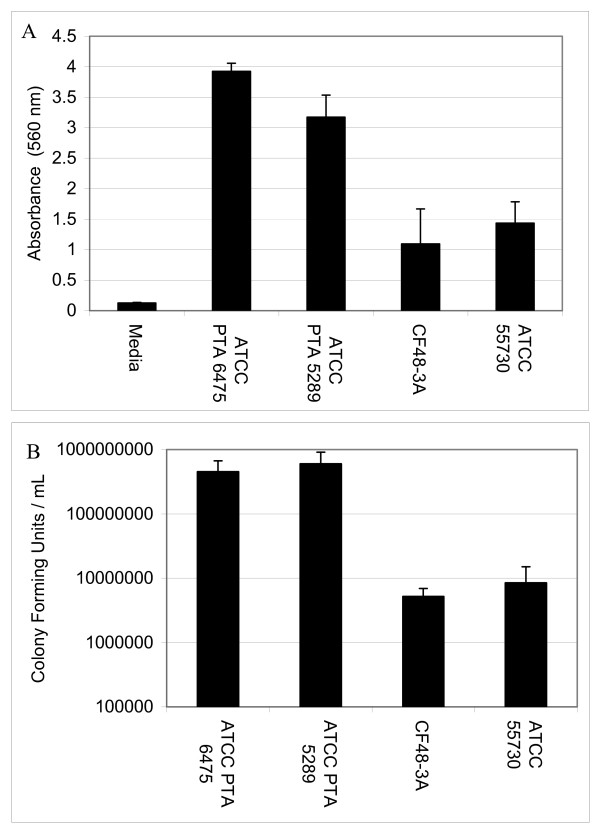
Figure 1
Figure 1
L. reuteri adherence is strain-dependent. L. reuteri biofilms were cultured for 24 hours in 96-well polystyrene plates. The relative propensities of L. reuteri to form biofilms were measured by absorbance spectrophotometry after staining with crystal violet. L. reuteri ATCC 6475 and ATCC PTA 5289 were more adherent then CF48-3A and ATCC 55730 (ANOVA, p < 0.02).
Figure 2
Figure 2
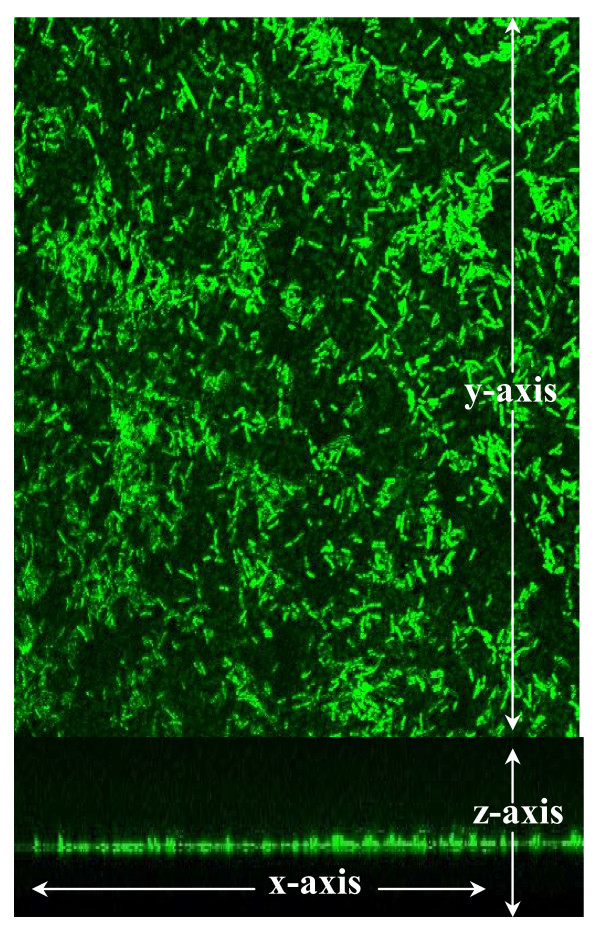
L. reuteri biofilms were observed by confocal microscopy. Biofilms were cultured in a flow cell supplied with MRS for 48 hours at 37°C in ambient atmosphere. L. reuteri biofilms (green) were stained with acridine orange and observed by confocal microscopy. A single optical section and the stacked optical sections of ATCC 55730 (A and B, respectively) are shown at 630× magnification. These images are representative of 30 microscopic fields obtained in 3 independent experiments.
Figure 3
Figure 3
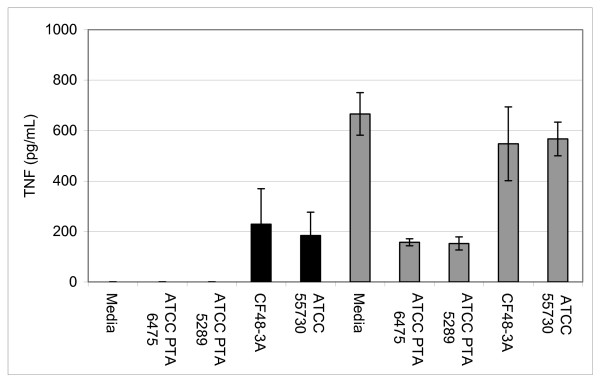
Modulation of TNF production by L. reuteri is strain-dependent. Cell-free supernatants from stationary phase L. reuteri cultures (planktonic cells) were added to human monocytoid cells in the presence or absence of E. coli-derived LPS (no LPS-black bars, LPS-gray bars). Quantitative ELISAs measured the amounts of human TNF produced by THP-1 cells. In the absence of LPS, supernatants from L. reuteri CF48-3A and ATCC 55730 stimulated TNF by human THP-1 cells, while supernatants from ATCC PTA 6475 and ATCC PTA 5289 did not induce TNF production. However, L. reuteri CF48-3A and ATCC 55730 did not suppress TNF production by LPS-activated cells, while PTA 6475 and ATCC PTA 5289 inhibited production of TNF by 76% and 77% respectively, when compared to the media control (ANOVA, p < 0.001).
Figure 4
Figure 4
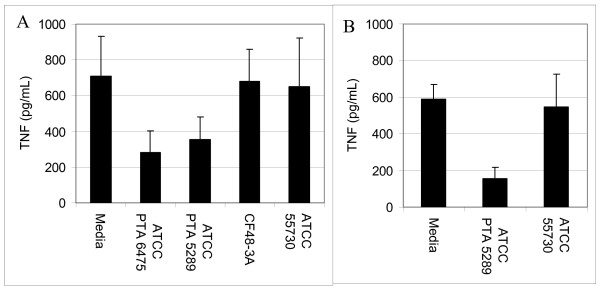
L. reuteri strains proficient in biofilm formation suppress TNF production. Cell-free supernatants from L. reuteri biofilms cultured in 24-well plates (A) or flow cells (B) were added to human monocytoid cells in the presence of E. coli-derived LPS. Quantitative ELISAs measured the amounts of human TNF produced by THP-1 cells. As biofilms, TNF inhibitory strains (ATCC PTA 6475 and ATCC PTA 5289) retained their ability to suppress TNF produced by LPS-activated human monocytoid cells. L. reuteri ATCC PTA 6475 and ATCC PTA 5289 biofilms cultured in 24-well plates (A) inhibited TNF by 60% and 50% respectively, (ANOVA, p < 0.02). Supernatants of L. reuteri ATCC PTA 5289 cultured in a flow cell (B) inhibited TNF by 73% when compared to the media control (ANOVA, p < 0.0001).
Figure 5
Figure 5
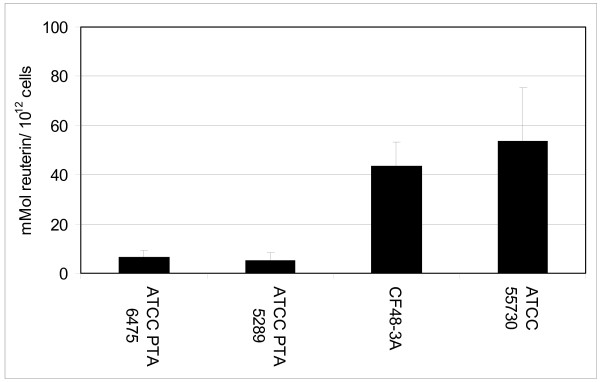
L. reuteri strains cultured as planktonic cells produce the antimicrobial compound, reuterin. Stationary phase planktonic cultures of L. reuteri were incubated anaerobically in a glycerol solution. Reuterin concentrations of the cell free supernatants were determined using a colorimetric assay and were normalized with respect to viable colony counts prior to the addition of glycerol. ATCC PTA 6475 and ATCC 5289 produced less reuterin than ATCC 55730 and CF48-3A (ANOVA, p < 0.05).
Figure 6
Figure 6
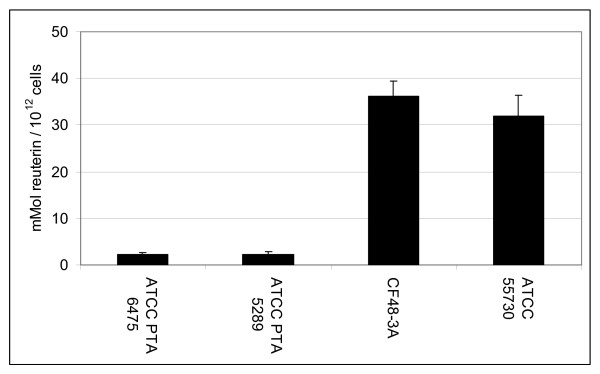
L. reuteri biofilms produce reuterin. L. reuteri biofilms were cultured in MRS for 48 hours at 37°C in ambient atmosphere in multiwell plates. In order to measure reuterin production, biofilms were incubated in the presence of glycerol in anaerobic conditions. Reuterin concentrations were determined using a colorimetric assay and were normalized with respect to viable colony counts prior to the addition of glycerol. All L. reuteri biofilms produced detectable amounts of reuterin, although inter-strain differences were observed. ATCC PTA 6475 and ATCC 5289 produced less reuterin than ATCC 55730 and CF48-3A (ANOVA, p < 0.05).

References

    1. Fuller R. Probiotics in man and animals. J Appl Bacteriol. 1989;66(5):365–378. - PubMed
    1. FAO/WHO. Health and Nutritional Properties of Probiotics in Food including Powder Milk with Live Lactic Acid Bacteria. Report of the Joint Food and Agriculture Organization (FAO) of the United Nations/World Health Organization (WHO) Expert Consultation on Evaluation of Health and Nutritional Properties of Probiotics in Food Including Powder Milk with Live Lactic Acid Bacteria. 2001. http://www.who.int/foodsafety/publications/fs_management/en/probiotics.pdf
    1. Abrahamsson TR, Jakobsson T, Bottcher MF, Fredrikson M, Jenmalm MC, Bjorksten B, Oldaeus G. Probiotics in prevention of IgE-associated eczema: a double-blind, randomized, placebo-controlled trial. J Allergy Clin Immunol. 2007;119(5):1174–1180. - PubMed
    1. Shornikova AV, Casas IA, Isolauri E, Mykkanen H, Vesikari T. Lactobacillus reuteri as a therapeutic agent in acute diarrhea in young children. J Pediatr Gastroenterol Nutr. 1997;24(4):399–404. - PubMed
    1. Shornikova AV, Casas IA, Mykkanen H, Salo E, Vesikari T. Bacteriotherapy with Lactobacillus reuteri in rotavirus gastroenteritis. Pediatr Infect Dis J. 1997;16(12):1103–1107. - PubMed

Publication types

MeSH terms