Pilot study of augmentation with aripiprazole for incomplete response in late-life depression: getting to remission
- PMID: 19210951
- PMCID: PMC2886714
- DOI: 10.4088/jcp.07m03805
Pilot study of augmentation with aripiprazole for incomplete response in late-life depression: getting to remission
Abstract
Objective: To determine the feasibility and safety of aripiprazole augmentation for incomplete response to sequential selective serotonin reuptake inhibitor (SSRI) and serotonin-norepinephrine reuptake inhibitor (SNRI) pharmacotherapy in late-life depression.
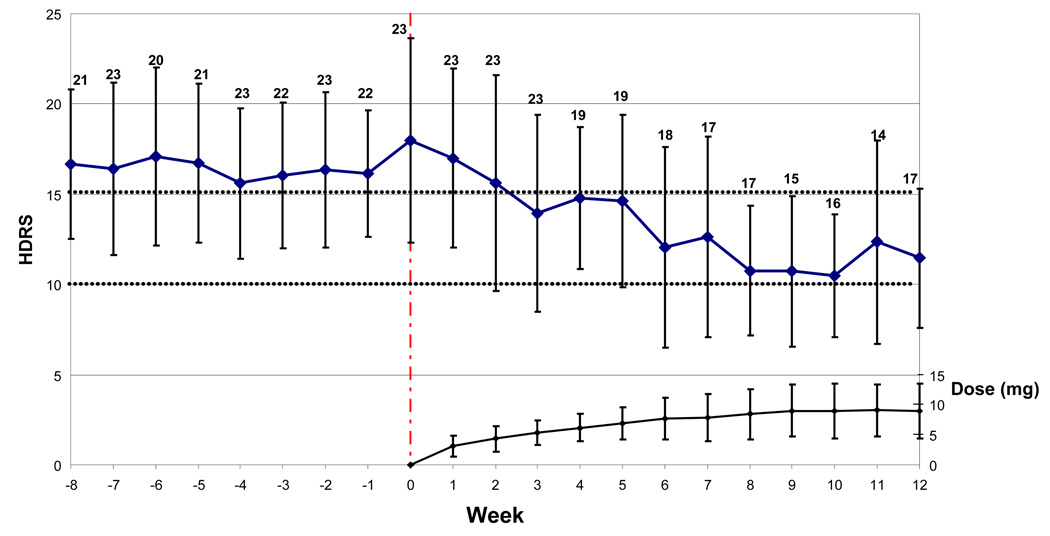
Method: This study was a 12-week, open-label pilot study of 24 patients (recruited from June 1, 2006, to June 1, 2007) aged 65 years and above (mean, 73.9 years) diagnosed with major depressive disorder (MDD) (according to DSM-IV) who responded partially (17-item Hamilton Rating Scale for Depression [HAM-D-17] score of 11 to 15) or not at all (HAM-D score > 15) to a 16-week trial of escitalopram (up to 20 mg/day), followed by either duloxetine (up to 120 mg/day) or venlafaxine (up to 225 mg/day) for 12 weeks. Subjects received 2.5 to 15 mg per day of adjunctive aripiprazole (mean dose, 9.0 mg/day) for 12 weeks. The criterion for remission during treatment with aripiprazole was a HAM-D score < or = 10 for 2 consecutive weeks.
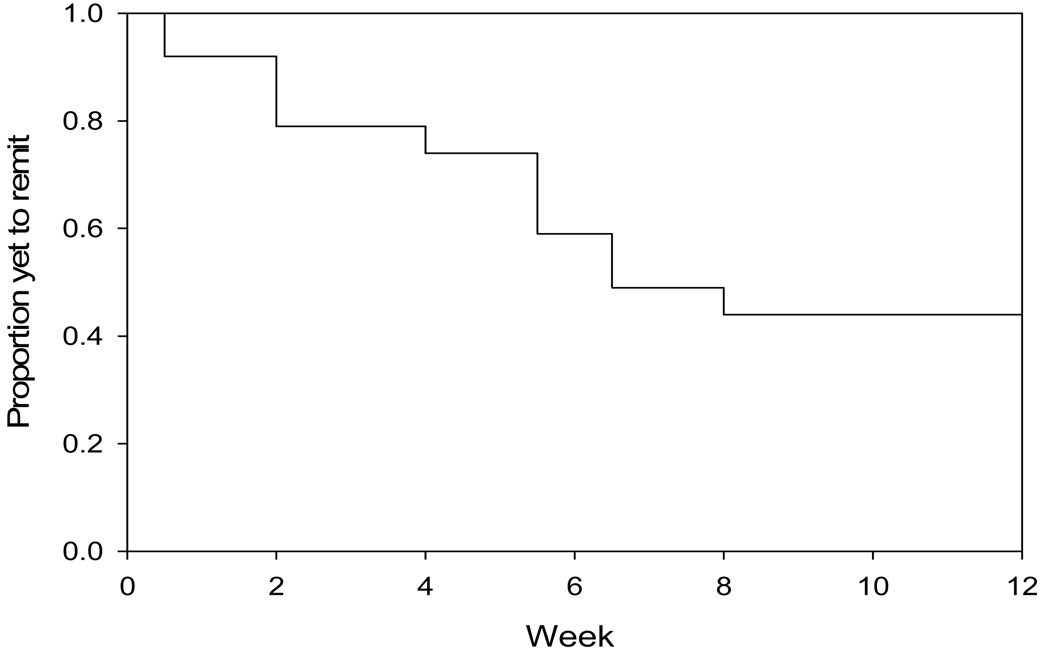
Results: Of 24 subjects in the intent-to-treat study group, 19 completed 12 weeks of augmentation with aripiprazole, 12 of 24 (50%) met criteria for remission, and 2 of 24 discontinued due to side effects (sedation, akathisia). The mean (SD) HAM-D score decreased significantly by 6.4 (5.8) points (paired t test for means, p < .01, df = 16). There were no relapses among the 12 subjects who participated in continuation treatment over a median period of 27.6 weeks.
Conclusions: In older adults with MDD with incomplete response to SSRI and SNRI pharmacotherapy, aripiprazole was well tolerated, and symptoms of depression improved significantly during treatment with aripiprazole. A randomized, double-blind, placebo-controlled trial of adjunctive aripiprazole for incomplete response in late-life depression is warranted to further evaluate benefit and risk.
Trial registration: clinicaltrials.gov Identifier: NCT00177671.
Copyright 2009 Physicians Postgraduate Press, Inc.
Conflict of interest statement
Conflict of interest: None
Clinical Trials Gov No.: NCT00177671
Figures
References
-
- Bruce ML, Ten Have TR, Reynolds CF, et al. Reducing suicidal ideation and depressive symptoms in depressed older primary care patients: A randomized controlled trial. JAMA. 2004;291:1081–1091. - PubMed
-
- Unutzer J, Katon W, Callahan CM, et al. Collaborative care management of late-life depression in the primary care setting: A randomized controlled trial. JAMA. 2002;288:2836–2845. - PubMed
-
- Lebowitz BD, Pearson JL, Schneider LS, et al. Diagnosis and treatment of depression in late-life: Consensus statement update. JAMA. 1997;278:1186–1190. - PubMed
-
- Stein DJ, Westenberg HGM, Liebowitz MR. Social anxiety disorder and generalized anxiety disorder: Serotonergic and dopaminergic neurocircuitry. J Clin Psychiatry. 2002;63:12–19. - PubMed
-
- Barbee JG, Conrad EJ, Jamhour NJ. Aripiprazole augmentation in treatment-resistant depression. Ann Clin Psychiatry. 2004;16:189–194. - PubMed
Publication types
MeSH terms
Substances
Associated data
Grants and funding
LinkOut - more resources
Full Text Sources
Medical
Miscellaneous