Comparative Study
. 2009 Jan;64(1):9-20.
doi: 10.1093/gerona/gln049. Epub 2009 Feb 10.

B6D2F1 Mice are a suitable model of oxidative stress-mediated impaired endothelium-dependent dilation with aging

Affiliations
Comparative Study

B6D2F1 Mice are a suitable model of oxidative stress-mediated impaired endothelium-dependent dilation with aging

Lisa A Lesniewski et al. J Gerontol A Biol Sci Med Sci. 2009 Jan.

Abstract

To determine if B6D2F1 mice represent a suitable model of oxidative stress-mediated impaired endothelium-dependent dilation (EDD) with aging, mice were studied at 6.9 +/- 0.3 and 31.9 +/- 0.6 months. EDD to acetylcholine (ACh) was 26% (p < .001) and 12% (p < .001) lower, respectively, in isolated carotid (n = 10-11) and femoral (n = 10) arteries from older mice, and reductions in arterial pressure to systemic ACh infusion were smaller in older mice (n = 6-10; p < .01). Nitrotyrosine was marked in aorta of older mice (p < .05, n = 4). Superoxide production in carotid arteries was greater (p < .05), and TEMPOL restored dilation in carotid arteries and systemically in older mice. N(G)-nitro-l-arginine methyl ester (l-NAME) reduced carotid artery dilation in young more than older mice, whereas TEMPOL restored the effects of l-NAME in older mice. Carotid artery stiffness was increased in older compared with young mice (p = .04). Our results provide the first comprehensive evidence that B6D2F1 mice are a useful model for investigating mechanisms of reduced nitric oxide-dependent, oxidative stress-associated EDD and increased arterial stiffness with aging.


Figures
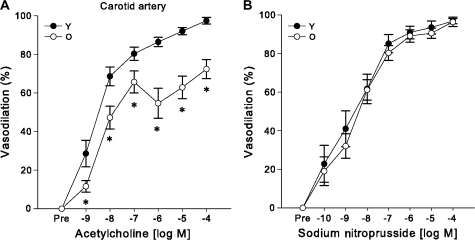
Figure 1.
Figure 1.
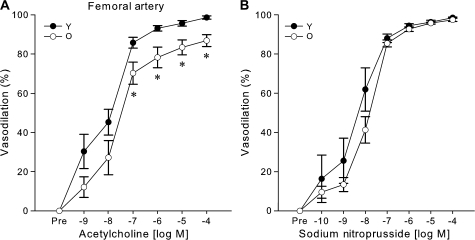
Reduced endothelium-dependent dilation, with preserved endothelium-independent dilation in the carotid arteries of older (O, 29–34 months) compared with young (Y, 6–9 months) B6D2F1 mice. (A) Dose–response dilations to the endothelium-dependent vasodilator, acetylcholine, in isolated carotid arteries from young (n = 10) and older (n = 11) mice. (B) Dose–response dilations to the endothelium-independent vasodilator sodium nitroprusside (Y: n = 7, O: n = 10). For dose–response relations with significant (p < .05) main effects for group or interaction, asterisk denotes significant (p < .05) differences between age groups at particular doses.
Figure 2.
Figure 2.
Reduced endothelium-dependent dilation, with preserved endothelium-independent dilation in the femoral arteries of older (O, 29–34 months) compared with young (Y, 6–9 months) B6D2F1 mice. (A) Dose–response dilations to the endothelium-dependent vasodilator, acetylcholine, in isolated femoral arteries from young (n = 10) and older (n = 10) mice. (B) Dose–response dilations to the endothelium-independent vasodilator sodium nitroprusside (Y: n = 7, O: n = 8). For dose–response relations with significant (p < .05) main effects for group or interaction, asterisk denotes significant (p < .05) differences between age groups at particular doses.
Figure 3.
Figure 3.
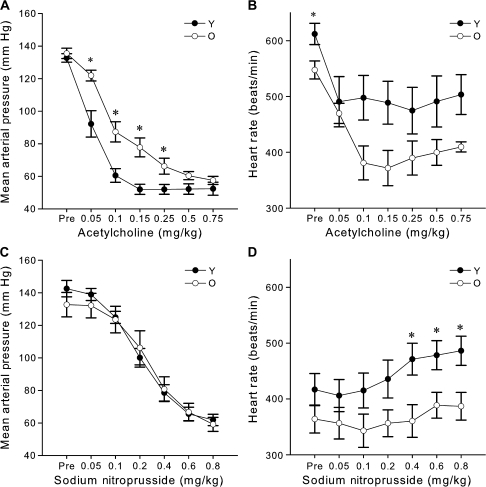
Reduced systemic endothelium-dependent dilation, with preserved systemic endothelium-independent dilation of older (O, 29–34 months) compared with young (Y, 6–9 months) B6D2F1 mice. (A) Dose–response reductions in mean arterial pressure to intravenous administration of the endothelium-dependent vasodilator, acetylcholine (ACh), in young (n = 6) and older (n = 6) mice. (B) Heart rate responses to the intravenous infusion of ACh in young (n = 5) and older (n = 5) mice. (C) Dose–response reductions in mean arterial pressure to intravenous administration of the endothelium-independent vasodilator sodium nitroprusside (SNP; Y: n = 8, O: n = 6). (D) Heart rate responses to the intravenous infusion of SNP in young (n = 12) and older (n = 10) mice. For dose–response relations with significant (p < .05) main effects for group or interaction, asterisk denotes significant (p < .05) differences between age groups at particular doses.
Figure 4.
Figure 4.
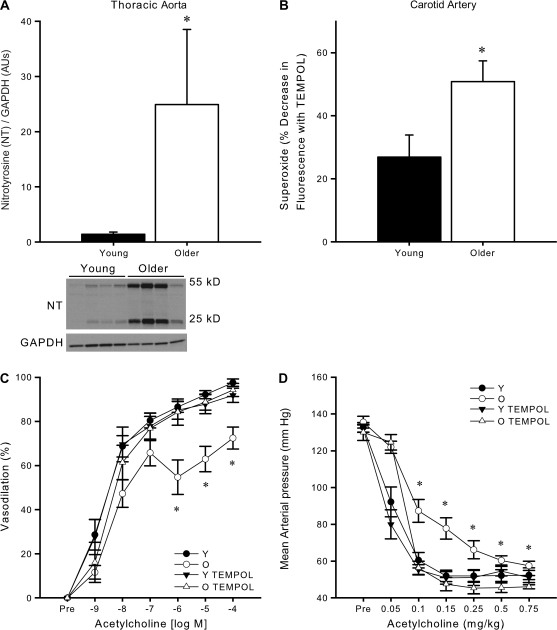
Vascular oxidative stress develops in older B6D2F1 mice and mediates impaired endothelium-dependent dilation. (A) Increased nitrotyrosine abundance in the thoracic aorta of older mice measured by western blot analysis. Data are normalized to GAPDH protein expression to account for differences in protein loading. The summary graph represents the mean quantification of the 55- and 25-kDa bands (n = 4 per group). The 55- and 25-kDa bands of a representative blot are shown below the summary graph. Asterisk denotes a significant group difference (p < .05). (B) Increased superoxide in carotid arteries of older mice indicated by a larger reduction in dihydroethidium staining in older compared with young mice following inhibition with the superoxide dismutase mimetic, TEMPOL (n = 5 per group). Asterisk denotes a significant group difference (p < .05). (C) Dose–response dilations to acetylcholine (ACh) in the absence (n = 10 per group) or presence (n = 9 per group) of TEMPOL in isolated carotid arteries of young (Y) and older (O) mice. Asterisk denotes significant (p < .05) differences between TEMPOL-treated and untreated responses in older mice. (D) Systemic endothelium-dependent dilation to intravenous ACh infusion in the absence (n = 6 per group) or presence (n = 6 per group) of TEMPOL. Asterisk denotes significant (P < .05) differences between TEMPOL-treated and untreated responses in O mice.
Figure 5.
Figure 5.
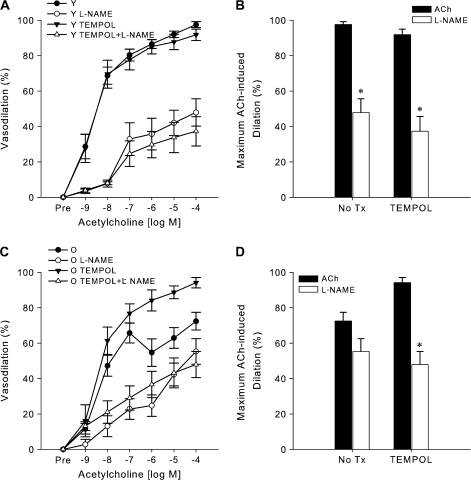
Reducing superoxide (oxidative stress) restores endothelium-dependent dilation in carotid arteries of older B6D2F1 mice by improving nitric oxide (NO) bioavailability. Dose–response dilations of carotid arteries to acetylcholine (ACh) in the absence (n = 10 per group) or presence (n = 7 per group) of the NO synthase inhibitor NG-nitro-l-arginine methyl ester (l-NAME) and/or the superoxide dismutase mimetic TEMPOL in (A) young (Y) and (C) older (O) mice. Maximal dilation to ACh in the carotid arteries of (B) young and (D) older mice following either no treatment (No Tx: n = 10 per group) or pretreatment (n = 7 per group) with TEMPOL in the absence or presence of l-NAME. Asterisk denotes significant (p < .05) differences in maximal dilation following l-NAME inhibition (p < .05).
Figure 6.
Figure 6.
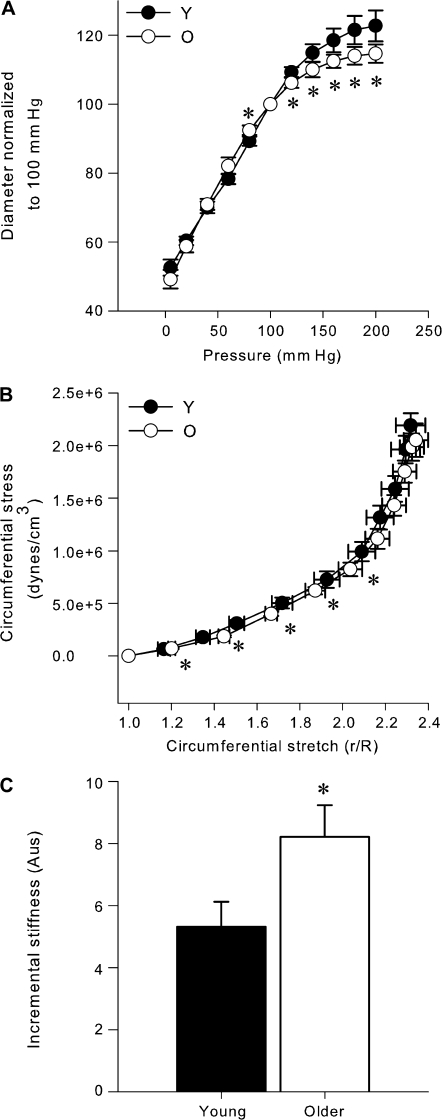
Increased stiffness in isolated carotid arteries of older B6D2F1 mice. (A) Passive pressure–diameter relations in isolated carotid arteries from young (Y: n = 10) and older (O: n = 10) mice. There was a significant (p < .05) interaction between group and pressure. Asterisk denotes significant (p < .05) differences between age groups at given pressures. (B) The circumferential stress and stretch calculated from the pressure–diameter relations (n = 10 per group). There was a significant (p < .05) interaction between group and pressure for circumferential stretch. Asterisk denotes significant (p < .05) differences in stretch between age groups at particular pressures. No significant differences were found for circumferential stress. (C) Incremental stiffness is greater in older B6D2F1 mice compared with young mice (n = 10 per group). Asterisk denotes significant differences (p < .05).

References

    1. Bonetti PO, Lerman LO, Lerman A. Endothelial dysfunction: a marker of atherosclerotic risk. Arterioscler Thromb Vasc Biol. 2003;23:168–175. - PubMed
    1. Vita JA, Keaney JF., Jr Endothelial function: a barometer for cardiovascular risk? Circulation. 2002;106:640–642. - PubMed
    1. Widlansky ME, Gokce N, Keaney JF, Jr, Vita JA. The clinical implications of endothelial dysfunction. J Am Coll Cardiol. 2003;42:1149–1160. - PubMed
    1. Yeboah J, Crouse JR, Hsu FC, Burke GL, Herrington DM. Brachial flow-mediated dilation predicts incident cardiovascular events in older adults: the Cardiovascular Health Study. Circulation. 2007;115:2390–2397. - PubMed
    1. Eskurza I, Monahan KD, Robinson JA, Seals DR. Effect of acute and chronic ascorbic acid on flow-mediated dilatation with sedentary and physically active human ageing. J Physiol. 2004;556:315–324. - PMC - PubMed

Publication types

MeSH terms