Elevated tricuspid regurgitant jet velocity in children and adolescents with sickle cell disease: association with hemolysis and hemoglobin oxygen desaturation
- PMID: 19211639
- PMCID: PMC2649356
- DOI: 10.3324/haematol.13812
Elevated tricuspid regurgitant jet velocity in children and adolescents with sickle cell disease: association with hemolysis and hemoglobin oxygen desaturation
Abstract
Background: Elevation of echocardiography-determined tricuspid regurgitant jet velocity predicts high systolic pulmonary artery pressure and early mortality in adults with sickle cell disease. The definition, prevalence and clinical correlates of elevated jet velocity have not been established in pediatric patients. The present study tested the hypotheses that elevated jet velocity affects 10% of pediatric patients, is associated with both hemolysis and hypoxia, and has clinical correlates with acute chest syndrome, stroke, transfusion requirement and abnormal 6-minute walk test results.
Design and methods: A prospective multicenter study of 310 patients aged 3-20 years old with sickle cell disease under basal conditions and 54 matched controls was conducted. A hemolytic index was generated by principal component analysis of the levels of lactate dehydrogenase, aspartate aminotransferase and bilirubin and reticulocyte count.
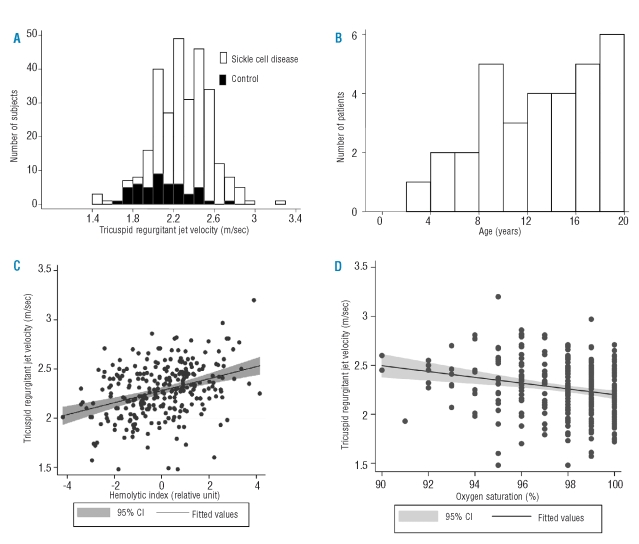
Results: Elevated jet velocity (defined as > or =2.60 m/sec based on the mean+/-2 SD in controls) occurred in 32 patients (11.0%) including one child of 3 years old. After adjustment for hemoglobin concentration, systolic blood pressure and left ventricular diastolic function, a 2 SD increase in the hemolytic index was associated with a 4.5-fold increase in the odds of elevated jet velocity (p=0.009) and oxygen saturation < or =98% with a 3.2-fold increase (p=0.028). Two or more episodes of acute chest syndrome had occurred in 28% of children with elevated jet velocity compared to in 13% of other children (p=0.012), more than ten units of blood had been transfused in 39% versus 18% (p=0.017) and stroke had occurred in 19% versus 11% (p=0.2). The distance walked in 6-minute walk tests did not differ significantly, but oxygen saturation declined during the tests in 68% of children with elevated jet velocity compared to in 32% of other children (p=0.0002).
Conclusions: According to a pediatric-specific definition the prevalence of elevated jet velocity in this population of young patients with sickle cell disease was 11%. The study provides evidence for independent associations of elevated jet velocity with hemolysis and oxygen desaturation. Further investigations should address whether elevated jet velocity may indicate future complications and whether early intervention is beneficial.
Figures
References
-
- Gladwin MT, Sachdev V, Jison ML, Shizukuda Y, Plehn JF, Minter K, et al. Pulmonary hypertension as a risk factor for death in patients with sickle cell disease. N Engl J Med. 2004;350:886–95. - PubMed
-
- Ataga KI, Sood N, De Gent G, Kelly E, Henderson AG, Jones S, et al. Pulmonary hypertension in sickle cell disease. Am J Med. 2004;117:665–9. - PubMed
-
- Castro O, Gladwin MT. Pulmonary hypertension in sickle cell disease: mechanisms, diagnosis, and management. Hematol Oncol Clin North Am. 2005;19:881–96. - PubMed
-
- Ataga KI, Moore CG, Jones S, Olajide O, Strayhorn D, Hinderliter A, et al. Pulmonary hypertension in patients with sickle cell disease: a longitudinal study. Br J Haematol. 2006;134:109–15. - PubMed
-
- De Castro LM, Jonassaint JC, Graham FL, Ashley-Koch A, Telen MJ. Pulmonary hypertension associated with sickle cell disease: clinical and laboratory endpoints and disease outcomes. Am J Hematol. 2008;83:19–25. - PubMed
Publication types
MeSH terms
Substances
Grants and funding
LinkOut - more resources
Full Text Sources
Medical
Molecular Biology Databases