. 2009 Mar 3;106(9):3408-13.
doi: 10.1073/pnas.0805323106. Epub 2009 Feb 11.

TRPA1 regulates gastrointestinal motility through serotonin release from enterochromaffin cells

Affiliations

TRPA1 regulates gastrointestinal motility through serotonin release from enterochromaffin cells

Katsura Nozawa et al. Proc Natl Acad Sci U S A. .

Abstract

Serotonin (5-hydroxytryptamine; 5-HT) is abundantly present throughout the gastrointestinal tract and stored mostly in enterochromaffin (EC) cells, which are located on the mucosal surface. 5-HT released from EC cells stimulate both intrinsic and extrinsic nerves, which results in various physiological and pathophysiological responses, such as gastrointestinal contractions. EC cells are believed to have the ability to respond to the chemical composition of the luminal contents of the gut; however, the underlying molecular and cellular mechanisms have not been identified. Here, we demonstrate that the transient receptor potential (TRP) cation channel TRPA1, which is activated by pungent compounds or cold temperature, is highly expressed in EC cells. We also found that TRPA1 agonists, including allyl isothiocyanate and cinnamaldehyde, stimulate EC cell functions, such as increasing intracellular Ca(2+) levels and 5-HT release, by using highly concentrated EC cell fractions and a model of EC cell function, the RIN14B cell line. Furthermore, we showed that allyl isothiocyanate promotes the contraction of isolated guinea pig ileum via the 5-HT(3) receptor. Taken together, our results indicate that TRPA1 acts as a sensor molecule for EC cells and may regulate gastrointestinal function.


Conflict of interest statement

The authors declare no conflict of interest.

Figures
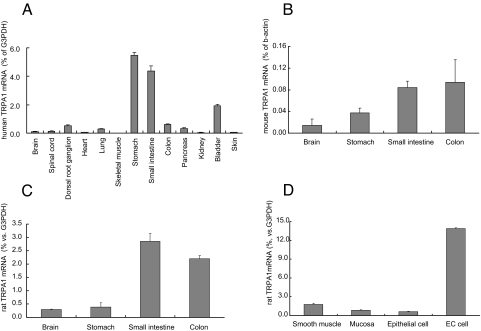
Fig. 1.
Fig. 1.
Distribution of transient receptor potential cation channel A1(TRPA1) mRNA in human (A), mouse (B), and rat (C) tissues, and localization in rat small intestine (D). Data represent the ratio of TRPA1 to glyceraldehyde-3-phosphate dehydrogenase (G3PDH) or β-actin mRNA. Smooth muscle, smooth muscle layer; mucosa, mucosal layer; epithelial cell, isolated epithelial cell fraction; EC cell, enriched EC cell fraction. Data represent the mean ± S.D. (n = 3).
Fig. 2.
Fig. 2.
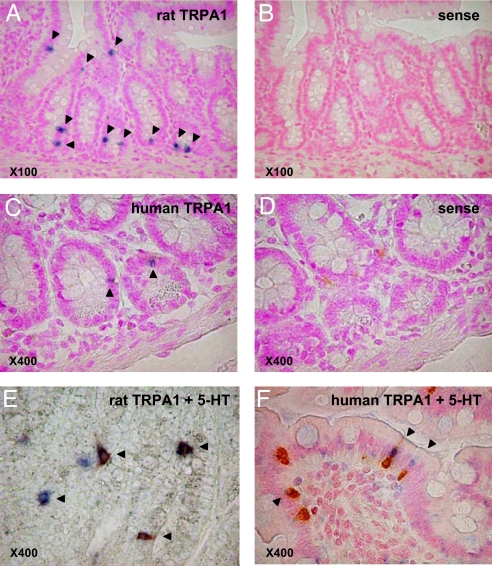
In situ hybridization (ISH) of TRPA1 mRNA in rats (A and B) and humans (C and D), as well as ISH combined with 5-HT antibody immunohistochemistry (IHC) in rats (E) and humans (F) using duodenal tissues. TRPA1 staining was restricted to epithelial cells facing the intestinal lumen in both rats and humans (arrows in A and C). No sense probes were stained (B and D). Many TRPA1-expressing cells (blue) were double-stained with the 5-HT antibody (brown) (E and F; arrow heads).
Fig. 3.
Fig. 3.
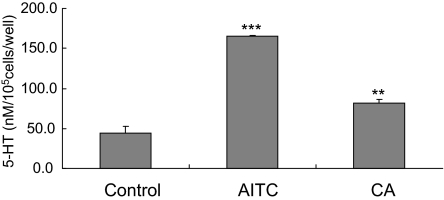
The release of 5-HT from rat enriched small intestine EC cell fractions induced by TRPA1 agonists. AITC (500 μM) and CA (500 μM) stimulated the release of 5-HT. Data represent the mean ± S.D. (n = 3). **, P < 0.01; ***, P < 0.001 vs. control group (Dunnett's t test).
Fig. 4.
Fig. 4.
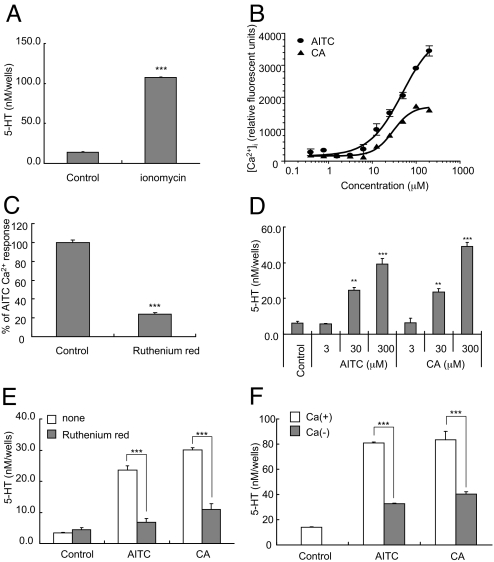
Stimulated 5-HT release and intracellular Ca2+ in RIN14B cells. Ionomycin (10 μM) induced the release of 5-HT from RIN14B cells (A). The dose-response curves of TRPA1 agonist-induced increase in [Ca2+]i in RIN14B cells (B). Blockade of the AITC (30 μM)-evoked increase in [Ca2+]i induced by ruthenium red (3 μM) in RIN14B cells (C). TRPA1 agonist-induced release of 5-HT from RIN14B cells (D). Effects of the TRPA1 inhibitor ruthenium red (30 μM) on the AITC (300 μM)- or CA (300 μM)-induced 5-HT release from RIN14B cells (E). Role of Ca2+ in the TRPA1 agonist-induced release of 5-HT from RIN14B cells (F). The cells were stimulated by AITC (300 μM) or CA (300 μM) in HBSS (open column) and Ca2+-free HBSS (solid column). All data represent the mean ± S.D. (n = 3). **, P < 0.01; ***, P < 0.001 vs. control group (Dunnett's test for D and Student's t test for A, C, E, and F).
Fig. 5.
Fig. 5.
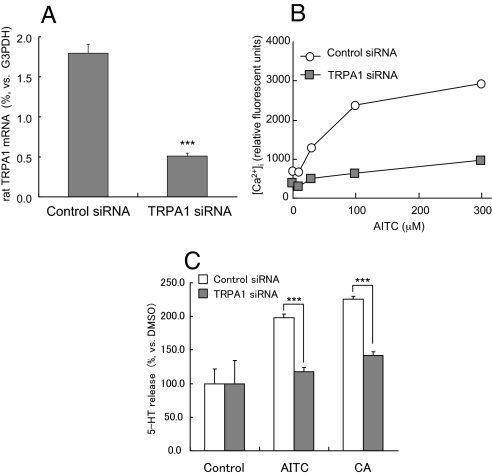
Analyses for TRPA1 agonist-induced 5-HT release mechanisms using TRPA1-specific siRNA. Effects of siRNA on either TRPA1 mRNA expression (A) or TRPA1 agonist-induced [Ca2+]i (B) in RIN14B cells. (C) Effects of siRNA on TRPA1 agonist-induced 5-HT released from RIN14B cells. Three to 5 independent experiments were performed and typical results are shown, respectively. Data represent the mean (B) or the mean ± S.D. (n = 3) (A and C), respectively. ***, P < 0.001 vs. control group (Student's t test).
Fig. 6.
Fig. 6.
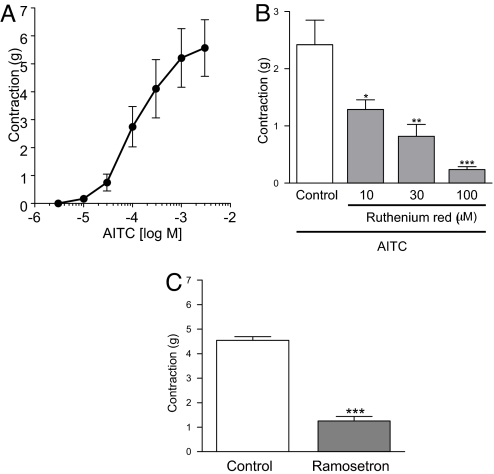
Contractile effect of AITC in guinea pig-isolated ileum. AITC dose-dependently induced contractions (A). Effect of ruthenium red (10–100 μM) (B) and ramosetron (0.3 μM) (C) on the contractile responses to AITC (300 μM). Data represent the means ± S.E. of 4 experiments. *, P < 0.05; **, P < 0.01; ***, P < 0.001 vs. control group (Dunnett's test for B and Student's t test for C).

References

    1. Dockray GJ. Luminal sensing in the gut: an overview. J Physiol Pharmacol. 2003;54(Suppl 4):9–17. - PubMed
    1. Sundler F, Bottcher G, Ekblad E, Hakanson R. The neuroendocrine system of the gastrointestinal tract. Nord Med. 1988;103:8–11. - PubMed
    1. Gershon MD, Tack J. The serotonin signaling system: from basic understanding to drug development for functional GI disorders. Gastroenterology. 2007;132:397–414. - PubMed
    1. Rindi G, Leiter AB, Kopin AS, Bordi C, Solcia E. The “normal” endocrine cell of the gut: changing concepts and new evidences. Ann N Y Acad Sci. 2004;1014:1–12. - PubMed
    1. Gershon MD. Plasticity in serotonin control mechanisms in the gut. Curr Opin Pharmacol. 2003;3:600–607. - PubMed

MeSH terms

LinkOut - more resources