


The relationship between cerebral hemisphere volume and receptive language functioning in dyslexia and attention-deficit hyperactivity disorder (ADHD)
- PMID: 19211921
- PMCID: PMC2664863
- DOI: 10.1177/0883073808324772
The relationship between cerebral hemisphere volume and receptive language functioning in dyslexia and attention-deficit hyperactivity disorder (ADHD)
Abstract
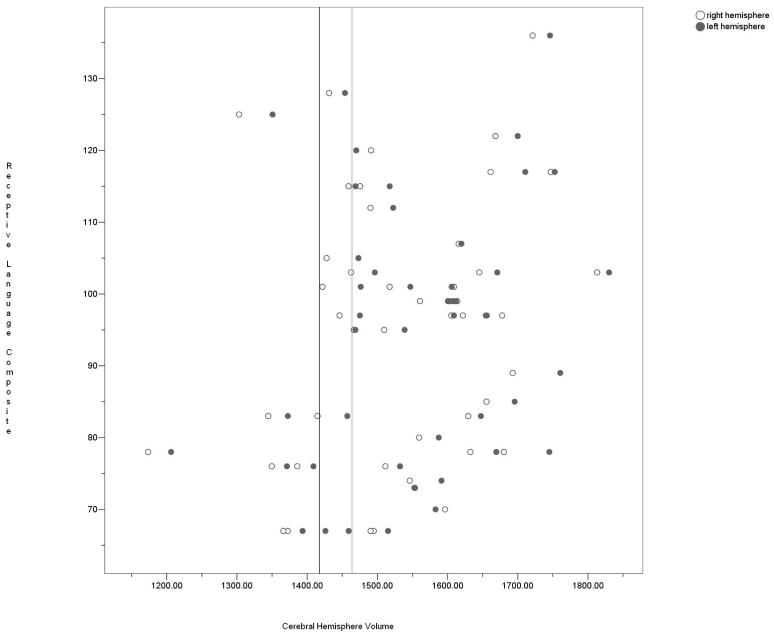
Because poor comprehension has been associated with small cerebral volume and there is a high comorbidity between developmental dyslexia, attention-deficit hyperactivity disorder (ADHD), and specific language impairment, the goal of this study was to determine whether cerebral volume is reduced in dyslexia and attention-deficit hyperactivity disorder in general, as some suggest, or whether the reduction in volume corresponds to poor receptive language functioning, regardless of the diagnosis. Participants included 46 children with and without dyslexia and attention-deficit hyperactivity disorder, aged 8 to 12 years. Our results indicated that cerebral volume was comparable between those with and without dyslexia and attention-deficit hyperactivity disorder overall. However, when groups were further divided into those with and without receptive language difficulties, children with poor receptive language had smaller volumes bilaterally as hypothesized. Nonetheless, the relationship between cerebral volume and receptive language was not linear; rather, our results suggest that small volume is associated with poor receptive language only in those with the smallest volumes in both dyslexia and attention-deficit hyperactivity disorder.
Figures
References
-
- Riccio CA, Hynd GW. Developmental language disorders in children: Relationship with learning disability and Attention Deficit Hyperacitivity Disorder. School Psychology Review. 1993;22:696–709.
-
- Preis S, Steinmetz H, Knorr U, Jancke L. Corpus callosum size in children with developmental language disorder. Cognitive Brain Research. 2000;10:37–44. - PubMed
-
- Herbert MR, Ziegler DA, Makris N, et al. Larger brain and white matter volumes in children with developmental language disorder. Developmental Science. 2003;6:F11–F22.
-
- Ahmed ST, Lombardino LJ, Leonard CM. Specific language impairment: Definitions, causal mechanisms and neurobiological factors. Journal of Medical Speech-Language Pathology. 2001;9:1–15.
-
- Aram DM, Eisele JA. Limits to a left hemisphere explanation for specific language impairment. Journal of Speech And Hearing Research. 1994;37:824–830. - PubMed
Publication types
MeSH terms
Grants and funding
LinkOut - more resources
Full Text Sources
Medical
