


High worry severity is associated with poorer acute and maintenance efficacy of antidepressants in late-life depression
- PMID: 19212971
- PMCID: PMC2680149
- DOI: 10.1002/da.20544
High worry severity is associated with poorer acute and maintenance efficacy of antidepressants in late-life depression
Abstract
Background: Co-morbid anxiety symptoms are common in late-life depression (LLD) and predict poorer treatment outcomes. No research has delineated the impact of different dimensions of anxiety (such as worry/anxious apprehension and panic/anxious arousal) on treatment response in LLD. We explored the impact of the dimensions of worry and panic on acute and maintenance treatment outcomes in LLD.
Methods: We measured anxiety symptoms in 170 LLD subjects receiving protocolized treatment. Exploratory principal component analysis was used to delineate dimensions of anxiety symptoms. We defined sub-groups based on factor scores. We used survival analysis to test the association of pretreatment anxiety dimensions with time to response and time to recurrence of LLD.
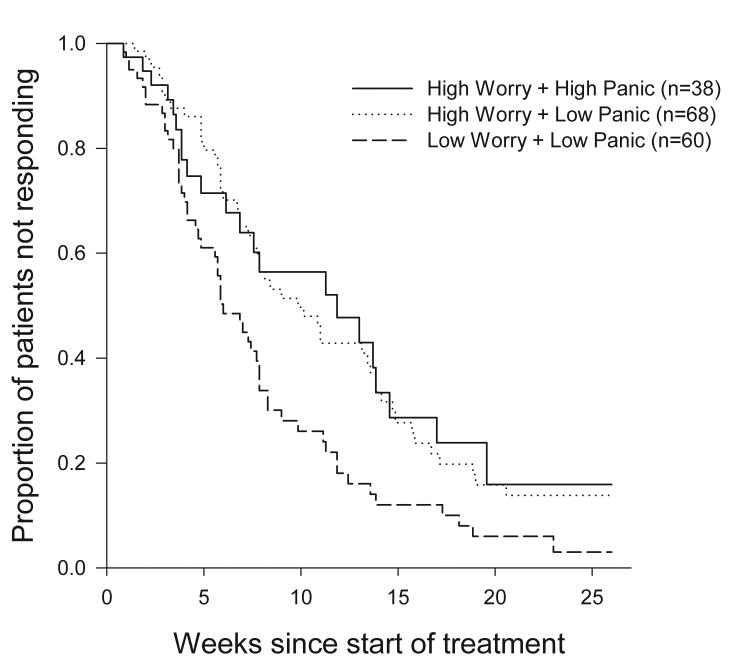
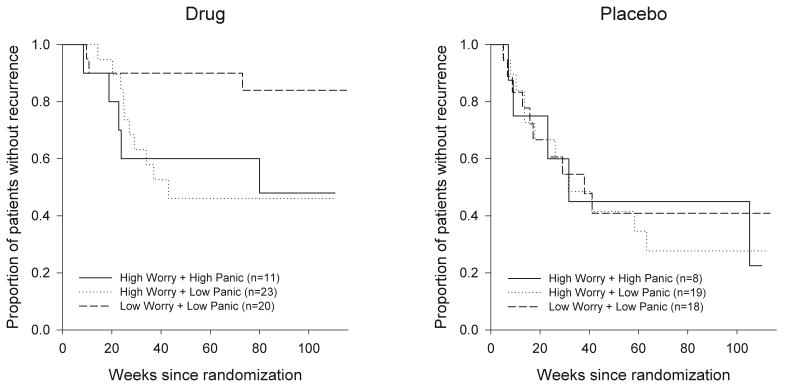
Results: The principal component analysis found two factors: "worry" and "panic." Three sub-groups were defined: low panic-low worry, low panic-high worry, and high panic-high worry. The low panic-high worry and high panic-high worry sub-groups had longer time to response than the low panic-low worry sub-group. Time to recurrence was longer in low panic-low worry subjects randomized to drug. Among subjects with high worry, there was no difference between those with low versus high panic regarding both time to response and time to recurrence of LLD.
Conclusion: High levels of worry were associated with longer time to response and earlier recurrence with pharmacotherapy for LLD. There was no additional effect of panic symptoms on treatment outcomes when accounting for the effects of excessive worry. These results suggest that worry symptoms should be a focus of strategies to improve acute and maintenance treatment response in LLD.
(c) 2009 Wiley-Liss, Inc.
Conflict of interest statement
Conflict of Interest: Carmen Andreescu and Amy Begley have no conflict of interest to report. Eric J. Lenze has received research support from OrthoMcNeill, Novartis and Forest Pharmaceuticals. Benoit H. Mulsant has received research support or honoraria from Astra-Zeneca, Bristol-Myers Squibb, Eli Lilly, Forest Laboratories, GlaxoSmithKline, Janssen, Lundbeck, and Pfizer; he holds stock (all less than $10,000) in Akzo-Nobel, Alkermes, AstraZeneca, Biogen Idec, Celsion, Elan, Eli Lilly, Forest and Orchestra Therapeutics. Dr. Wetherell has received research support from Forest Pharmaceuticals. Sati Mazumdar directly purchased stocks from Forest (less than $10,000). Charles F. Reynolds III has received pharmaceutical supplies for his NIH-sponsored research from GlaxoSmithKline, Pfizer Inc., Eli Lilly and Co., Bristol Meyers Squibb, Wyeth Pharmaceuticals and Forest Pharmaceuticals.
Figures
References
-
- Beekman AT, de Beurs E, van Balkom AJ, Deeg DJ, van Dyck R, van Tilburg W. Anxiety and depression in later life: Co-occurrence and communality of risk factors. Am J Psychiatry. 2000;157(1):89–95. - PubMed
-
- Larkin BA, Copeland JR, Dewey ME, Davidson IA, Saunders PA, Sharma VK, et al. The natural history of neurotic disorder in an elderly urban population. Findings from the Liverpool longitudinal study of continuing health in the community. Br J Psychiatry. 1992;160:681–6. - PubMed
-
- Fawcett J. The detection and consequences of anxiety in clinical depression. J Clin Psychiatry. 1997;58 Suppl 8:35–40. - PubMed
-
- Flint AJ, Rifat SL. Anxious depression in elderly patients. Response to antidepressant treatment. Am J Geriatr Psychiatry. 1997;5(2):107–15. - PubMed
-
- Steffens DC, McQuoid DR. Impact of symptoms of generalized anxiety disorder on the course of late-life depression. Am J Geriatr Psychiatry. 2005;13(1):40–7. - PubMed
