


Total water intakes of community-living middle-old and oldest-old adults
- PMID: 19213852
- PMCID: PMC2657166
- DOI: 10.1093/gerona/gln045
Total water intakes of community-living middle-old and oldest-old adults
Abstract
Background: Literature reporting total daily water intake of community-dwelling older adults is limited. We evaluated differences in total water intake, water sources, water from meal and snack beverages, timing of beverage consumption, and beverage selection for three older age groups (young-old, 65-74 years; middle-old, 75-84 years; and oldest-old, >or=85 years).
Methods: Data for 2,054 older adults from the 1999-2002 National Health and Nutrition Examination Survey were used for this study. Multivariate analyses controlling for age, sex, race-ethnicity, education, and marital status were conducted to determine differences in water intake variables across the age groups.
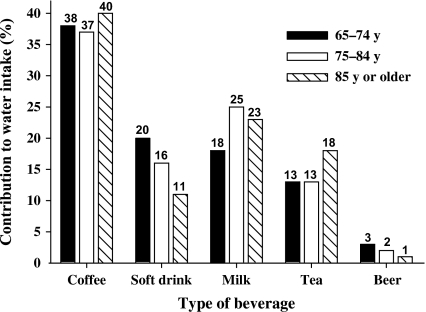
Results: Total water intakes found for the middle-old and oldest-old age groups were significantly lower than those found for the young-old age group. The relative contributions of beverages to total water intake were 40.8%, 38.3%, and 36.4% for the young-old, middle-old, and oldest-old, respectively. The water intakes from beverages consumed at snack occasions were significantly lower for the middle-old and oldest-old groups than those for the young-old group. All groups consumed the greatest amount of water in the morning. Coffee was the predominant source of water from beverages for all groups.
Conclusions: This study fills a gap in the literature by providing an analysis of the daily water intake of middle-old and oldest-old adults. We found that the total water intake for the middle-old and oldest-old was significantly lower than that for the young-old. Future research needs to investigate the clinical outcomes associated with declining water intakes of community-dwelling older adults.
Figures
References
-
- Negoianu D, Goldfarb S. Just add water. J Am Soc Nephrol. 2008;19:1–3. - PubMed
-
- Otten JJ, Hellwig JP, Meyers LD. Dietary Reference Intakes: The Essential Guide to Nutrient Requirements. Washington, DC: The National Academies Press; 2006.
-
- Volkert D, Kreuel K, Stehle P. Fluid intake of community-living, independent elderly in Germany—a nationwide, representative study. J Nutr Health Aging. 2005;9:305–309. - PubMed
-
- Rolls BJ. Regulation of food and fluid intake in the elderly. Ann N Y Acad Sci. 1989;561:217–225. - PubMed
-
- Stookey JD, Pieper CF, Cohen HJ. Is the prevalence of dehydration among community-dwelling older adults really low? Informing current debate over the fluid recommendation for adults aged 70+ years. Public Health Nutr. 2005;8:1275–1285. - PubMed
Publication types
MeSH terms
LinkOut - more resources
Full Text Sources
Medical
Miscellaneous
