. 2009 Feb;5(2):e1000381.
doi: 10.1371/journal.pgen.1000381. Epub 2009 Feb 13.

Sporadic infantile epileptic encephalopathy caused by mutations in PCDH19 resembles Dravet syndrome but mainly affects females

Affiliations

Sporadic infantile epileptic encephalopathy caused by mutations in PCDH19 resembles Dravet syndrome but mainly affects females

Christel Depienne et al. PLoS Genet. 2009 Feb.

Erratum in

Abstract

Dravet syndrome (DS) is a genetically determined epileptic encephalopathy mainly caused by de novo mutations in the SCN1A gene. Since 2003, we have performed molecular analyses in a large series of patients with DS, 27% of whom were negative for mutations or rearrangements in SCN1A. In order to identify new genes responsible for the disorder in the SCN1A-negative patients, 41 probands were screened for micro-rearrangements with Illumina high-density SNP microarrays. A hemizygous deletion on chromosome Xq22.1, encompassing the PCDH19 gene, was found in one male patient. To confirm that PCDH19 is responsible for a Dravet-like syndrome, we sequenced its coding region in 73 additional SCN1A-negative patients. Nine different point mutations (four missense and five truncating mutations) were identified in 11 unrelated female patients. In addition, we demonstrated that the fibroblasts of our male patient were mosaic for the PCDH19 deletion. Patients with PCDH19 and SCN1A mutations had very similar clinical features including the association of early febrile and afebrile seizures, seizures occurring in clusters, developmental and language delays, behavioural disturbances, and cognitive regression. There were, however, slight but constant differences in the evolution of the patients, including fewer polymorphic seizures (in particular rare myoclonic jerks and atypical absences) in those with PCDH19 mutations. These results suggest that PCDH19 plays a major role in epileptic encephalopathies, with a clinical spectrum overlapping that of DS. This disorder mainly affects females. The identification of an affected mosaic male strongly supports the hypothesis that cellular interference is the pathogenic mechanism.


Conflict of interest statement

The authors have declared that no competing interests exist.

Figures
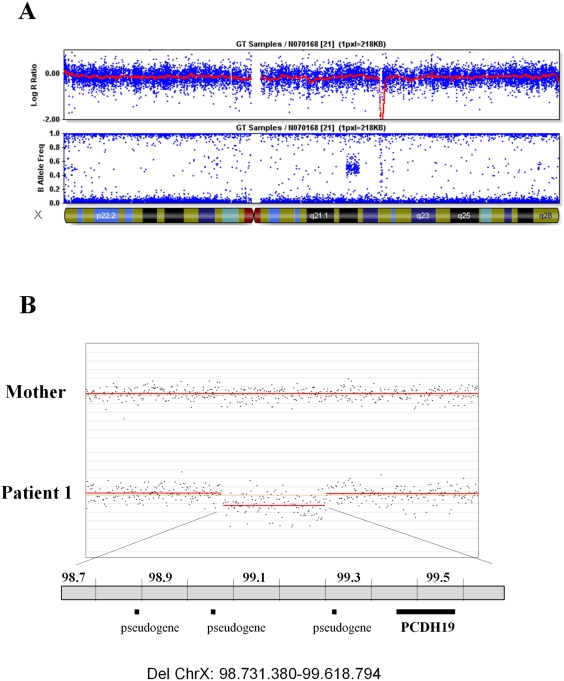
Figure 1
Figure 1. Identification of a deletion encompassing PCDH19 in a male patient.
A) Identification of a hemizygous Xq22.1 deletion with a 370 K SNP microarray (Illumina): Y-axes represent Log R ratio (above) and B allele frequency (below); the X-axis indicates the position on the X chromosome. The red line (log R ratio profile) corresponds to the median smoothing series (Beadstudio). B) Analysis of the patient and his mother with CGH microarrays (Nimblegen), showing that the deletion occurred de novo. Indicated genomic positions are based upon the Ensembl Genome Browser. Black horizontal bars (below) represent the gene (PCDH19) and pseudogenes comprised in the deleted region.
Figure 2
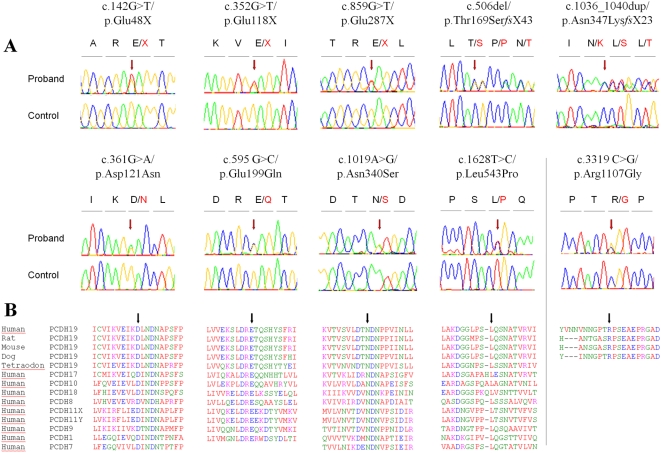
Figure 2. Detection of 9 different point mutations of PCDH19 in 11 female patients by direct sequencing.
A) Sequence electropherograms of the mutations and the missense variant (c.3319C>G/p.Arg1107Gly) identified in association with the c.859G>T/p.Glu287X nonsense mutation. The mutation nomenclature is based on the PCDH19 transcript reference EF676096. Nucleotides are numbered according to the cDNA with +1 corresponding to the A of the ATG translation initiation codon in the reference sequence, according to the journal guidelines (www.hgvs.org/mutnomen). B) Alignment of the regions surrounding the mutations (indicated by an arrow) in orthologous and paralogous proteins, showing the high conservation of each affected amino-acid in vertebrates and in the delta protocadherin paralogous genes.
Figure 3
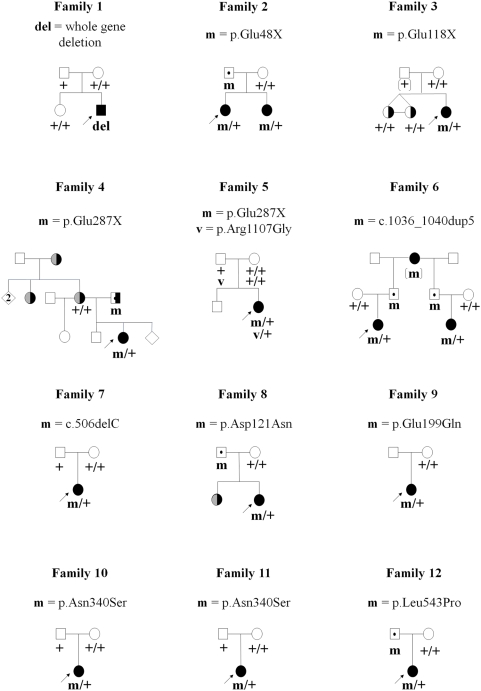
Figure 3. Pedigrees of the families and segregation analysis of the PCDH19 deletion and point mutations.
del/+, m/+ or v/+ denote individuals heterozygous for the deletion, mutation or variant, respectively; +/+ denotes individuals carrying homozygous wild-type alleles. Squares represent males, circles females; filled black symbols: patients diagnosed as having Dravet syndrome; right black half: Cognitive delay or impairment; left grey half: adolescence-onset idiopathic epilepsy. Dots in the middle of the squares indicate unaffected mutation carriers. The arrows indicate the index cases.
Figure 4
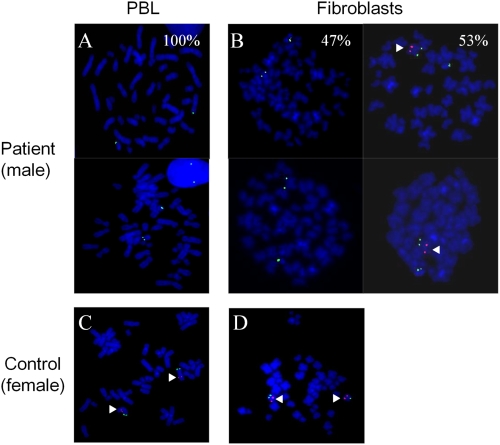
Figure 4. FISH analysis of the PCDH19 deletion in the male patient showing somatic mosaicism in fibroblasts.
(A) Absence of the specific Xq22.1 probe site on metaphase chromosomes in peripheral blood lymphocytes (PBL); (B) In fibroblasts, presence of one hybridization spot in 53% of the cells and absence of signal in the remaining 47%; C) and D) FISH analysis on PBL (C) and fibroblasts (D) of a female control. PCDH19-specific signals (red) are indicated by arrowheads. Magnification ×1000.
Figure 5
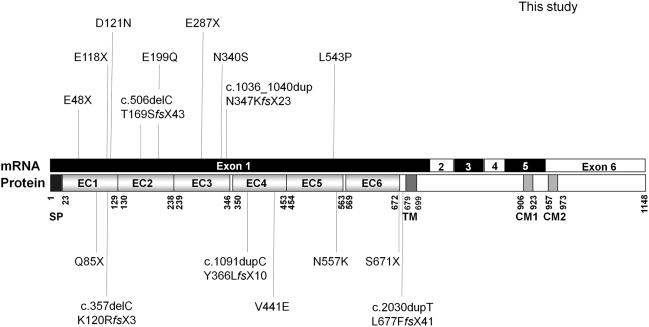
Figure 5. Schematic representation of the point mutations identified in the PCDH19 gene.
Above: mutations identified in this study; Below: mutations identified by Dibbens et al. (2008). SP: signal peptide; EC: extracellular cadherin domain; TM: transmembrane domain; CM1 and CM2: cytoplasmic domains 1 and 2.
Figure 6
Figure 6. Schematic illustration of the cellular interference mechanism associated with PCDH19 mutations.
A) In normal individuals, characterized by a homogeneous population of PCDH19-positive cells, neurons are able to form normal neuronal networks; B) In mutated male patients, hemizygosity leads to a homogeneous population of PCDH19-negative cells; in this condition, neurons preserve the ability to form normal neuronal networks; C) In heterozygous mutated females, random X inactivation leads to the co-existence of two PCDH19-positive and PCDH19-negative cell populations. These two cell populations cause divergent cell sorting and migration (due to attractive or repulsive interactions) and lead to abnormal neuronal networks. Somatic mosaicism in mutated males gives rise to the same pathological situation. The precise mechanisms by which the neuronal networks are altered are still unknown.

References

    1. Claes L, Del-Favero J, Ceulemans B, Lagae L, Van Broeckhoven C, et al. De novo mutations in the sodium-channel gene SCN1A cause severe myoclonic epilepsy of infancy. Am J Hum Genet. 2001;68:1327–1332. - PMC - PubMed
    1. Weaving LS, Christodoulou J, Williamson SL, Friend KL, McKenzie OL, et al. Mutations of CDKL5 cause a severe neurodevelopmental disorder with infantile spasms and mental retardation. Am J Hum Genet. 2004;75:1079–1093. - PMC - PubMed
    1. Tao J, Van Esch H, Hagedorn-Greiwe M, Hoffmann K, Moser B, et al. Mutations in the X-linked cyclin-dependent kinase-like 5 (CDKL5/STK9) gene are associated with severe neurodevelopmental retardation. Am J Hum Genet. 2004;75:1149–1154. - PMC - PubMed
    1. Stromme P, Mangelsdorf ME, Shaw MA, Lower KM, Lewis SM, et al. Mutations in the human ortholog of Aristaless cause X-linked mental retardation and epilepsy. Nat Genet. 2002;30:441–445. - PubMed
    1. Roll P, Rudolf G, Pereira S, Royer B, Scheffer IE, et al. SRPX2 mutations in disorders of language cortex and cognition. Hum Mol Genet. 2006;15:1195–1207. - PubMed

Publication types

LinkOut - more resources