. 2009 Feb;5(2):e1000300.
doi: 10.1371/journal.ppat.1000300. Epub 2009 Feb 13.

Species-specific activity of HIV-1 Vpu and positive selection of tetherin transmembrane domain variants

Affiliations

Species-specific activity of HIV-1 Vpu and positive selection of tetherin transmembrane domain variants

Matthew W McNatt et al. PLoS Pathog. 2009 Feb.

Abstract

Tetherin/BST-2/CD317 is a recently identified antiviral protein that blocks the release of nascent retrovirus, and other virus, particles from infected cells. An HIV-1 accessory protein, Vpu, acts as an antagonist of tetherin. Here, we show that positive selection is evident in primate tetherin sequences and that HIV-1 Vpu appears to have specifically adapted to antagonize variants of tetherin found in humans and chimpanzees. Tetherin variants found in rhesus macaques (rh), African green monkeys (agm) and mice were able to inhibit HIV-1 particle release, but were resistant to antagonism by HIV-1 Vpu. Notably, reciprocal exchange of transmembrane domains between human and monkey tetherins conferred sensitivity and resistance to Vpu, identifying this protein domain as a critical determinant of Vpu function. Indeed, differences between hu-tetherin and rh-tetherin at several positions in the transmembrane domain affected sensitivity to antagonism by Vpu. Two alterations in the hu-tetherin transmembrane domain, that correspond to differences found in rh- and agm-tetherin proteins, were sufficient to render hu-tetherin completely resistant to HIV-1 Vpu. Interestingly, transmembrane and cytoplasmic domain sequences in primate tetherins exhibit variation at numerous codons that is likely the result of positive selection, and some of these changes coincide with determinants of HIV-1 Vpu sensitivity. Overall, these data indicate that tetherin could impose a barrier to viral zoonosis as a consequence of positive selection that has been driven by ancient viral antagonists, and that the HIV-1 Vpu protein has specialized to target the transmembrane domains found in human/chimpanzee tetherin proteins.


Conflict of interest statement

The authors have declared that no competing interests exist.

Figures

Figure 1
Figure 1. Effect of nonhuman tetherins on HIV-1 particle release and antagonism by Vpu.
A, B) Western blot analysis (anti HIV-1 capsid, p24) of cell and virion lysates following transfection of cells with WT and Vpu deleted (delVpu) proviral plasmids, alone (none) or in combination with 50 ng of the indicated human (hu) rhesus monkey (rh) African green monkey (agm) tetherin-HA expression plasmids (A) or 50 ng of hu- or mouse (mo) HA-tetherin expression plasmids (B). Numbers to the left of the blots indicate the positions of molecular weight markers. C) Infectious virion yield, measured using HeLa-TZM indicator cells and given in relative light units (RLU), following transfection of cells with WT and Vpu deleted (delVpu) proviral plasmids, in combination with varying amounts of the indicated tetherin-HA or HA-tetherin expression plasmids. D) Western blot analysis (anti HIV-1 capsid, p24) of cell and virion lysates following transfection of cells with WT and Vpu deleted (delVpu) proviral plasmids in combination with 100 ng of untagged human (hu) or chimpanzee (cpz) tetherin expression plasmids. Numbers to the left of the blots indicate the positions of molecular weight markers. E) Infectious virion yield, measured using HeLa-TZM indicator cells and given in relative light units (RLU), following transfection of cells with WT and Vpu deleted (delVpu) proviral plasmids, in combination with 100 ng of hu-tetherin or cpz-tetherin expression plasmids.
Figure 2
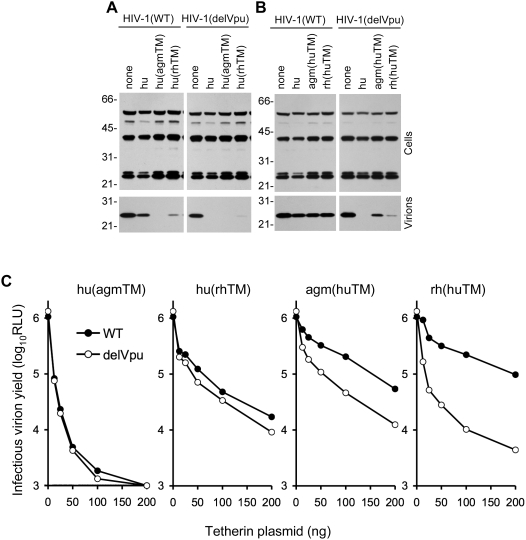
Figure 2. Tetherin TM domains are determinants of sensitivity/resistance to HIV-1 Vpu.
A, B) Western blot analysis (anti HIV-1 capsid, p24) of cell and virion lysates following transfection of cells with WT and Vpu deleted (delVpu) proviral plasmids, either alone (none) or in combination with 50 ng of plasmids expressing chimeric human tetherin-HA proteins encoding monkey-derived TM domains (A), or monkey tetherin-HA proteins encoding a human tetherin TM domain (B). C) Infectious virion yield, measured as in Fig. 1, following transfection of cells with WT and delVpu proviral plasmids, with varying amounts of the indicated tetherin-HA expression plasmids.
Figure 3
Figure 3. Effects of individual TM domain mutations on tetherin potency and Vpu antagonism.
A) Differences between hu- and rh-tetherin TM domains. The human (left) and rhesus (right) sequences are depicted, from the cytoplasmic face (lower) to the extracellular face (upper) of the plasma membrane; an integrin beta3 transmembrane segment was used to model the position of the differences. B) Western blot analysis (anti HIV-1 capsid, p24) of cell and virion lysates following transfection of cells with WT and Vpu deleted (delVpu) proviral plasmids, alone (none) or in combination with 50 ng of the indicated unmanipulated or mutant hu-tetherin-HA expression plasmids. C) Infectious virion yield, measured as in Fig. 1, following transfection of cells with WT and Vpu deleted (delVpu) proviral plasmids, in combination with 50 ng of the indicated mutant hu-tetherin-HA expression plasmids. Numbers above each pair of bars indicate the fold difference in virion yield when WT and delVpu viruses are compared.
Figure 4
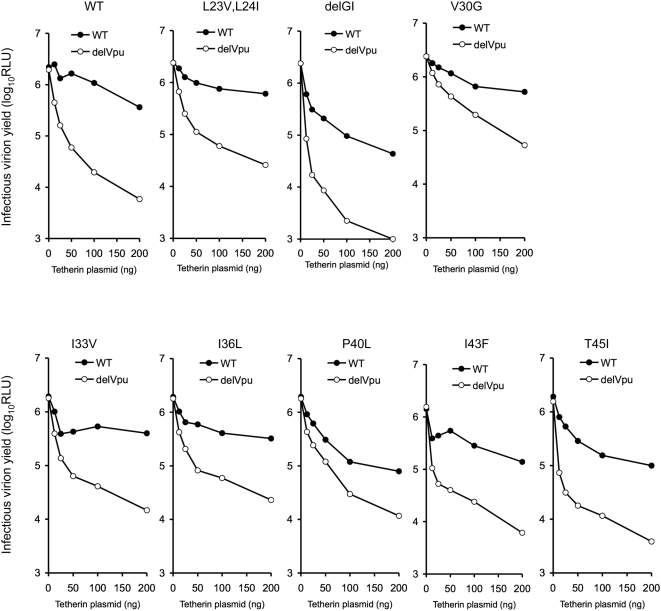
Figure 4. Effects of individual TM domain mutations on tetherin potency and Vpu antagonism.
Each chart shows infectious virion yield, measured as in Fig. 1, following transfection of cells with WT and Vpu deleted (delVpu) proviral plasmids, in combination with varying amounts of the indicated mutant hu-tetherin-HA expression plasmids.
Figure 5
Figure 5. Effects of combined TM domain mutations on tetherin potency and Vpu antagonism.
A) Western blot analysis (anti HIV-1 capsid, p24) of cell and virion lysates following transfection of cells with WT and Vpu deleted (delVpu) proviral plasmids, alone (none) or in combination with 50 ng of the indicated unmanipulated or mutant hu-tetherin-HA expression plasmids. B) Infectious virion yield, measured as in Fig. 1, following transfection of cells with WT and delVpu proviral plasmids, with varying amounts of the indicated mutant tetherin-HA expression plasmids.
Figure 6
Figure 6. A tetherin mutant that is resistant to antagonism by Vpu is also resistant to surface downregulation by Vpu.
A) 293T cells stably expressing either WT or mutant (delGI/T45I) hu-tetherin were infected with VSV-G pseudotyped HIV-1(WT) or HIV-1(delVpu) variants that carried Cerulean-FP (CFP, green), as indicated. Cells were fixed but not permeabilized in order to confine tetherin-HA staining to surface expressed protein (red). B) Cells were scored visually for the presence (tetherin +) or absence (tetherin −) of intense tetherin-HA staining on the cell's surface (see examples in panel (A)). Greater than 95% of the uninfected WT or delGI/T45I hu-tetherin-HA expressing cells exhibited intense surface tetherin-HA expression. At least seventy individual CFP-positive infected cells were evaluated for surface tetherin-HA expression each experimental condition.
Figure 7
Figure 7. Positive selection in primate tetherin sequences.
A diagram representing the various domains of the tetherin protein is shown, below plots of the dN/dS ratio (upper plot) and the Bayes factor for dN>dS (lower plot) at each codon in an alignment of primate tetherin coding sequences. Sequences from human, chimpanzee, gorilla, gibbon, African green monkey, pigtail macaque (2 variants), rhesus macaque (4 variants), long tail macaque (2 variants), sooty mangabey (2 variants), and marmoset were used in the analysis (see Fig. S2 for the codon alignment). Also indicated are residues in hu-tetherin that contribute to HIV-1 Vpu sensitivity.

References

    1. Samuel CE. Antiviral actions of interferons. Clin Microbiol Rev. 2001;14:778–809, table of contents. - PMC - PubMed
    1. Stetson DB, Medzhitov R. Type I interferons in host defense. Immunity. 2006;25:373–381. - PubMed
    1. Neil SJ, Sandrine V, Sundquist WI, bieniasz PD. An Interferon-alpha-Induced Tethering Mechanism Inhibits HIV-1 and Ebola Virus Particle Release but Is Counteracted by the HIV-1 Vpu Protein. Cell Host and Microbe. 2007;2:193–203. - PMC - PubMed
    1. Neil SJ, Zang T, Bieniasz PD. Tetherin inhibits retrovirus release and is antagonized by HIV-1 Vpu. Nature. 2008;451:425–430. - PubMed
    1. Van Damme N, Goff D, Katsura C, Jorgenson RL, Mitchell R, et al. The interferon-induced protein BST-2 restricts HIV-1 release and is downregulated from the cell surface by the viral Vpu protein. Cell Host Microbe. 2008;3:245–252. - PMC - PubMed

Publication types

MeSH terms

Substances