


Review
doi: 10.1186/jbiol110.
Epub 2009 Jan 23.
Happy together: genomic insights into the unique Nanoarchaeum/Ignicoccus association
Affiliations
- PMID: 19216728
- PMCID: PMC2656216
- DOI: 10.1186/jbiol110
Item in Clipboard
Review
Happy together: genomic insights into the unique Nanoarchaeum/Ignicoccus association
J Biol.
2009.
Abstract
The complete genome sequence of the crenarchaeon Ignicoccus hospitalis published recently in Genome Biology provides a great leap forward in the dissection of its unique association with another hyperthermophilic archaeon, Nanoarchaeum equitans.
Figures
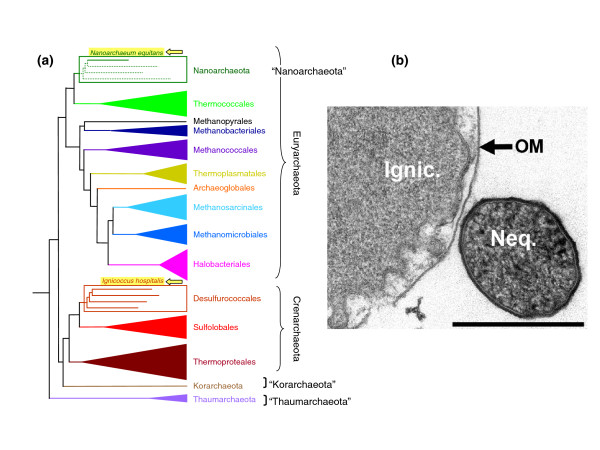
(a) Schematic diagram of archaeal phylogeny showing the evolutionary relationships between archaeal lineages for which completely sequenced genomes are available (updated from [12]). The positions of Ignicoccus hospitalis and Nanoarchaeum equitans are indicated by arrows. The position of N. equitans has been controversial [2,8], but the position suggested here has been recently supported by a specific synapomorphy (a derived character state shared by two or more groups) [13] and signature genes [14]. (b) Electron micrograph showing a cell of N. equitans attached to a cell of I. hospitalis. The scale bar is 100 nm. Courtesy of Dr Rachel Reinhard, Regensburg University. OM: outer membrane.
References
-
- Waters E, Hohn MJ, Ahel I, Graham DE, Adams MD, Barnstead M, Beeson KY, Bibbs L, Bolanos R, Keller M, Kretz K, Lin X, Mathur E, Ni J, Podar M, Richardson T, Sutton GG, Simon M, Soll D, Stetter KO, Short JM, Noordewier M. The genome of Nanoarchaeum equitans: insights into early archaeal evolution and derived parasitism. Proc Natl Acad Sci USA. 2003;100:12984–12988. doi: 10.1073/pnas.1735403100. - DOI - PMC - PubMed
-
- Podar M, Anderson I, Makarova KS, Elkins JG, Ivanova N, Wall MA, Lykidis A, Mavromatis K, Sun H, Hudson ME, Chen W, Deciu C, Hutchison D, Eads JR, Anderson A, Fernandes F, Szeto E, Lapidus A, Kyrpides NC, Saier MH, Jr, Richardson PM, Rachel R, Huber H, Eisen JA, Koonin EV, Keller M, Stetter KO. A genomic analysis of the archaeal system Ignicoccus hospitalis-Nanoarchaeum equitans. Genome Biol. 2008;9:R158. doi: 10.1186/gb-2008-9-11-r158. - DOI - PMC - PubMed
-
- Junglas B, Briegel A, Burghardt T, Walther P, Wirth R, Huber H, Rachel R. Ignicoccus hospitalis and Nanoarchaeum equitans: ultrastructure, cell-cell interaction, and 3D reconstruction from serial sections of freeze-substituted cells and by electron cryotomography. Arch Microbiol. 2008;190:395–408. doi: 10.1007/s00203-008-0402-6. - DOI - PMC - PubMed
Publication types
MeSH terms
LinkOut - more resources
Full Text Sources
