


Conserved herpesviral kinase promotes viral persistence by inhibiting the IRF-3-mediated type I interferon response
- PMID: 19218087
- PMCID: PMC2749518
- DOI: 10.1016/j.chom.2008.12.013
Conserved herpesviral kinase promotes viral persistence by inhibiting the IRF-3-mediated type I interferon response
Abstract
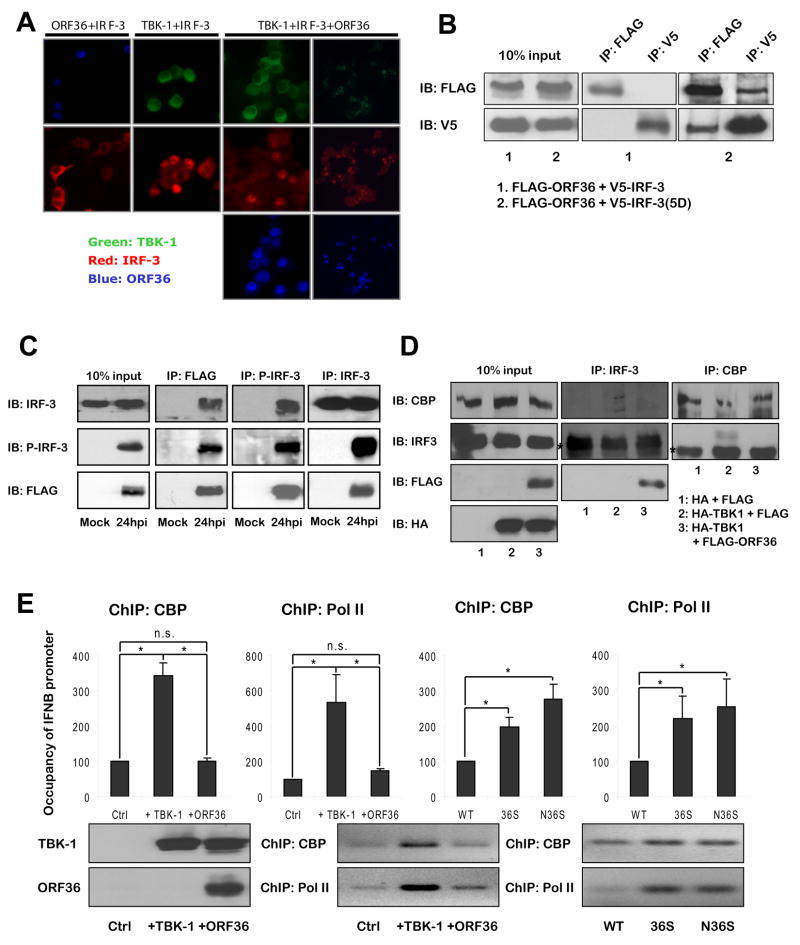
A conserved herpesviral kinase, designated ORF36 in murine gamma-herpesvirus 68 (MHV-68), plays multiple vital roles in the viral life cycle. Here, we show by screening mutant viruses that ORF36 counteracts the antiviral type I interferon (IFN) response. ORF36 specifically binds to the activated form of interferon regulatory factor 3 (IRF-3) in the nucleus, inhibiting IRF-3 interaction with the cotranscriptional activator CBP and thereby suppressing the recruitment of RNA polymerase II to the interferon beta promoter. The anti-IFN function of ORF36 is conserved among herpesvirus subfamilies, although the conserved kinase activity is not absolutely required for this function. MHV-68 lacking ORF36 induces a greater interferon response and is attenuated in vitro and in vivo, where acute viral infection in the lung and latency in the spleen are compromised. Our data suggest that herpesviruses have evolved within their conserved kinase an anti-IFN activity critical for evasion of host immunity and for persistence.
Figures




References
-
- Agnello D, Lankford CS, Bream J, Morinobu A, Gadina M, O’Shea JJ, Frucht DM. Cytokines and transcription factors that regulate T helper cell differentiation: new players and new insights. Journal of clinical immunology. 2003;23:147–161. - PubMed
-
- Asai R, Kato A, Kato K, Kanamori-Koyama M, Sugimoto K, Sairenji T, Nishiyama Y, Kawaguchi Y. Epstein-Barr virus protein kinase BGLF4 is a virion tegument protein that dissociates from virions in a phosphorylation-dependent process and phosphorylates the viral immediate-early protein BZLF1. Journal of virology. 2006;80:5125–5134. - PMC - PubMed
-
- Asai R, Ohno T, Kato A, Kawaguchi Y. Identification of proteins directly phosphorylated by UL13 protein kinase from herpes simplex virus 1. Microbes and Infection. 2007;9:1434–1438. - PubMed
Publication types
MeSH terms
Substances
Grants and funding
- P01 DE019085/DE/NIDCR NIH HHS/United States
- R01 DE015752/DE/NIDCR NIH HHS/United States
- P01-DE019085/DE/NIDCR NIH HHS/United States
- AI28697/AI/NIAID NIH HHS/United States
- T32AI060567/AI/NIAID NIH HHS/United States
- R01-DE15752/DE/NIDCR NIH HHS/United States
- K22 DE015612/DE/NIDCR NIH HHS/United States
- R01-AI59603/AI/NIAID NIH HHS/United States
- T32 AI060567/AI/NIAID NIH HHS/United States
- R21-CA120761/CA/NCI NIH HHS/United States
- R21 CA120761/CA/NCI NIH HHS/United States
- P50 CA086306/CA/NCI NIH HHS/United States
- P50-CA86306/CA/NCI NIH HHS/United States
- R01 AI059603/AI/NIAID NIH HHS/United States
- DE015612/DE/NIDCR NIH HHS/United States
- P30 AI028697/AI/NIAID NIH HHS/United States
LinkOut - more resources
Full Text Sources
Other Literature Sources
