Contribution of race/ethnicity and country of origin to variations in lifetime reported asthma: evidence for a nativity advantage
- PMID: 19218175
- PMCID: PMC2661487
- DOI: 10.2105/AJPH.2007.128843
Contribution of race/ethnicity and country of origin to variations in lifetime reported asthma: evidence for a nativity advantage
Abstract
Objectives: We assessed the relative contribution of Hispanic ethnicity, country of origin, and nativity to lifetime prevalence of asthma among mothers and children enrolled in the Project on Human Development in Chicago Neighborhoods.
Methods: We used multilevel models to analyze data from wave 3 of the Project on Human Development in Chicago Neighborhoods study (2000 to 2001). Mothers reported physician-diagnosed asthma for themselves and their children. Maternal race, ethnicity, country of origin, and nativity were the predictors of interest.
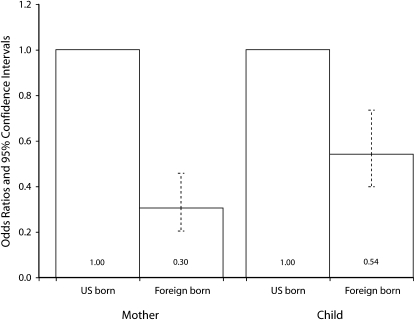
Results: We found substantial heterogeneity in lifetime asthma within Hispanic subgroups for mothers and children. Hispanics of non-Mexican origin had greater odds of having asthma than did non-Hispanic Whites; respondents of Mexican origin did not differ from non-Hispanic Whites. Odds of experiencing asthma were more strongly related to nativity than to race, Hispanic ethnicity, or country of origin. Only immigrant Mexicans reported asthma prevalence lower than that of native non-Hispanic Whites.
Conclusions: Nativity is a strong predictor of lifetime asthma prevalence, suggesting the importance of potential interactions between genetic susceptibilities and environmental factors in both the native and the host countries.
Figures

References
-
- Vega WA, Amaro H. Latino outlook: good health, uncertain prognosis. Annu Rev Public Health 1994;15:39–67 - PubMed
-
- Franzini L, Ribble JC, Keddie AM. Understanding the Hispanic paradox. Ethn Dis 2001;11(3):496–518 - PubMed
-
- Palloni A, Morenoff JD. Interpreting the paradoxical in the Hispanic paradox: demographic and epidemiologic approaches. Ann N Y Acad Sci 2001;954:140–174 - PubMed
Publication types
MeSH terms
Grants and funding
LinkOut - more resources
Full Text Sources
Medical