Randomized Controlled Trial
. 2009 Apr 15;169(8):946-53.
doi: 10.1093/aje/kwn413. Epub 2009 Feb 13.

Modification of the effect of vitamin E supplementation on the mortality of male smokers by age and dietary vitamin C

Affiliations
Randomized Controlled Trial

Modification of the effect of vitamin E supplementation on the mortality of male smokers by age and dietary vitamin C

Harri Hemilä et al. Am J Epidemiol. .

Abstract

The Alpha-Tocopherol, Beta-Carotene Cancer Prevention (ATBC) Study (1985-1993) recruited 29,133 Finnish male cigarette smokers, finding that vitamin E supplementation had no overall effect on mortality. The authors of this paper found that the effect of vitamin E on respiratory infections in ATBC Study participants was modified by age, smoking, and dietary vitamin C intake; therefore, they examined whether the effect of vitamin E supplementation on mortality is modified by the same variables. During a median follow-up time of 6.1 years, 3,571 deaths occurred. Age and dietary vitamin C intake had a second-order interaction with vitamin E supplementation of 50 mg/day. Among participants with a dietary vitamin C intake above the median of 90 mg/day, vitamin E increased mortality among those aged 50-62 years by 19% (95% confidence interval: 5, 35), whereas vitamin E decreased mortality among those aged 66-69 years by 41% (95% CI: -56, -21). Vitamin E had no effect on participants who had a dietary vitamin C intake below the median. Smoking quantity did not modify the effect of vitamin E. This study provides strong evidence that the effect of vitamin E supplementation on mortality varies between different population groups. Further study is needed to confirm this heterogeneity.


Figures
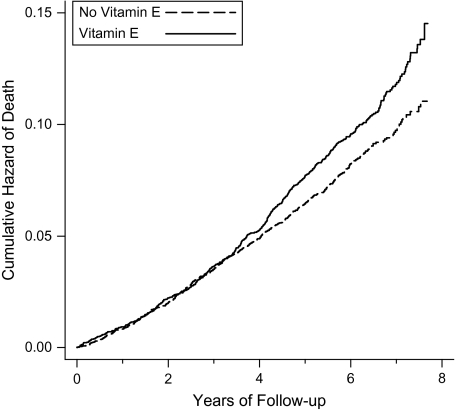
Figure 1.
Figure 1.
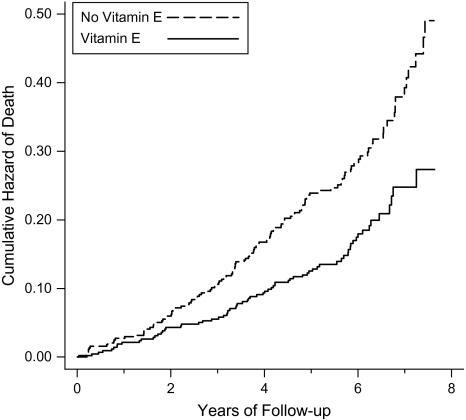
Effect of vitamin E supplementation on mortality among participants aged 50–62 years with a dietary vitamin C intake of >90 mg/day (n = 11,448 with 1,021 deaths), Alpha-Tocopherol, Beta-Carotene Cancer Prevention Study, 1985–1993. Nelson-Aalen cumulative hazard functions for the vitamin-E and no-vitamin-E groups are shown. Each step indicates 1 death. For the difference between the 2 groups, log-rank-test P = 0.006. The number of participants with follow-up time of ≥7 years was 2,316; the curves are cut at 7.8 years because the number of participants declined abruptly thereafter. The possibility of a lag period was examined by adding a different risk ratio term for vitamin E effect starting at variable time points. The best improvement in the regression model was achieved by adding the second vitamin E effect starting at 3.3 person-years, which improved the regression model by χ2(1 df) = 7.1, P = 0.007. This model gives risk ratios of 0.99 (95% confidence interval: 0.82, 1.19) during the first 3.3 years and 1.38 (95% confidence interval: 1.17, 1.63) thereafter.
Figure 2.
Figure 2.
Effect of vitamin E supplementation on mortality among participants aged 66–69 years with a dietary vitamin C intake of >90 mg/day (n = 872 with 195 deaths), Alpha-Tocopherol, Beta-Carotene Cancer Prevention Study, 1985–1993. Nelson-Aalen cumulative hazard functions for the vitamin-E and no-vitamin-E groups are shown. Each step indicates 1 death. For the difference between the 2 groups, log-rank-test P = 0.0003. The number of participants with follow-up time of ≥7 years was 128; the curves are cut at 7.8 years because the number of participants declined abruptly thereafter. The possibility of a lag period was examined by adding 2 different risk ratio terms for vitamin E effect starting at variable time points because the 2 curves diverge at the initiation of supplementation and at about 2 years. The best improvement in the regression model was achieved by adding the second vitamin E effect starting at 0.3 person-years and the third risk ratio starting from 1.9 years, which improved the regression model by χ2(2 df) = 5.2, P = 0.073. This model gives risk ratios of 0.15 (95% confidence interval: 0.02, 1.2) during the first 0.3 years, 1.04 (95% confidence interval: 0.53, 2.04) during the period 0.3–1.9 years, and 0.54 (95% confidence interval: 0.39, 0.76) thereafter. During the first 0.3 years of follow-up, there were 5 deaths in the β-carotene arm, 2 deaths in the placebo arm, 1 death in the vitamin E arm, and no deaths in the vitamin E + β-carotene arm.

References

    1. Radimer K, Bindewald B, Hughes J, et al. Dietary supplement use by US adults: data from the National Health and Nutrition Examination Survey, 1999–2000. Am J Epidemiol. 2004;160(4):339–349. - PubMed
    1. Beckman KB, Ames BN. The free radical theory of aging matures. Physiol Rev. 1998;78(2):547–581. - PubMed
    1. Finkel T, Holbrook NJ. Oxidants, oxidative stress and the biology of ageing. Nature. 2000;408(6809):239–247. - PubMed
    1. Vivekananthan DP, Penn MS, Sapp SK, et al. Use of antioxidant vitamins for the prevention of cardiovascular disease: meta-analysis of randomised trials. Lancet. 2003;361(9374):2017–2023. - PubMed
    1. Miller ER, Pastor-Barriuso R, Dalal D, et al. Meta-analysis: high-dosage vitamin E supplementation may increase all-cause mortality. Ann Intern Med. 2005;142(1):37–46. (Comments: Ann Intern Med. 2005;143(2):150–158) - PubMed

Publication types