. 2009 Apr;191(8):2806-14.
doi: 10.1128/JB.01688-08. Epub 2009 Feb 13.

Functional genomics of Enterococcus faecalis: multiple novel genetic determinants for biofilm formation in the core genome

Affiliations

Functional genomics of Enterococcus faecalis: multiple novel genetic determinants for biofilm formation in the core genome

Katie S Ballering et al. J Bacteriol. 2009 Apr.

Abstract

The ability of Enterococcus faecalis to form robust biofilms on host tissues and on abiotic surfaces such as catheters likely plays a major role in the pathogenesis of opportunistic antibiotic-resistant E. faecalis infections and in the transfer of antibiotic resistance genes. We have carried out a comprehensive analysis of genetic determinants of biofilm formation in the core genome of E. faecalis. Here we describe 68 genetic loci predicted to be involved in biofilm formation that were identified by recombinase in vivo expression technology (RIVET); most of these genes have not been studied previously. Differential expression of a number of these determinants during biofilm growth was confirmed by quantitative reverse transcription-PCR, and genetic complementation studies verified a role in biofilm formation for several candidate genes. Of particular interest was genetic locus EF1809, predicted to encode a regulatory protein of the GntR family. We isolated 14 independent nonsibling clones containing the putative promoter region for this gene in the RIVET screen; EF1809 also showed the largest increase in expression during biofilm growth of any of the genes tested. Since an in-frame deletion of EF1809 resulted in a severe biofilm defect that could be complemented by the cloned wild-type gene, we have designated EF1809 ebrA (enterococcal biofilm regulator). Most of the novel genetic loci identified in our studies are highly conserved in gram-positive bacterial pathogens and may thus constitute a pool of uncharacterized genes involved in biofilm formation that may be useful targets for drug discovery.


Figures
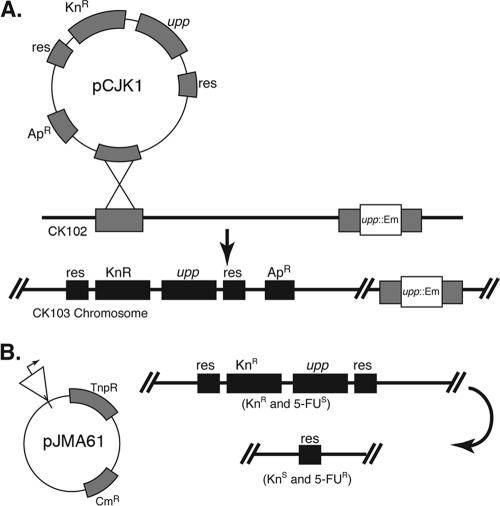
FIG. 1.
FIG. 1.
RIVET plasmid and strains. (A) RIVET host strain CK103 was created via Campbell insertion of pCJK1 containing the res cassettes flanking selectable and counterselectable genes into the CK102 chromosome. (B) An OG1RF genomic library was created in the resolvase fusion reporter vector pJMA61. This vector contains a promoterless copy of the resolvase gene, tnpR, adjacent to the cloning site. When tnpR transcription is activated, the resulting resolvase protein catalyzes site-specific recombination between the duplicated res sites (depicted on the right side), leaving a heritable genetic change in the host strain that can be screened for at a later time. The phenotype of the host strain before and after TnpR-mediated excision is indicated in parentheses.
FIG. 2.
FIG. 2.
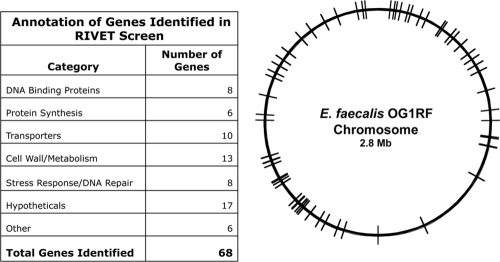
Genome distribution of determinants identified in a RIVET screen. The list on the left indicates the number of putative biofilm-related genes identified by RIVET in various categories based on the TIGR (The Institute for Genomic Research) gene annotation for the genome of E. faecalis V583 (45) and on the recently published genome sequence of OG1RF (6). In the circular map on the right, the location of each gene in the chromosome is indicated by a line. For a complete compilation of all 68 genetic determinants identified in this study, see Table S1 in the supplemental material; further analysis of selected genes is presented in other sections of this paper.
FIG. 3.
FIG. 3.
Confirmation of differential expression of RIVET-identified genes during biofilm growth. The transcription of four genes identified in the RIVET screen was examined by qRT-PCR analysis of RNA extracted from either planktonic cells or biofilm cells after 24 h of growth. All of the graphs show the n-fold expression change on the y axis normalized to that of the reference gene, gyrB (7). This gene was shown to be expressed at the same level by biofilm and planktonic cells of E. faecalis strain OG1RF (data not shown). The level of expression of the gene of interest relative to gyrB in the planktonic sample was set at 1 in all cases and is shown in gray on the x axis along with the biofilm sample shown in black. (A) Expression of EF1809. (B) Expression of EF3282. (C) Expression of EF2207. (D) Expression of EF984. Error bars represent 1 standard deviation. The asterisk indicates a P value of 0.001.
FIG. 4.
FIG. 4.
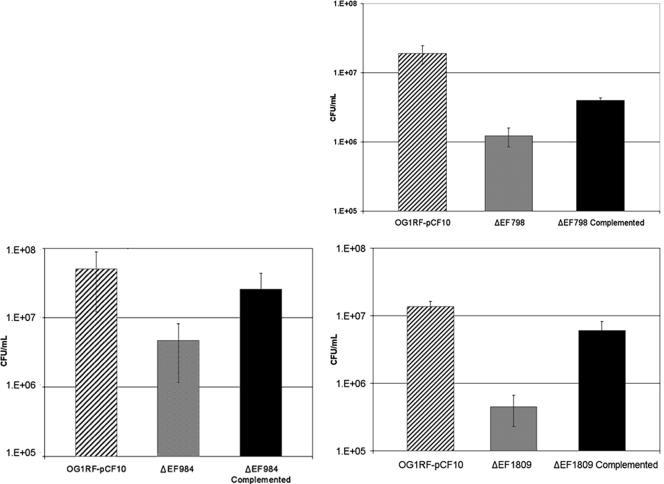
Biofilm defects of E. faecalis strains carrying null mutations in RIVET-identified genes. Isogenic strains carrying nonpolar null mutations in either EF1809, EF798, or EF984 were examined for biofilm formation on submerged cellulose membranes. The populations of mutant cells in biofilms after 24 h were compared with those obtained with either the wild-type strain or the null strain expressing the cloned wild-type gene in trans as described in Materials and Methods. This assay was repeated on five separate occasions. In planktonic growth, neither the null strains nor the complemented strains showed a defect compared to the wild type (data not shown). The strain designations are indicated on the x axis, and numbers of CFU per milliliter are shown on the y axis. Error bars represent 1 standard deviation. P values: EF1809, 0.01; EF798, 0.01; EF984, 0.01.
FIG. 5.
FIG. 5.
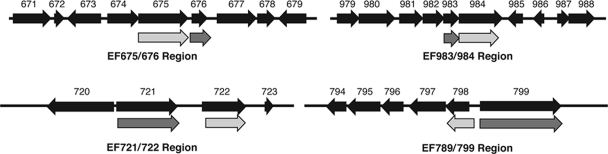
RIVET and transposon screens for biofilm determinants identify unique but linked genes. Linear maps of four regions (black arrows) where the RIVET screen and transposon screens identified adjacent genes are depicted at the top. Annotation of the genes is shown at the bottom; RIVET-identified genes are in light gray, and transposon-identified genes are in dark gray.

References

    1. Anderson, G. G., S. Moreau-Marquis, B. A. Stanton, and G. A. O'Toole. 2008. In vitro analysis of tobramycin-treated Pseudomonas aeruginosa biofilms on cystic fibrosis-derived airway epithelial cells. Infect. Immun. 761423-1433. - PMC - PubMed
    1. Aravind, L., and V. Anantharaman. 2003. HutC/FarR-like bacterial transcription factors of the GntR family contain a small molecule-binding domain of the chorismate lyase fold. FEMS Microbiol. Lett. 22217-23. - PubMed
    1. Baldassarri, L., R. Creti, C. R. Arciola, L. Montanaro, M. Venditti, and R. Di Rosa. 2004. Analysis of virulence factors in cases of enterococcal endocarditis. Clin. Microbiol. Infect. 101006-1008. - PubMed
    1. Becker, P., W. Hufnagle, G. Peters, and M. Herrmann. 2001. Detection of differential gene expression in biofilm-forming versus planktonic populations of Staphylococcus aureus using micro-representational-difference analysis. Appl. Environ. Microbiol. 672958-2965. - PMC - PubMed
    1. Benkert, B., N. Quack, K. Schreiber, L. Jaensch, D. Jahn, and M. Schobert. 2008. Nitrate-responsive NarX-NarL represses arginine-mediated induction of the Pseudomonas aeruginosa arginine fermentation arcDABC operon. Microbiology 1543053-3060. - PubMed

Publication types

MeSH terms

LinkOut - more resources