


Functional expression of a bacterial xylose isomerase in Saccharomyces cerevisiae
- PMID: 19218403
- PMCID: PMC2675233
- DOI: 10.1128/AEM.02522-08
Functional expression of a bacterial xylose isomerase in Saccharomyces cerevisiae
Abstract
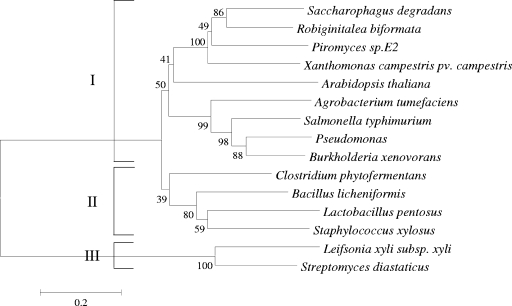
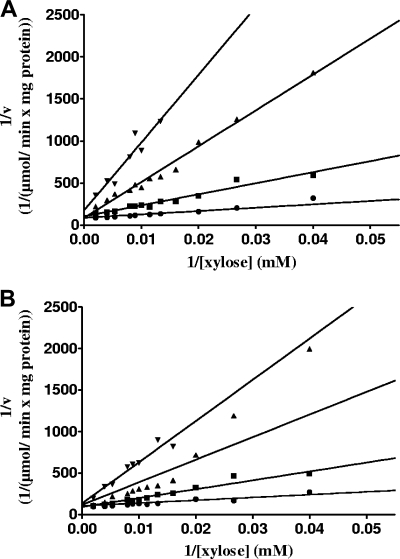
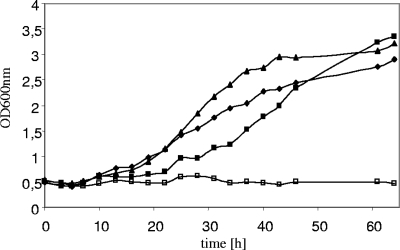
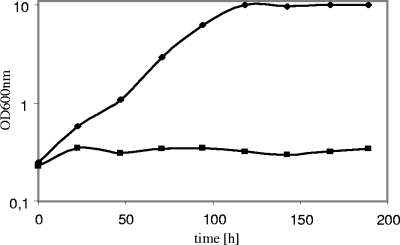
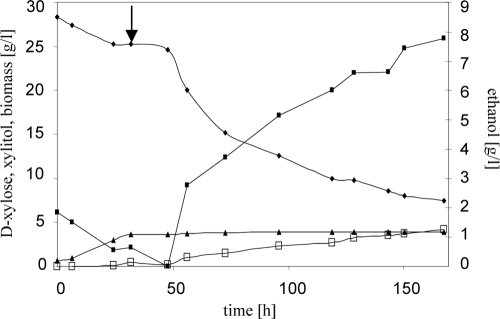
In industrial fermentation processes, the yeast Saccharomyces cerevisiae is commonly used for ethanol production. However, it lacks the ability to ferment pentose sugars like d-xylose and l-arabinose. Heterologous expression of a xylose isomerase (XI) would enable yeast cells to metabolize xylose. However, many attempts to express a prokaryotic XI with high activity in S. cerevisiae have failed so far. We have screened nucleic acid databases for sequences encoding putative XIs and finally were able to clone and successfully express a highly active new kind of XI from the anaerobic bacterium Clostridium phytofermentans in S. cerevisiae. Heterologous expression of this enzyme confers on the yeast cells the ability to metabolize d-xylose and to use it as the sole carbon and energy source. The new enzyme has low sequence similarities to the XIs from Piromyces sp. strain E2 and Thermus thermophilus, which were the only two XIs previously functionally expressed in S. cerevisiae. The activity and kinetic parameters of the new enzyme are comparable to those of the Piromyces XI. Importantly, the new enzyme is far less inhibited by xylitol, which accrues as a side product during xylose fermentation. Furthermore, expression of the gene could be improved by adapting its codon usage to that of the highly expressed glycolytic genes of S. cerevisiae. Expression of the bacterial XI in an industrially employed yeast strain enabled it to grow on xylose and to ferment xylose to ethanol. Thus, our findings provide an excellent starting point for further improvement of xylose fermentation in industrial yeast strains.
Figures
References
-
- Aguilera, J., and J. A. Prieto. 2001. The Saccharomyces cerevisiae aldose reductase is implied in the metabolism of methylglyoxal in response to stress conditions. Curr. Genet. 39:273-283. - PubMed
-
- Amore, R., M. Wilhelm, and C. P. Hollenberg. 1989. The fermentation of xylose—an analysis of the expression of Bacillus and Actinoplanes xylose isomerase genes in yeast. Appl. Microbiol. Biotechnol. 30:351-357.
-
- Ångspanneföreningen. 1994. Report: P23332-1. NUTEK, Stockholm, Sweden.
-
- Aristidou, A., and M. Penttila. 2000. Metabolic engineering applications to renewable resource utilization. Curr. Opin. Biotechnol. 11:187-198. - PubMed
-
- Bradford, M. M. 1976. A rapid and sensitive method for the quantitation of microgram quantities of protein utilizing the principle of protein-dye binding. Anal. Biochem. 72:248-254. - PubMed
Publication types
MeSH terms
Substances
LinkOut - more resources
Full Text Sources
Other Literature Sources
Molecular Biology Databases
