


Development of bacteriocinogenic strains of Saccharomyces cerevisiae heterologously expressing and secreting the leaderless enterocin L50 peptides L50A and L50B from Enterococcus faecium L50
- PMID: 19218405
- PMCID: PMC2675236
- DOI: 10.1128/AEM.01476-08
Development of bacteriocinogenic strains of Saccharomyces cerevisiae heterologously expressing and secreting the leaderless enterocin L50 peptides L50A and L50B from Enterococcus faecium L50
Abstract
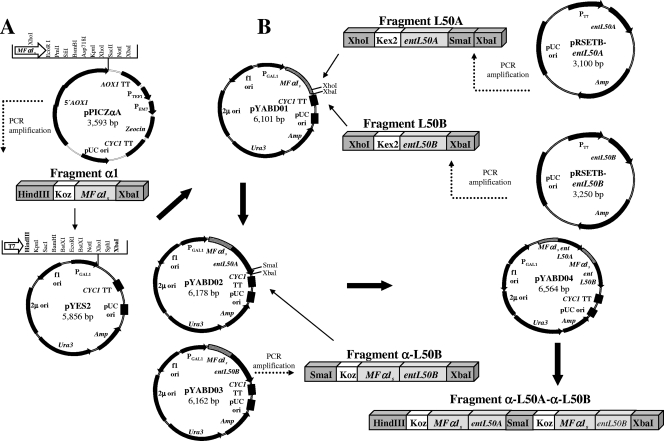
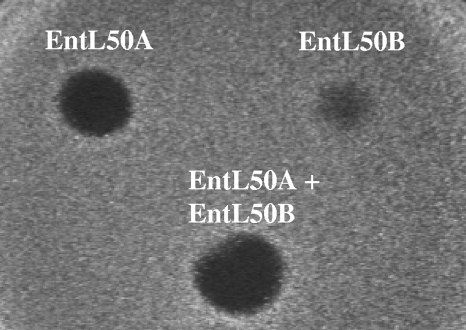
A segregationally stable expression and secretion vector for Saccharomyces cerevisiae, named pYABD01, was constructed by cloning the yeast gene region encoding the mating pheromone alpha-factor 1 secretion signal (MFalpha1(s)) into the S. cerevisiae high-copy-number expression vector pYES2. The structural genes of the two leaderless peptides of enterocin L50 (EntL50A and EntL50B) from Enterococcus faecium L50 were cloned, separately (entL50A or entL50B) and together (entL50AB), into pYABD01 under the control of the galactose-inducible promoter P(GAL1). The generation of recombinant S. cerevisiae strains heterologously expressing and secreting biologically active EntL50A and EntL50B demonstrates the suitability of the MFalpha1(s)-containing vector pYABD01 to direct processing and secretion of these antimicrobial peptides through the S. cerevisiae Sec system.
Figures
References
-
- Basanta, A., J. Sánchez, B. Gómez-Sala, C. Herranz, P. E. Hernández, and L. M. Cintas. 2008. Antimicrobial activity of Enterococcus faecium L50, a strain producing enterocins L50 (L50A and L50B), P and Q, against beer spoilage lactic acid bacteria in broth, wort (hopped and unhopped), and alcoholic and non-alcoholic lager beers. Int. J. Food Microbiol. 125:293-307. - PubMed
-
- Beaulieu, L., D. Groleau, C. B. Miguez, J. F. Jetté, H. Aomari, and M. Subirade. 2005. Production of pediocin PA-1 in the methylotrophic yeast P. pastoris reveals unexpected inhibition of its biological activity due to the presence of collagen-like material. Protein Expr. Purif. 43:111-125. - PubMed
-
- Bhunia, A. K., M. G. Johnson, and B. Ray. 1987. Direct detection of an antimicrobial peptide of Pediococcus acidilactici in sodium dodecyl sulphate-polyacrylamide gel electrophoresis. J. Ind. Microbiol. 2:319-322.
-
- Brot, N., and H. Weissbach. 1991. Biochemistry of methionine sulfoxide residues in proteins. Biofactors 3:91-96. - PubMed
-
- Casaus, M. P., T. Nilsen, L. M. Cintas, I. F. Nes, and P. E. Hernández. 1997. Enterocin B, a new bacteriocin from Enterococcus faecium T136 which can act synergistically with enterocin A. Microbiology 143:2287-2294. - PubMed
Publication types
MeSH terms
Substances
LinkOut - more resources
Full Text Sources
Other Literature Sources
Molecular Biology Databases
Research Materials
