


LapD is a bis-(3',5')-cyclic dimeric GMP-binding protein that regulates surface attachment by Pseudomonas fluorescens Pf0-1
- PMID: 19218451
- PMCID: PMC2651287
- DOI: 10.1073/pnas.0808933106
LapD is a bis-(3',5')-cyclic dimeric GMP-binding protein that regulates surface attachment by Pseudomonas fluorescens Pf0-1
Abstract
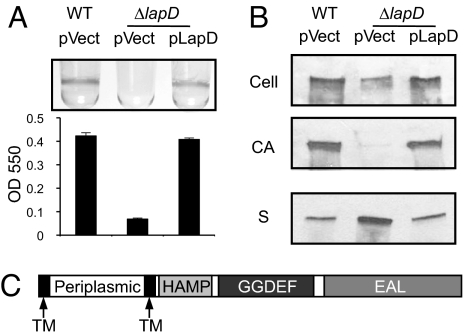
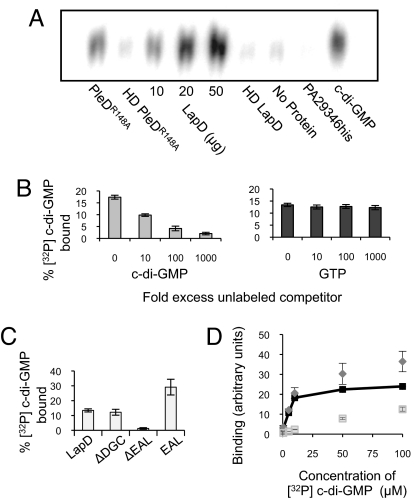
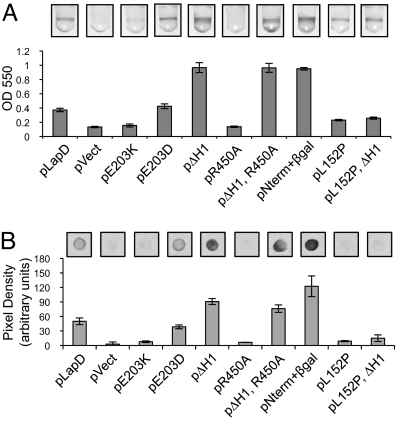
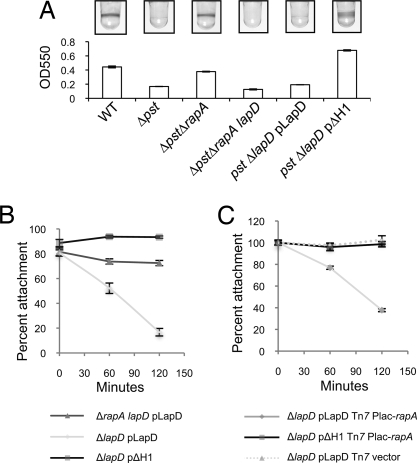
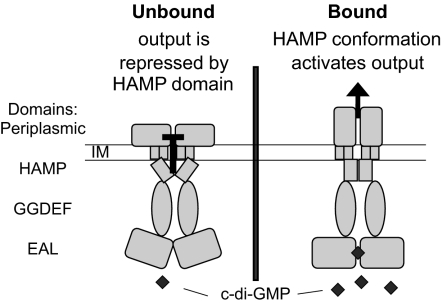
The second messenger cyclic dimeric GMP (c-di-GMP) regulates surface attachment and biofilm formation by many bacteria. For Pseudomonas fluorescens Pf0-1, c-di-GMP impacts the secretion and localization of the adhesin LapA, which is absolutely required for stable surface attachment and biofilm formation by this bacterium. In this study we characterize LapD, a unique c-di-GMP effector protein that controls biofilm formation by communicating intracellular c-di-GMP levels to the membrane-localized attachment machinery via its periplasmic domain. LapD contains degenerate and enzymatically inactive diguanylate cyclase and c-di-GMP phosphodiesterase (EAL) domains and binds to c-di-GMP through a degenerate EAL domain. We present evidence that LapD utilizes an inside-out signaling mechanism: binding c-di-GMP in the cytoplasm and communicating this signal to the periplasm via its periplasmic domain. Furthermore, we show that LapD serves as the c-di-GMP receptor connecting environmental modulation of intracellular c-di-GMP levels by inorganic phosphate to regulation of LapA localization and thus surface commitment by P. fluorescens.
Conflict of interest statement
The authors declare no conflict of interest.
Figures

References
-
- O'Toole GA, Kolter R. Initiation of biofilm formation in Pseudomonas fluorescens WCS365 proceeds via multiple, convergent signaling pathways: A genetic analysis. Mol Microbiol. 1998;28:449–461. - PubMed
-
- Römling U, Gomelsky M, Galperin MY. c-di-GMP: The dawning of a novel bacterial signaling system. Mol Microbiol. 2005;57(3):629–639. - PubMed
-
- Ross P, et al. Regulation of cellulose synthesis in Acetobacter xylinum by cyclic diguanylic acid. Nature. 1987;325(15):279–281. - PubMed
Publication types
MeSH terms
Substances
Grants and funding
LinkOut - more resources
Full Text Sources
Other Literature Sources
Miscellaneous
