


Early and sustained innate immune response defines pathology and death in nonhuman primates infected by highly pathogenic influenza virus
- PMID: 19218453
- PMCID: PMC2642661
- DOI: 10.1073/pnas.0813234106
Early and sustained innate immune response defines pathology and death in nonhuman primates infected by highly pathogenic influenza virus
Abstract
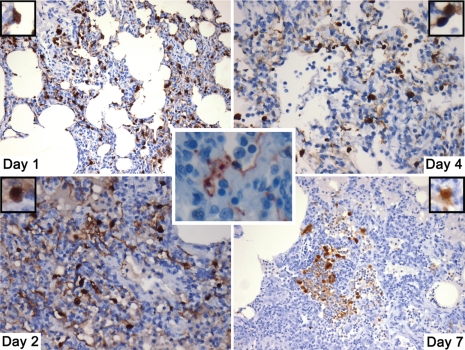
The mechanisms responsible for the virulence of the highly pathogenic avian influenza (HPAI) and of the 1918 pandemic influenza virus in humans remain poorly understood. To identify crucial components of the early host response during these infections by using both conventional and functional genomics tools, we studied 34 cynomolgus macaques (Macaca fascicularis) to compare a 2004 human H5N1 Vietnam isolate with 2 reassortant viruses possessing the 1918 hemagglutinin (HA) and neuraminidase (NA) surface proteins, known conveyors of virulence. One of the reassortants also contained the 1918 nonstructural (NS1) protein, an inhibitor of the host interferon response. Among these viruses, HPAI H5N1 was the most virulent. Within 24 h, the H5N1 virus produced severe bronchiolar and alveolar lesions. Notably, the H5N1 virus targeted type II pneumocytes throughout the 7-day infection, and induced the most dramatic and sustained expression of type I interferons and inflammatory and innate immune genes, as measured by genomic and protein assays. The H5N1 infection also resulted in prolonged margination of circulating T lymphocytes and notable apoptosis of activated dendritic cells in the lungs and draining lymph nodes early during infection. While both 1918 reassortant viruses also were highly pathogenic, the H5N1 virus was exceptional for the extent of tissue damage, cytokinemia, and interference with immune regulatory mechanisms, which may help explain the extreme virulence of HPAI viruses in humans.
Conflict of interest statement
Conflict of interest statement: A.G.-S. owns patent positions for reverse genetics of influenza viruses.
Figures



References
-
- Ng WF, To KF. Pathology of human H5N1 infection: New findings. Lancet. 2007;370:1106–1108. - PubMed
-
- Writing Committee of the Second World Health Organization Consultation on Clinical Aspects of Human Infection with Avian Influenza A (H5N1) Virus. Update on avian influenza A (H5N1) virus infection in humans. N Engl J Med. 2008;358:261–273. - PubMed
-
- Uyeki TM. Global epidemiology of human infections with highly pathogenic avian influenza A (H5N1) viruses. Respirology. 2008;13(s1):S2–S9. - PubMed
-
- Morens DM, Fauci AS. The 1918 influenza pandemic: Insights for the 21st century. J Infect Dis. 2007;195:1018–1028. - PubMed
Publication types
MeSH terms
Grants and funding
- R01 AI046954/AI/NIAID NIH HHS/United States
- P51 RR000166/RR/NCRR NIH HHS/United States
- R03 AI075019/AI/NIAID NIH HHS/United States
- U01AI070469/AI/NIAID NIH HHS/United States
- P01AI58113,/AI/NIAID NIH HHS/United States
- K08 AI059106/AI/NIAID NIH HHS/United States
- R01 AI022646-20A1/AI/NIAID NIH HHS/United States
- R01 AI022646/AI/NIAID NIH HHS/United States
- P51 RR00166-45/RR/NCRR NIH HHS/United States
- P01 AI058113/AI/NIAID NIH HHS/United States
- R03 AI075019-01/AI/NIAID NIH HHS/United States
- U01 AI070469/AI/NIAID NIH HHS/United States
- K08 AI059106-02/AI/NIAID NIH HHS/United States
- R24 RR016354/RR/NCRR NIH HHS/United States
- R24 RR16354-04/RR/NCRR NIH HHS/United States
- R01AI46954,/AI/NIAID NIH HHS/United States
LinkOut - more resources
Full Text Sources
Medical
Molecular Biology Databases
