


Translocon closure to Ca2+ leak in proliferating vascular smooth muscle cells
- PMID: 19218505
- PMCID: PMC2670693
- DOI: 10.1152/ajpheart.00984.2008
Translocon closure to Ca2+ leak in proliferating vascular smooth muscle cells
Abstract
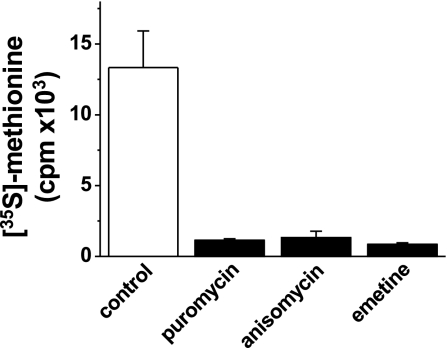
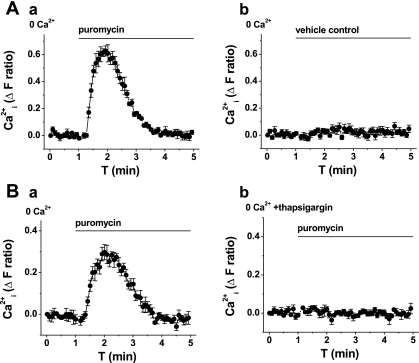
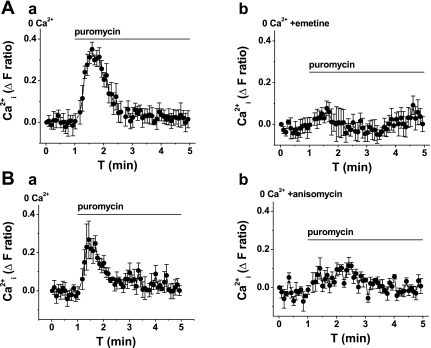
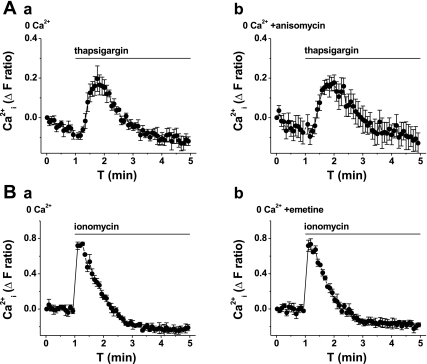
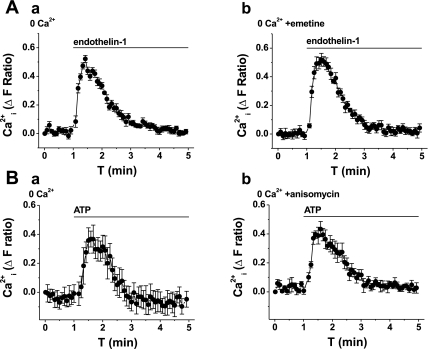
Vascular smooth muscle cells have a proliferative phenotype that is important in vascular development, adaptation, and disease. Intracellular calcium handling is thought to play pivotal roles in determining the properties of these cells, and thus previously unrecognized mechanisms for transmembrane calcium movement are of potential interest. An unsolved question is the mechanism of constitutive (passive) calcium leak from the intracellular stores. Studies of other cell types have suggested that the translocon is a calcium leak pathway. Here we investigated the contribution of the translocon in proliferating vascular smooth muscle cells. Calcium leak into the cytoplasm was measured using fura-2, and protein synthesis was measured using radioactive methionine. Puromycin, emetine, and anisomycin are chemicals that inhibit protein synthesis, acting via the translocon; all three agents strongly inhibited protein synthesis in the smooth muscle cells within 1 h. Puromycin, which opens the translocon, evoked a transient increase in cytoplasmic calcium that was similar in amplitude to the calcium rise evoked by thapsigargin. The puromycin effect was abolished by thapsigargin. The treatment of cells for 1 h with emetine or anisomycin, which close the translocon, inhibited the calcium release evoked by puromycin but not the calcium release evoked by extracellular ATP, endothelin-1, or the calcium ionophore ionomycin. Thapsigargin-evoked calcium rises were slightly suppressed by emetine but unaffected by puromycin or anisomycin. The data suggest that the translocon has the capacity to act as a calcium leak pathway in the ribosomal endoplasmic reticulum but that it is normally closed and lacks relevance to physiological calcium leak mechanisms.
Figures
Comment in
-
Is the translocon a crucial player of the calcium homeostasis in vascular smooth muscle cell?Am J Physiol Heart Circ Physiol. 2009 Apr;296(4):H906-7. doi: 10.1152/ajpheart.00177.2009. Epub 2009 Feb 27. Am J Physiol Heart Circ Physiol. 2009. PMID: 19252099 No abstract available.
References
-
- Angelini GD, Jeremy JY. Towards the treatment of saphenous vein bypass graft failure—a perspective of the Bristol Heart Institute. Biorheology 39: 491–499, 2002. - PubMed
-
- Beech DJ Ion channel switching and activation in smooth-muscle cells of occlusive vascular diseases. Biochem Soc Trans 35: 890–894, 2007. - PubMed
-
- Berk BC Vascular smooth muscle growth: autocrine growth mechanisms. Physiol Rev 81: 999–1030, 2001. - PubMed
-
- Borna C, Wang L, Gudbjartsson T, Karlsson L, Jern S, Malmsjo M, Erlinge D. Contractions in human coronary bypass vessels stimulated by extracellular nucleotides. Ann Thorac Surg 76: 50–57, 2003. - PubMed
Publication types
MeSH terms
Substances
Grants and funding
LinkOut - more resources
Full Text Sources
Molecular Biology Databases
Miscellaneous
