


Therapeutic effects of recombinant human endostatin adenovirus in a mouse model of malignant pleural effusion
- PMID: 19219619
- PMCID: PMC12160210
- DOI: 10.1007/s00432-009-0555-y
Therapeutic effects of recombinant human endostatin adenovirus in a mouse model of malignant pleural effusion
Abstract
Purpose: Malignant pleural effusion (MPE) is a common clinical problem in patients with advanced cancer. Evidence suggests that tumor-mediated angiogenesis and enhanced vascular permeability in the pleural wall are due to high levels of vascular endothelial growth factor (VEGF), which plays an important role in the pathogenesis of MPE. The present study was designed to test whether the recombinant adenovirus-mediated delivery of human endostatin (Ad-hEndo), one of the potent inhibitors of angiogenesis, would inhibit the formation and progression of MPE.
Methods: We developed a novel mouse model of MPE by injecting Lewis lung carcinoma (LLC) cells directly into pleural cavity of C57BL/6 mice. To evaluate the therapeutic effects of endostatin in this MPE model, we injected the Ad-hEndo into the pleural cavity of MPE-bearing mice three times with the 3-day interval.
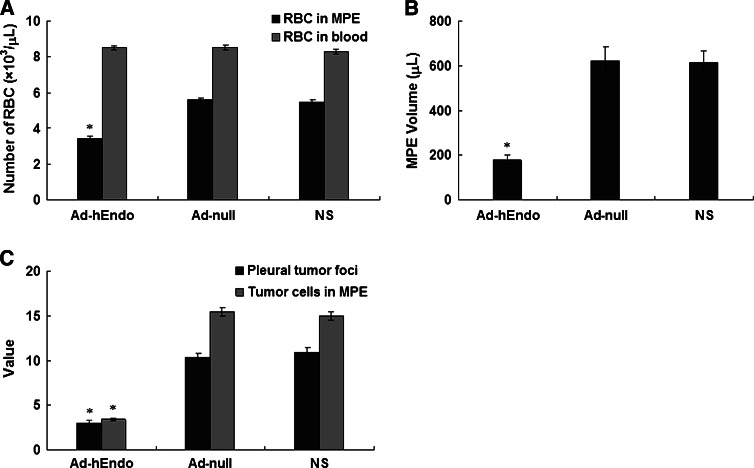
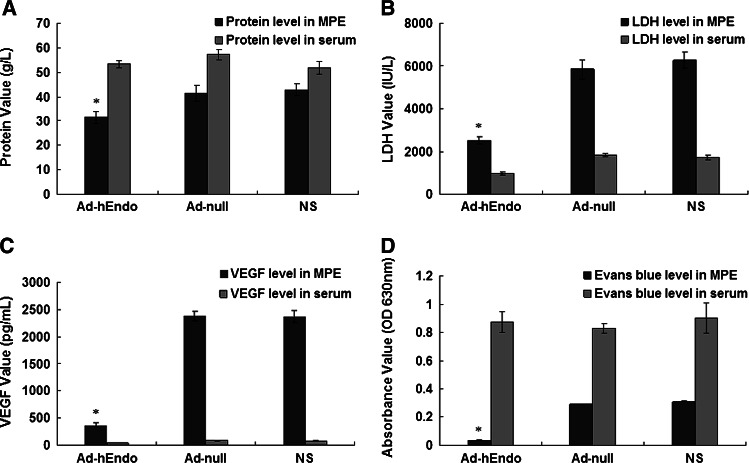
Results: We found that this treatment resulted in significant reduction in pleural effusion volume, the number of pleural tumor foci, microvessel density, and vascular permeability, while it significantly prolonged the survival time. In addition, VEGF level of MPE in the group administered with the Ad-hEndo was obviously decreased as compared with that in the two control groups administered with null-adenovirus (Ad-null) or normal saline.
Conclusions: Our work provides a rationale for future studies toward evaluating the effectiveness of the adenovirus-based endostatin therapy for MPE.
Figures


References
-
- Antony VB, Loddenkemper R, Astoul P, Boutin C, Goldstraw P, Hott J et al (2000) Management of malignant pleural effusions. Am J Respir Crit Care Med 162:1987–2001 - PubMed
-
- Burrows CM, Mathews WC, Colt HG (2000) Predicting survival in patients with recurrent symptomatic malignant pleural effusions. Chest 117:73–78. doi:10.1378/chest.117.1.73 - PubMed
-
- Carmeliet P, Ferreira V, Breier G, Pollefeyt S, Kieckens L, Gertsenstein M et al (1996) Abnormal blood vessel development and lethality in embryos lacking a single VEGF allele. Nature 380:435–439. doi:10.1038/380435a0 - PubMed
-
- Ceyhan BB, Ozgun S, Celikel T, Yalcin M, Koc M (1996) IL-8 in pleural effusion. Respir Med 90:215–221. doi:10.1016/S0954-6111(96)90290-5 - PubMed
-
- Cheng D, Lee YCG, Rogers JT, Perkett EA, Moyers JP, Rodriguez RM et al (2000) Vascular endothelial growth factor level correlates with transforming growth factor-β isoform levels in pleural effusions. Chest 118:1747–1753. doi:10.1378/chest.118.6.1747 - PubMed
Publication types
MeSH terms
Substances
LinkOut - more resources
Full Text Sources
