


Substituent effects in cation/pi interactions and electrostatic potentials above the centers of substituted benzenes are due primarily to through-space effects of the substituents
- PMID: 19219986
- PMCID: PMC2787874
- DOI: 10.1021/ja809097r
Substituent effects in cation/pi interactions and electrostatic potentials above the centers of substituted benzenes are due primarily to through-space effects of the substituents
Abstract
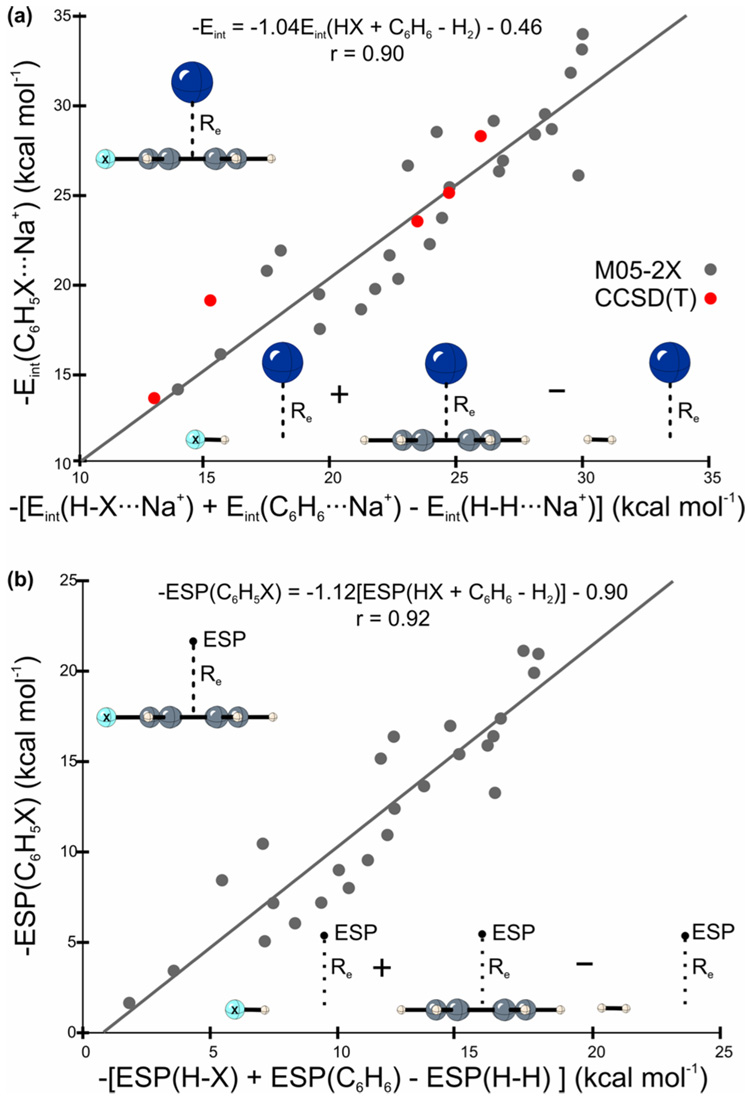
Substituent effects in cation/pi interactions have been examined using the M05-2X DFT functional and CCSD(T) paired with triple-zeta-quality basis sets. In contrast to popular, intuitive models, trends in substituent effects are explained primarily in terms of direct through-space interactions with the substituents. While there is some scatter in the data, which is attributed to pi polarization, the trend in substituent effects in cation/pi interactions is captured by an additive model in which the substituent is isolated from the aryl ring. Similarly, changes in the electrostatic potential at a point above the center of a substituted benzene arise largely from through-space effects of the substituents; pi polarization is not the dominant underlying cause.
Figures
References
-
- Ma JC, Dougherty DA. Chem. Rev. 1997;97:1303–1324. - PubMed
Publication types
MeSH terms
Substances
Grants and funding
LinkOut - more resources
Full Text Sources
Research Materials
Miscellaneous
