Review
. 2009 Jun;13(6):1004-33.
doi: 10.1111/j.1582-4934.2009.00697.x. Epub 2009 Feb 9.

The mitochondrial death pathway: a promising therapeutic target in diseases

Affiliations
Review

The mitochondrial death pathway: a promising therapeutic target in diseases

Sanjeev Gupta et al. J Cell Mol Med. 2009 Jun.

Abstract

The mitochondrial pathway to apoptosis is a major pathway of physiological cell death in vertebrates. The mitochondrial cell death pathway commences when apoptogenic molecules present between the outer and inner mitochondrial membranes are released into the cytosol by mitochondrial outer membrane permeabilization (MOMP). BCL-2 family members are the sentinels of MOMP in the mitochondrial apoptotic pathway; the pro-apoptotic B cell lymphoma (BCL)-2 proteins, BCL-2 associated x protein and BCL-2 antagonist killer 1 induce MOMP whereas the anti-apoptotic BCL-2 proteins, BCL-2, BCL-x(l) and myeloid cell leukaemia 1 prevent MOMP from occurring. The release of pro-apoptotic factors such as cytochrome c from mitochondria leads to formation of a multimeric complex known as the apoptosome and initiates caspase activation cascades. These pathways are important for normal cellular homeostasis and play key roles in the pathogenesis of many diseases. In this review, we will provide a brief overview of the mitochondrial death pathway and focus on a selection of diseases whose pathogenesis involves the mitochondrial death pathway and we will examine the various pharmacological approaches that target this pathway.


Figures
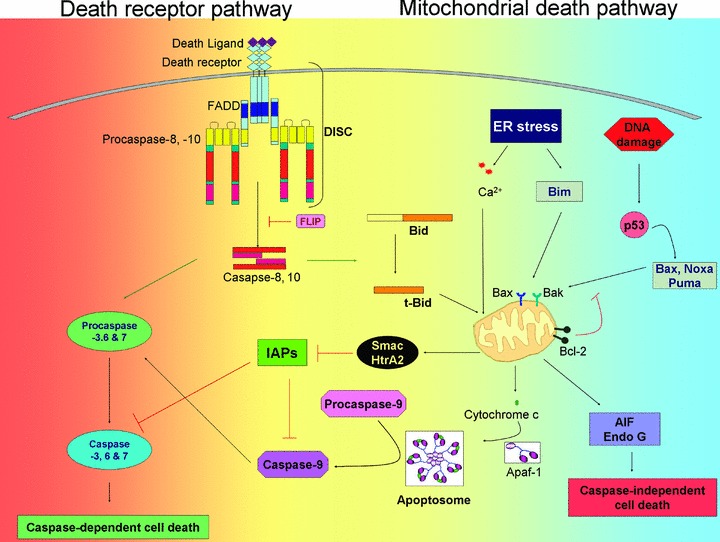
Figure 1
Figure 1
Schematic representation of the extrinsic and intrinsic apoptotic pathway. In the extrinsic pathway, ligation of receptor to death receptor causes DISC formation leading to caspase-8 activation. In type I cells caspase-8 directly cleaves caspase-3, which starts the death cascade. In type II cells an additional amplification loop is required, which involves tBid-mediated cytochrome c release from mitochondria followed by apoptosome formation. In the intrinsic pathway, stress signals from a variety of insults are sensed by BH3-only pro-apoptotic proteins and communicated to multidomain pro-apoptotic and anti-apoptotic BCL-2 proteins. The functional interplay of the proteins ultimately results in the activation of BAX and BAK at target organelles such as mitochondria and ER, which participate in apoptosis by releasing apoptogenic factors. Cytosolic cytochrome c triggers the formation of apoptosome, followed by activation of caspases-9 and -3. Function of caspase can be modulated on several levels. Activation of caspases at the DISC is inhibited by c-FLIP proteins; activation of effector caspases is inhibited by IAPs (see text for details). Smac/DIABLO and HtrA2/Omi neutralize the inhibition of caspases by IAPs. Smac/DIABLO, HtrA2/Omi, AIF and endo G may also initiate a caspase-independent cell death pathway. Abbreviations: FADD, Fas-associated death domain; DISC, death-inducing signalling complex; BAK, BCL-2 antagonist/killer; BAX, BCL-2-associated X protein; BCL-2, B-cell lymphoma 2 protein; IAPs; inhibitor of apoptosis proteins; Apaf-1; apoptosis protease activating factor1 and AIF, apoptosis-inducing factor.
Figure 2
Figure 2
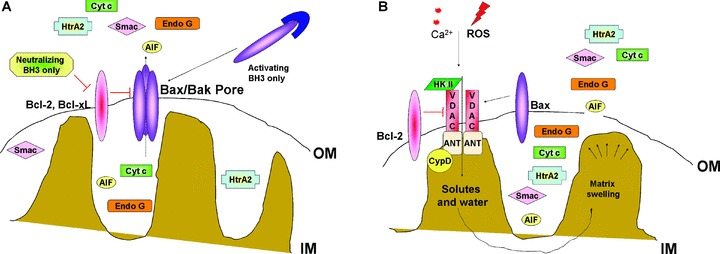
Molecular mechanisms of MOMP. (A) According to first model, the pro-apoptotic members of BCL-2 family BAX and BAK form a multimeric pore across the outer mitochondrial membrane upon activation by BH3-only proteins. This channel mediates the release of apoptogenic factors from IMS. (B) According to second model, opening of voltage-gated channel results in mitochondrial matrix swelling and rupture of MOM, releasing IMS proteins in the cytosol. Abbreviations: ANT, adenine nucleotide translocator; BAK, BCL-2 antagonist/killer; BAX, BCL-2-associated X protein; BCL-2, B-cell lymphoma 2 protein; BH3, BCL-2 homology domain 3; CypD, cyclophilin D; HK, hexokinase; IM, mitochondrial inner membrane; OM, mitochondrial outer membrane and VDAC, voltage-dependent anion channel.
Figure 3
Figure 3
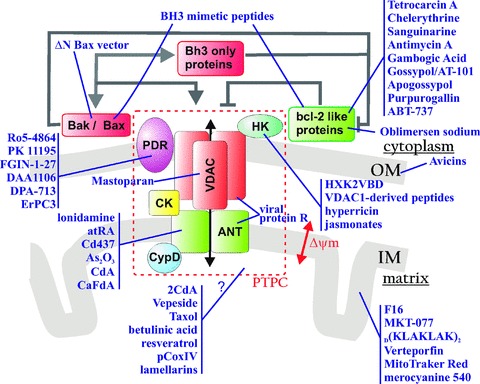
Therapeutic agents acting on mitochondria to promote cell death. Pharmacological inducers of cell death and their target molecules are shown. Please refer to the text for additional detail. Abbreviations: ANT, adenine nucleotide translocator; BAK, BCL-2 antagonist/killer; BAX, BCL-2-associated X protein; BCL-2, B-cell lymphoma 2 protein; BH3, BCL-2 homology domain 3; CK, creatine kinase; CypD, cyclophilin D; HK, hexokinase; IM, mitochondrial inner membrane; OM, mitochondrial outer membrane; PBR, peripheral-type benzodiazepine receptor; PTPC, permeability transition pore complex and VDAC, voltage-dependent anion channel.
Figure 4
Figure 4
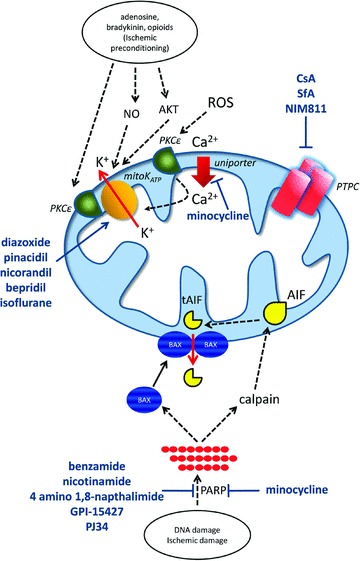
Therapeutic agents acting on mitochondria to prevent cell death. Pharmacological compounds and their target molecules are shown. Please refer to the text for additional detail. Abbreviations: CsA, cyclosporine A; SfA, sanglifehrin A; PTPC, permeability transition pore complex; AIF, apoptosis inducing factor; tAIF, truncated AIF and ROS, reactive oxygen species.

References

    1. Wang J, Lenardo MJ. Roles of caspases in apoptosis, development, and cytokine maturation revealed by homozygous gene deficiencies. J Cell Sci. 2000;113:753–7. - PubMed
    1. Cohen GM. Caspases: the executioners of apoptosis. Biochem J. 1997;326:1–16. - PMC - PubMed
    1. Samali A, Zhivotovsky B, Jones D, Nagata S, Orrenius S. Apoptosis: cell death defined by caspase activation. Cell Death Differ. 1999;6:495–6. - PubMed
    1. Thornberry NA, Lazebnik Y. Caspases: enemies within. Science. 1998;28:1312–6. - PubMed
    1. Salvesen GS. Caspases and apoptosis. Essays Biochem. 2002;38:9–19. - PubMed

MeSH terms

Substances