


Behavioral self-regulation for weight loss in young adults: a randomized controlled trial
- PMID: 19220909
- PMCID: PMC2652418
- DOI: 10.1186/1479-5868-6-10
Behavioral self-regulation for weight loss in young adults: a randomized controlled trial
Abstract
Objective: To determine the feasibility of recruiting and retaining young adults in a brief behavioral weight loss intervention tailored for this age group, and to assess the preliminary efficacy of an intervention that emphasizes daily self-weighing within the context of a self-regulation model.
Methods: Forty young adults (29.1 +/- 3.9 years, range 21-35, average BMI of 33.36 +/- 3.4) were randomized to one of two brief behavioral weight loss interventions: behavioral self-regulation (BSR) or adapted standard behavioral treatment (SBT). Assessments were conducted at baseline, post-treatment (10 weeks), and follow-up (20 weeks). Intent to treat analyses were conducted using general linear modeling in SPSS version 14.0.
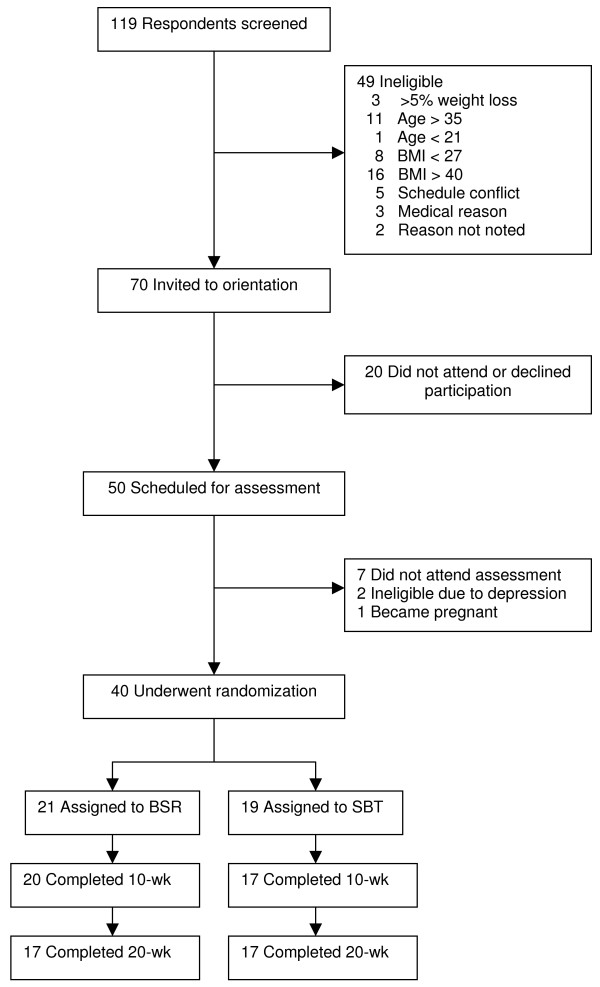
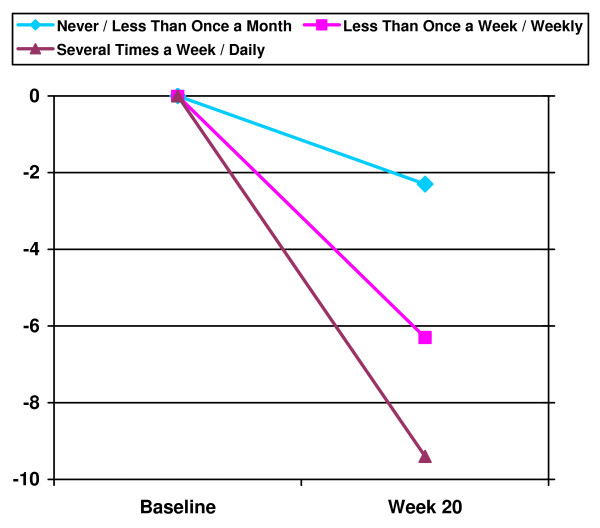
Results: Participants in both groups attended an average of 8.7 out of 10 group meetings, and retention rates were 93% and 88% for post-treatment and follow-up assessments, respectively. Both groups achieved significant weight losses at post-treatment (BSR = -6.4 kg (4.0); SBT = -6.2 kg (4.5) and follow-up (BSR = -6.6 kg (5.5); SBT = -5.8 kg (5.2), p < .001; but the interaction of group x time was not statistically significant, p = .84. Across groups, there was a positive association between frequency of weighing at follow-up and overall weight change at follow-up (p = .01). Daily weighing was not associated with any adverse changes in psychological symptoms.
Conclusion: Young adults can be recruited and retained in a behavioral weight loss program tailored to their needs, and significant weight losses can be achieved and maintained through this brief intervention. Future research on the longer-term efficacy of a self-regulation approach using daily self-weighing for weight loss in this age group is warranted.
Clinical trials registration: # NCT00488228.
Figures

References
-
- Truesdale KP, Stevens J, Lewis CE, Schreiner PJ, Loria CM, Cai J. Changes in risk factors for cardiovascular disease by baseline weight status in young adults who maintain or gain weight over 15 years: the CARDIA study. Int J Obes (Lond) 2006;30:1397–1407. doi: 10.1038/sj.ijo.0803307. - DOI - PMC - PubMed
-
- Lewis CE, Jacobs DR, Jr, McCreath H, Kiefe CI, Schreiner PJ, Smith DE, Williams OD. Weight gain continues in the 1990s: 10-year trends in weight and overweight from the CARDIA study. Coronary Artery Risk Development in Young Adults. Am J Epidemiol. 2000;15;151:1172–81. - PubMed
-
- Norman SA, Greenberg R, Marconi K, et al. A process evaluation of a two-year community cardiovascular risk reduction program: What was done and who knew about it? Health Educ Res. 1990;5:87–97. doi: 10.1093/her/5.1.87. - DOI
-
- Gokee-LaRose J, Gorin AA, Raynor HA, Wing RR. Poster presented at the annual meeting of The Obesity Society. Phoenix, Arizona; 2008. Standard behavioral treatment is not effective for weight loss in young adults.
Associated data
Grants and funding
LinkOut - more resources
Full Text Sources
Medical
