


Exercise and adrenaline increase PGC-1{alpha} mRNA expression in rat adipose tissue
- PMID: 19221126
- PMCID: PMC2678229
- DOI: 10.1113/jphysiol.2008.165464
Exercise and adrenaline increase PGC-1{alpha} mRNA expression in rat adipose tissue
Abstract
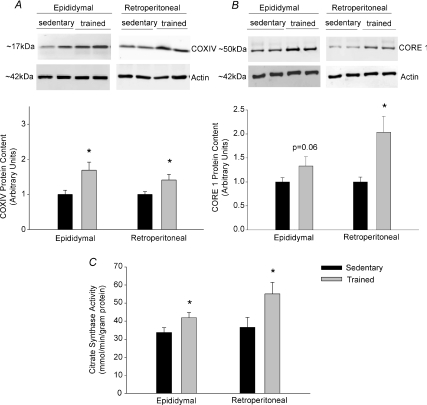
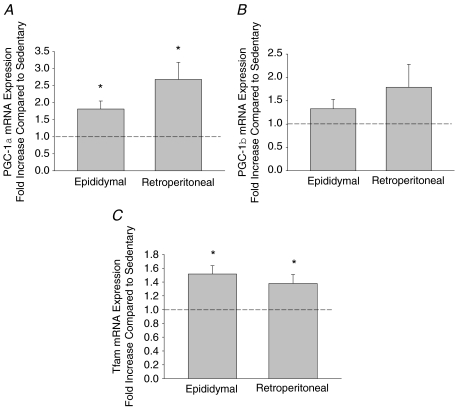
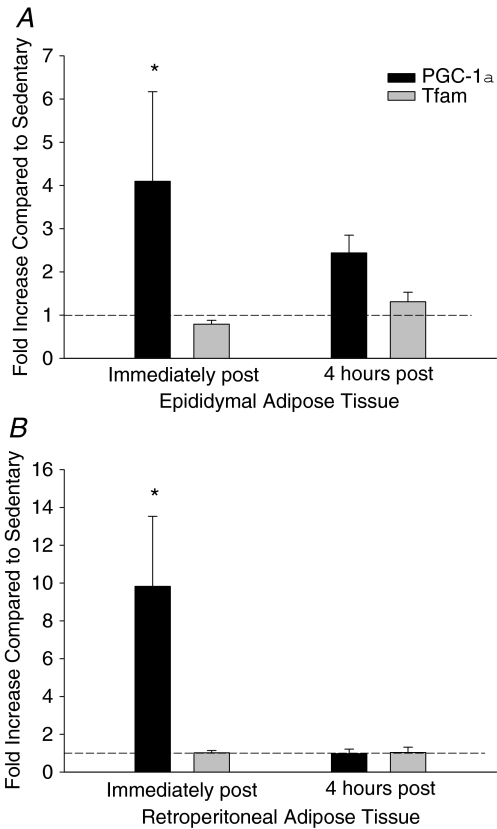
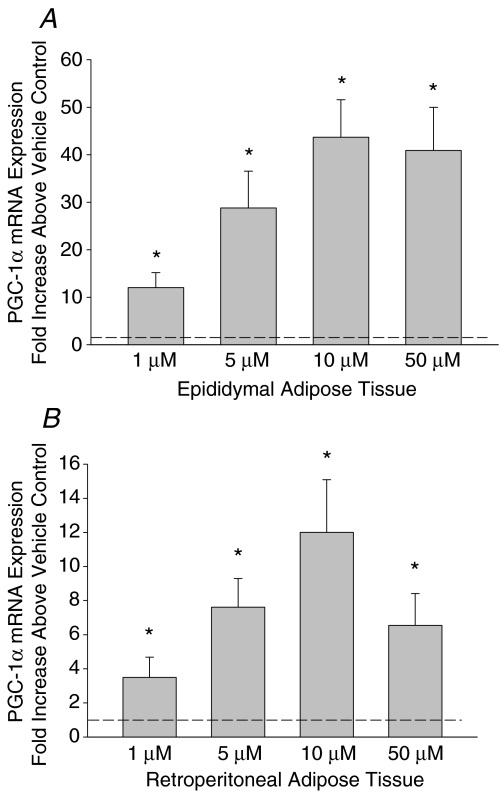
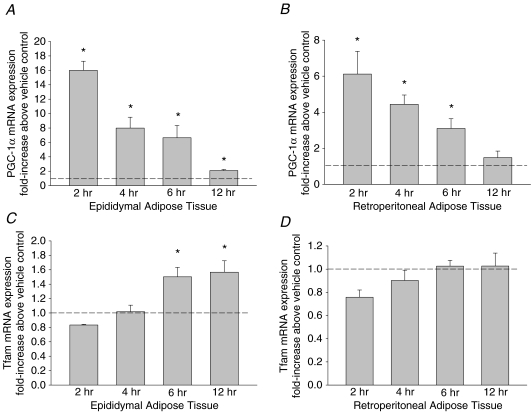
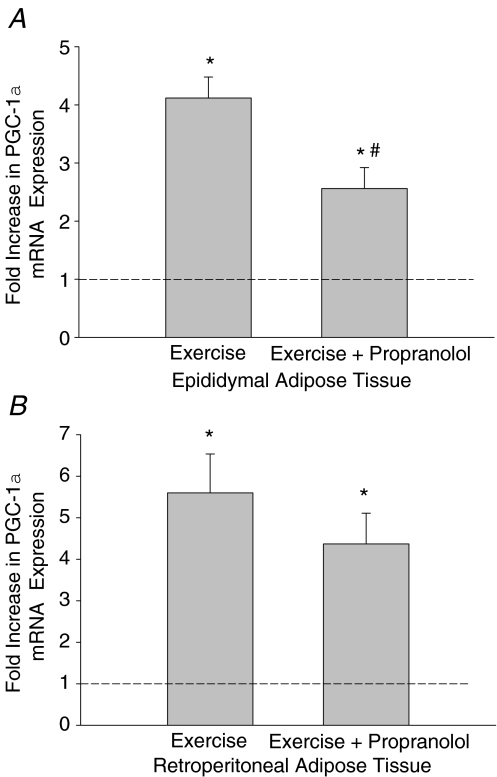
The purpose of the present investigation was to explore the effects of exercise and adrenaline on the mRNA expression of PGC-1alpha, a master regulator of mitochondrial biogenesis, in rat abdominal adipose tissue. We hypothesized that (1) exercise training would increase PGC-1alpha mRNA expression in association with increases in mitochondrial marker enzymes, (2) adrenaline would increase PGC-1alpha mRNA expression and (3) the effect of exercise on PGC-1alpha mRNA expression in white adipose tissue would be attenuated by a beta-blocker. Two hours of daily swim training for 4 weeks led to increases in mitochondrial marker proteins and PGC-1alpha mRNA expression in epididymal and retroperitoneal fat depots. Additionally, a single 2 h bout of exercise led to increases in PGC-1alpha mRNA expression immediately following exercise cessation. Adrenaline treatment of adipose tissue organ cultures led to dose-dependent increases in PGC-1alpha mRNA expression. A supra-physiological concentration of adrenaline increased PGC-1alpha mRNA expression in epididymal but not retroperitoneal adipose tissue. beta-Blockade attenuated the effects of an acute bout of exercise on PGC-1alpha mRNA expression in epididymal but not retroperitoneal fat pads. In summary, this is the first investigation to demonstrate that exercise training, an acute bout of exercise and adrenaline all increase PGC-1alpha mRNA expression in rat white adipose tissue. Furthermore it would appear that increases in circulating catecholamine levels may be one potential mechanism mediating exercise induced increases in PGC-1alpha mRNA expression in rat abdominal adipose tissue.
Figures
Comment in
-
Mitochondrial biogenesis in adipose tissue: can exercise make fat cells 'fit'?J Physiol. 2009 Jul 15;587(Pt 14):3427-8. doi: 10.1113/jphysiol.2009.175307. J Physiol. 2009. PMID: 19602637 Free PMC article. No abstract available.
References
-
- Baar K, Wende AR, Jones TE, Marison M, Nolte LA, Chen M, Kelly DP, Holloszy JO. Adaptations of skeletal muscle to exercise: rapid increase in the transcriptional coactivator PGC-1. FASEB J. 2002;16:1879–1886. - PubMed
-
- Bergeron R, Ren JM, Cadman KS, Moore IK, Perret P, Pypaert M, Young LH, Semenkovich CF, Shulman GI. Chronic activation of AMP kinase results in NRF-1 activation and mitochondrial biogenesis. Am J Physiol Endocrinol Metab. 2001;281:E1340–E1346. - PubMed
-
- Branvold DJ, Allred DR, Beckstead DJ, Kim HJ, Fillmore N, Condon BM, Brown JD, Sudweeks SN, Thomson DM, Winder WW. Thyroid hormone effects on LKB1, MO25, phospho-AMPK, phospho-CREB, and PGC-1α in rat muscle. J Appl Physiol. 2008;105:1218–1227. - PubMed
-
- Choo HJ, Kim JH, Kwon OB, Lee CS, Mun JY, Han SS, Yoon YS, Yoon G, Choi KM, Ko YG. Mitochondria are impaired in the adipocytes of type 2 diabetic mice. Diabetologia. 2006;49:784–791. - PubMed
-
- Crowe S, Turpin SM, Ke F, Kemp BE, Watt MJ. Metabolic remodeling in adipocytes promotes ciliary neurotrophic factor-mediated fat loss in obesity. Endocrinology. 2008;149:2546–2556. - PubMed
Publication types
MeSH terms
Substances
LinkOut - more resources
Full Text Sources
Other Literature Sources
Molecular Biology Databases
