Primary care physicians' links to other physicians through Medicare patients: the scope of care coordination
- PMID: 19221375
- PMCID: PMC3718023
- DOI: 10.7326/0003-4819-150-4-200902170-00004
Primary care physicians' links to other physicians through Medicare patients: the scope of care coordination
Abstract
Background: Primary care physicians are expected to coordinate care for their patients.
Objective: To assess the number of physician peers providing care to the Medicare patients of a primary care physician.
Design: Cross-sectional analysis of claims data.
Setting: Fee-for-service Medicare in 2005.
Participants: 2284 primary care physicians who responded to the 2004 to 2005 Community Tracking Study Physician Survey.
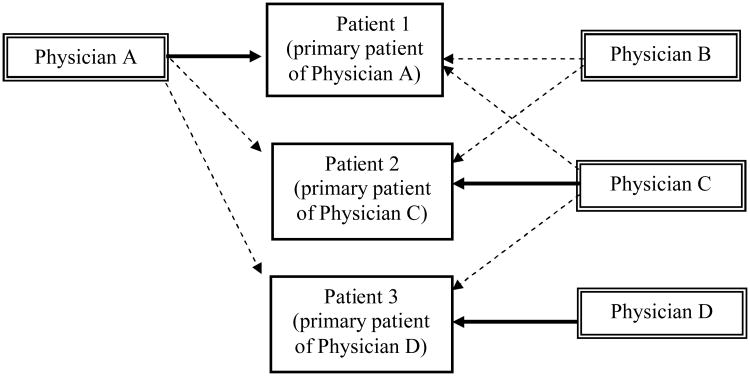
Measurements: Primary patients for each physician were defined as beneficiaries for whom the physician billed for more evaluation and management visits than any other physician in 2005. The number of physician peers for each physician was the sum of other unique physicians that the index physician's primary patients visited plus other unique physicians who served as the primary physician for each of the index physician's nonprimary patients during 2005.
Results: The typical primary care physician has 229 (interquartile range, 125 to 340) other physicians working in 117 (interquartile range, 66 to 175) practices with which care must be coordinated, equivalent to an additional 99 physicians and 53 practices for every 100 Medicare beneficiaries managed by the primary care physician. When only the 31% of a primary care physician's primary patients who had 4 or more chronic conditions was considered, the median number of peers involved was still substantial (86 physicians in 36 practices). The number of peers varied with geographic region, practice type, and reliance on Medicaid revenues.
Limitations: Estimates are based only on fee-for-service Medicare patients and physician peers, and the number of peers is therefore probably an underestimate. The modest response rate of the Community Tracking Study Physician Survey may bias results in unpredictable directions.
Conclusion: In caring for his or her own primary and nonprimary patients during a single year, each primary care physician potentially must coordinate with a large number of individual physician colleagues who also provide care to these patients.
Funding: National Institute on Aging, American Medical Group Association, and the Robert Wood Johnson Foundation.
Figures
Comment in
-
Primary care: too important to fail.Ann Intern Med. 2009 Feb 17;150(4):272-3. doi: 10.7326/0003-4819-150-4-200902170-00009. Ann Intern Med. 2009. PMID: 19221380 No abstract available.
Summary for patients in
-
Summaries for patients. How many other doctors do primary care doctors need to coordinate patient care with?Ann Intern Med. 2009 Feb 17;150(4):I-44. doi: 10.7326/0003-4819-150-4-200902170-00002. Ann Intern Med. 2009. PMID: 19221373 No abstract available.
References
-
- Institute of Medicine. Primary Care: American's Health in a New Era. Washington, DC: National Academy Press; 1996.
-
- Starfield B. Primary Care: Balancing Health Needs, Services, and Technology. Oxford University Press; New York, NY: 1998.
-
- McDonald KM, Sundaram V, Bravata DM, et al. Care Coordination. In: Shojania KG, McDonald KM, Wachter RM, Owens DK, editors. Closing the Quality Gap: A Critical Analysis of Quality Improvement Strategies Technical Review 9(Prepared by the Stanford University-UCSF Evidence-based Practice Center under contract 290-02-0017) Vol. 7. Rockville, MD: Agency for Healthcare Research and Quality; Jun, 2007. AHRQ Publication No. 04(07)-0051-7.
-
- Barr M, Ginsburg J. The Advanced Medical Home: A Patient-Centered, Physician-Guided Model of Health Care. American College of Physicians; Philadelphia, PA: [Accessed August 20, 2007]. http://www.acponline.org/hpp/adv_med.pdf.
-
- Institute of Medicine. Crossing the Quality Chasm: A New Health System for the 21st Century In America. Washington, DC: National Academy Press; 2001. p. 337. - PubMed
Publication types
MeSH terms
Grants and funding
LinkOut - more resources
Full Text Sources
Medical