


FGFR2 variants and breast cancer risk: fine-scale mapping using African American studies and analysis of chromatin conformation
- PMID: 19223389
- PMCID: PMC2733817
- DOI: 10.1093/hmg/ddp078
FGFR2 variants and breast cancer risk: fine-scale mapping using African American studies and analysis of chromatin conformation
Abstract
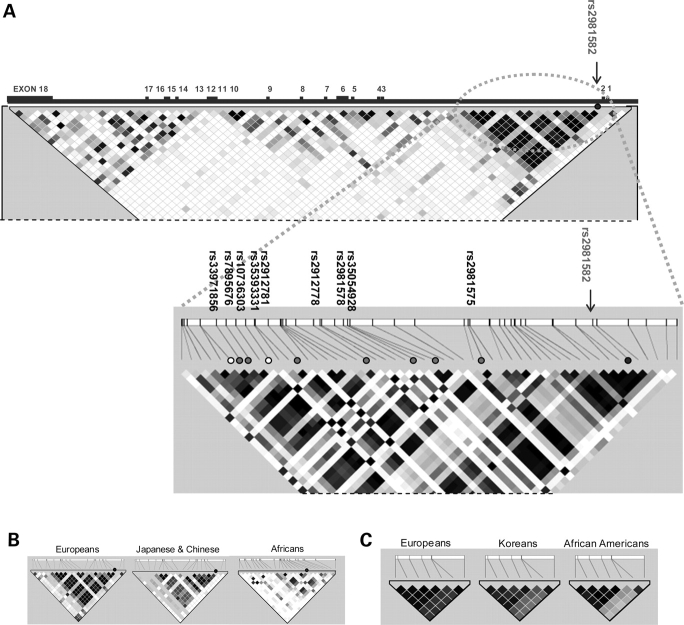
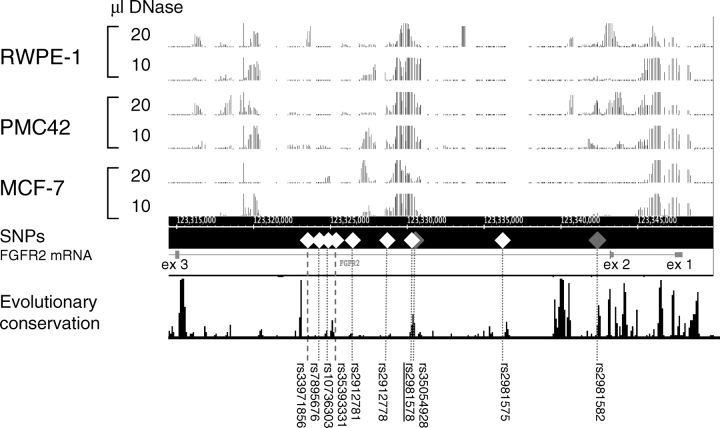
Genome-wide association studies have identified FGFR2 as a breast cancer (BC) susceptibility gene in populations of European and Asian descent, but a causative variant has not yet been conclusively identified. We hypothesized that the weaker linkage disequilibrium across this associated region in populations of African ancestry might help refine the set of candidate-causal single nucleotide polymorphisms (SNPs) previously identified by our group. Eight candidate-causal SNPs were evaluated in 1253 African American invasive BC cases and 1245 controls. A significant association with BC risk was found with SNP rs2981578 (unadjusted per-allele odds ratio = 1.20, 95% confidence interval 1.03-1.41, P(trend) = 0.02), with the odds ratio estimate similar to that reported in European and Asian subjects. To extend the fine-mapping, genotype data from the African American studies were analyzed jointly with data from European (n = 7196 cases, 7275 controls) and Asian (n = 3901 cases, 3205 controls) studies. In the combined analysis, SNP rs2981578 was the most strongly associated. Five other SNPs were too strongly correlated to be excluded at a likelihood ratio of < 1/100 relative to rs2981578. Analysis of DNase I hypersensitive sites indicated that only two of these map to highly accessible chromatin, one of which, SNP rs2981578, has previously been implicated in up-regulating FGFR2 expression. Our results demonstrate that the association of SNPs in FGFR2 with BC risk extends to women of African American ethnicity, and illustrate the utility of combining association analysis in datasets of diverse ethnic groups with functional experiments to identify disease susceptibility variants.
Figures
References
-
- Adnane J., Gaudray P., Dionne C.A., Crumley G., Jaye M., Schlessinger J., Jeanteur P., Birnbaum D., Theillet C. BEK and FLG, two receptors to members of the FGF family, are amplified in subsets of human breast cancers. Oncogene. 1991;6:659–663. - PubMed
-
- Penault-Llorca F., Bertucci F., Adelaide J., Parc P., Coulier F., Jacquemier J., Birnbaum D., deLapeyriere O. Expression of FGF and FGF receptor genes in human breast cancer. Int. J. Cancer. 1995;61:170–176. - PubMed
-
- Adelaide J., Finetti P., Bekhouche I., Repellini L., Geneix J., Sircoulomb F., Charafe-Jauffret E., Cervera N., Desplans J., Parzy D., et al. Integrated profiling of basal and luminal breast cancers. Cancer Res. 2007;67:11565–11575. - PubMed
Publication types
MeSH terms
Substances
Grants and funding
- N01 HD 3-3175/HD/NICHD NIH HHS/United States
- N01 HD 2-3166/HD/NICHD NIH HHS/United States
- A10123/CRUK_/Cancer Research UK/United Kingdom
- 11022/CRUK_/Cancer Research UK/United Kingdom
- 19275/CRUK_/Cancer Research UK/United Kingdom
- N01-PC-67006/PC/NCI NIH HHS/United States
- Y01 HD 7022/HD/NICHD NIH HHS/United States
- ImNIH/Intramural NIH HHS/United States
- CA 63464/CA/NCI NIH HHS/United States
- N01 HD 3-3174/HD/NICHD NIH HHS/United States
- N01 HD 3-3168/HD/NICHD NIH HHS/United States
- N01 HD 3-3176/HD/NICHD NIH HHS/United States
- N01-CN-0532/CN/NCI NIH HHS/United States
- N01-CN-67010/CN/NCI NIH HHS/United States
- 10118/CRUK_/Cancer Research UK/United Kingdom
- CA 54281/CA/NCI NIH HHS/United States
- N01-CN-65064/CN/NCI NIH HHS/United States
LinkOut - more resources
Full Text Sources
Medical
Miscellaneous
