


Modified-release hydrocortisone to provide circadian cortisol profiles
- PMID: 19223520
- PMCID: PMC2684472
- DOI: 10.1210/jc.2008-2380
Modified-release hydrocortisone to provide circadian cortisol profiles
Abstract
Context: Cortisol has a distinct circadian rhythm regulated by the brain's central pacemaker. Loss of this rhythm is associated with metabolic abnormalities, fatigue, and poor quality of life. Conventional glucocorticoid replacement cannot replicate this rhythm.
Objectives: Our objectives were to define key variables of physiological cortisol rhythm, and by pharmacokinetic modeling test whether modified-release hydrocortisone (MR-HC) can provide circadian cortisol profiles.
Setting: The study was performed at a Clinical Research Facility.
Design and methods: Using data from a cross-sectional study in healthy reference subjects (n = 33), we defined parameters for the cortisol rhythm. We then tested MR-HC against immediate-release hydrocortisone in healthy volunteers (n = 28) in an open-label, randomized, single-dose, cross-over study. We compared profiles with physiological cortisol levels, and modeled an optimal treatment regimen.
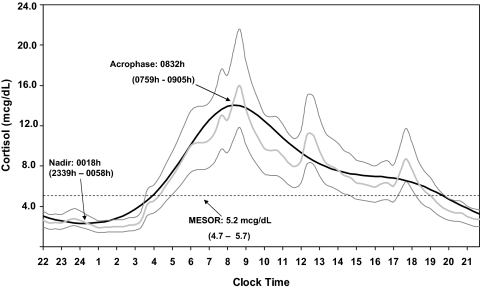
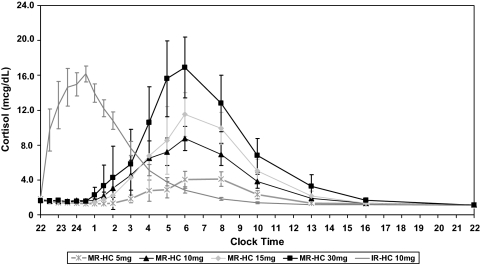
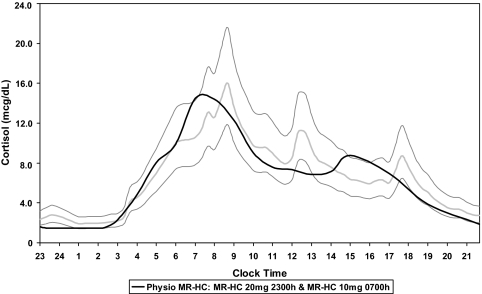
Results: The key variables in the physiological cortisol profile included: peak 15.5 microg/dl (95% reference range 11.7-20.6), acrophase 0832 h (95% confidence interval 0759-0905), nadir less than 2 microg/dl (95% reference range 1.5-2.5), time of nadir 0018 h (95% confidence interval 2339-0058), and quiescent phase (below the mesor) 1943-0531 h. MR-HC 15 mg demonstrated delayed and sustained release with a mean (sem) maximum observed concentration of 16.6 (1.4) microg/dl at 7.41 (0.57) h after drug. Bioavailability of MR-HC 5, 10, and 15 mg was 100, 79, and 86% that of immediate-release hydrocortisone. Modeling suggested that MR-HC 15-20 mg at 2300 h and 10 mg at 0700 h could reproduce physiological cortisol levels.
Conclusion: By defining circadian rhythms and using modern formulation technology, it is possible to allow a more physiological circadian replacement of cortisol.
Figures
References
-
- Krieger DT, Allen W, Rizzo F, Krieger HP 1971 Characterization of the normal temporal pattern of plasma corticosteroid levels. J Clin Endocrinol Metab 32:266–284 - PubMed
-
- Dunlap JC 1999 Molecular bases for circadian clocks. Cell 96:271–290 - PubMed
-
- Balsalobre A, Damiola F, Schibler U 1998 A serum shock induces circadian gene expression in mammalian tissue culture cells. Cell 93:929–937 - PubMed
-
- Balsalobre A, Brown SA, Marcacci L, Tronche F, Kellendonk C, Reichardt HM, Schutz G, Schibler U 2000 Resetting of circadian time in peripheral tissues by glucocorticoid signaling. Science 289:2344–2347 - PubMed
-
- Buckley TM, Schatzberg AF 2005 On the interactions of the hypothalamic-pituitary-adrenal (HPA) axis and sleep: normal HPA axis activity and circadian rhythm, exemplary sleep disorders. J Clin Endocrinol Metab 90:3106–3114 - PubMed
Publication types
MeSH terms
Substances
Grants and funding
LinkOut - more resources
Full Text Sources
Other Literature Sources
Medical
