


Review
doi: 10.1038/mt.2009.5.
Epub 2009 Feb 17.
Electroporation for the delivery of DNA-based vaccines and immunotherapeutics: current clinical developments
Affiliations
- PMID: 19223870
- PMCID: PMC2835112
- DOI: 10.1038/mt.2009.5
Item in Clipboard
Review
Electroporation for the delivery of DNA-based vaccines and immunotherapeutics: current clinical developments
Mol Ther.
2009 Apr.
Abstract
Electroporation (EP) has been used in basic research for the past 25 years to aid in the transfer of DNA into cells in vitro. EP in vivo enhances transfer of DNA vaccines and therapeutic plasmids to the skin, muscle, tumors, and other tissues resulting in high levels of expression, often with serological and clinical benefits. The recent interest in nonviral gene transfer as treatment options for a vast array of conditions has resulted in the refinement and optimization of EP technology. Current research has revealed that EP can be successfully used in many species, including humans. Clinical trials are currently under way. Herein, the transition of EP from basic science to clinical trials will be discussed.
Figures
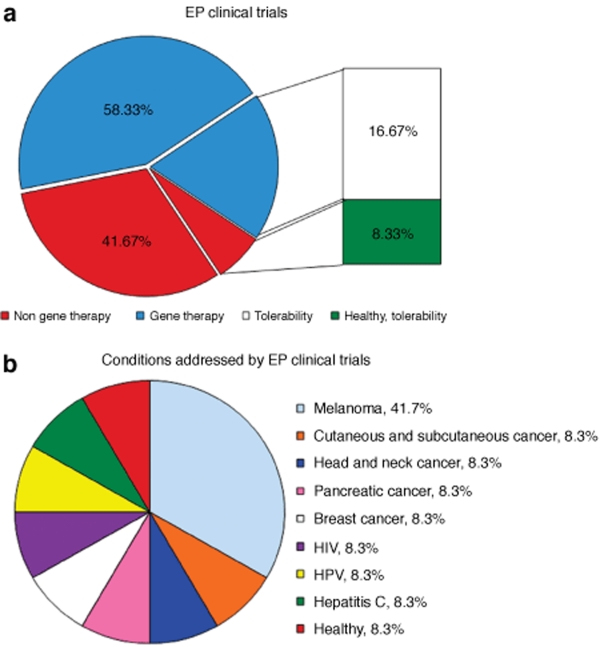
Clinical trials using electroporation. (a) Seven gene therapy trials are listed on regulatory Web sites and investigate the benefits of EP; out of these, two are examining the tolerability of the technology. Five trials are investigating the combination of EP with nongene therapy approaches (anticancer drugs) for the treatment of cancer. One completed nongene therapy study by Merck tested the tolerability of EP in healthy adults. The number of trials is presented as a percentage. (b) Conditions addressed by EP clinical trials. Four trials examining the potential of EP in the treatment of melanoma. For all other conditions there is presently just one trial. Five of the trials (one head and neck cancer, one melanoma, one pancreatic cancer, one breast cancer, and one cutaneous/subcutaneous cancer) involve non-gene therapy approaches. The number of trials is presented as a percentage.
References
-
- Ewert KK, Ahmad A, Bouxsein NF, Evans HM., and , Safinya CR. Non-viral gene delivery with cationic liposome-DNA complexes. Methods Mol Biol. 2008;433:159–175. - PubMed
-
- Fuller DH, Loudon P., and , Schmaljohn C. Preclinical and clinical progress of particle-mediated DNA vaccines for infectious diseases. Methods. 2006;40:86–97. - PubMed
-
- Ohta S, Suzuki K, Ogino Y, Miyagawa S, Murashima A, Matsumaru D, et al. Gene transduction by sonoporation. Dev Growth Differ. 2008;50:517–520. - PubMed
-
- Rols MP. Mechanism by which electroporation mediates DNA migration and entry into cells and targeted tissues. Methods Mol Biol. 2008;423:19–33. - PubMed
Publication types
MeSH terms
Substances
LinkOut - more resources
Full Text Sources
Other Literature Sources
Miscellaneous
