


Xenon preconditioning: the role of prosurvival signaling, mitochondrial permeability transition and bioenergetics in rats
- PMID: 19224794
- PMCID: PMC2748301
- DOI: 10.1213/ane.0b013e318192a520
Xenon preconditioning: the role of prosurvival signaling, mitochondrial permeability transition and bioenergetics in rats
Abstract
Background: Similar to volatile anesthetics, the anesthetic noble gas xenon protects the heart from ischemia/reperfusion injury, but the mechanisms responsible for this phenomenon are not fully understood. We tested the hypothesis that xenon-induced cardioprotection is mediated by prosurvival signaling kinases that target mitochondria.
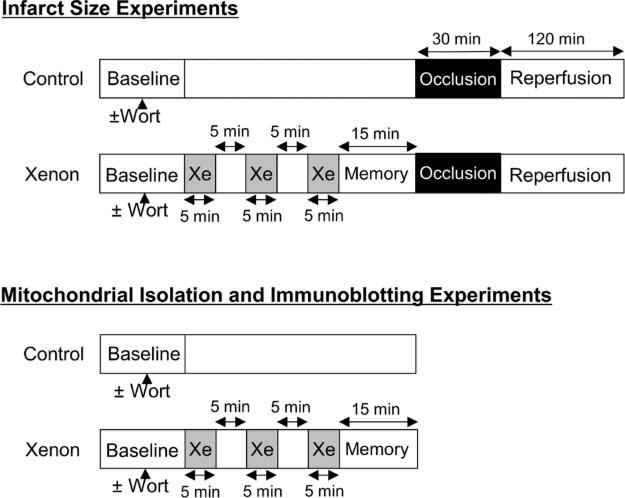
Methods: Male Wistar rats instrumented for hemodynamic measurements were subjected to a 30 min left anterior descending coronary artery occlusion and 2 h reperfusion. Rats were randomly assigned to receive 70% nitrogen/30% oxygen (control) or three 5-min cycles of 70% xenon/30% oxygen interspersed with the oxygen/nitrogen mixture administered for 5 min followed by a 15 min memory period. Myocardial infarct size was measured using triphenyltetrazolium staining. Additional hearts from control and xenon-pretreated rats were excised for Western blotting of Akt and glycogen synthase kinase 3 beta (GSK-3beta) phosphorylation and isolation of mitochondria. Mitochondrial oxygen consumption before and after hypoxia/reoxygenation and mitochondrial permeability transition pore opening were determined.
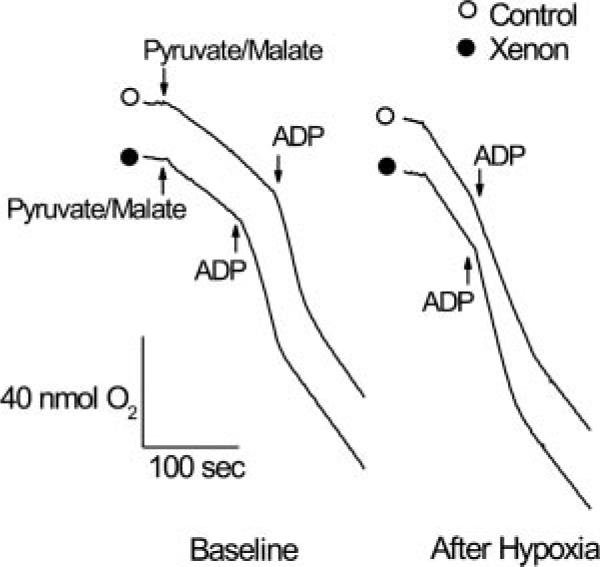
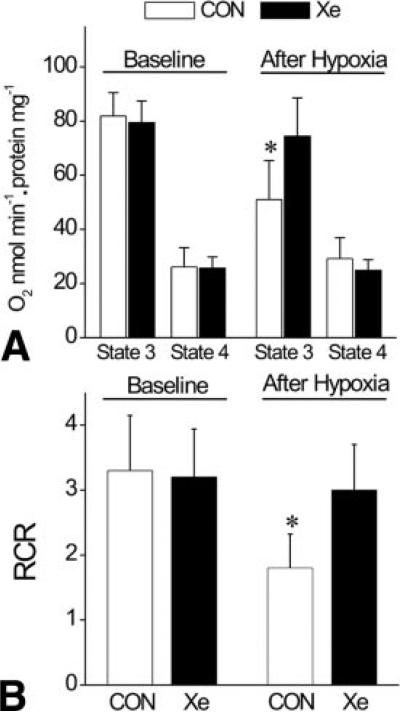
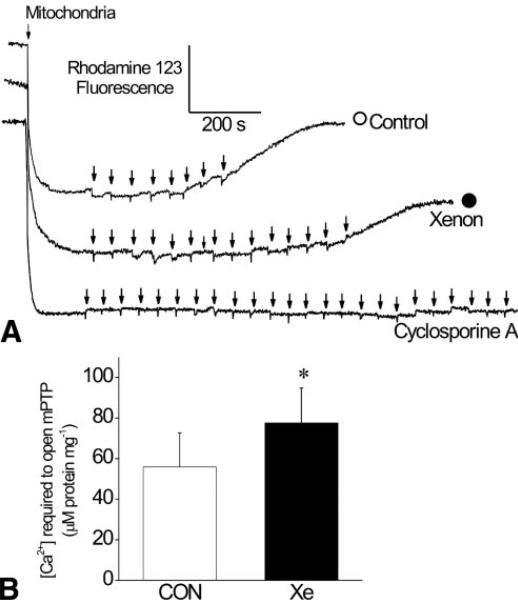
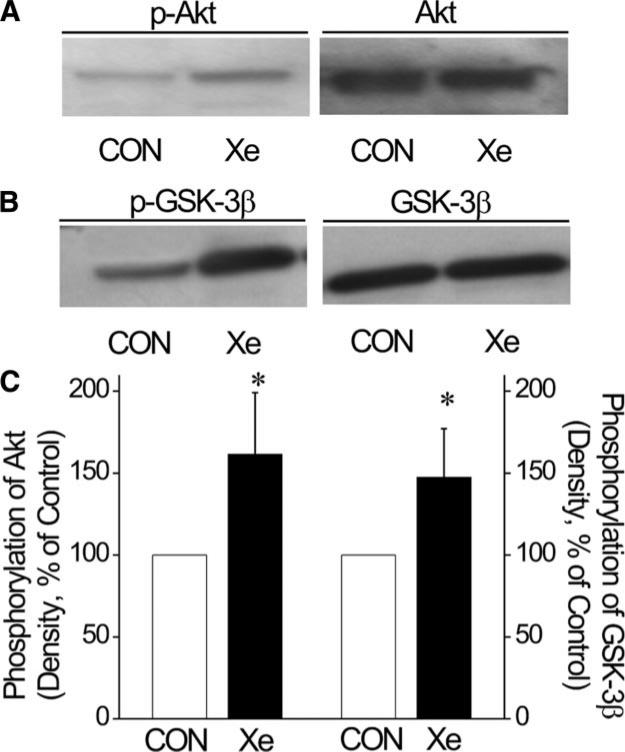
Results: Xenon significantly (P < 0.05) reduced myocardial infarct size compared with control (32 +/- 4 and 59% +/- 4% of the left ventricular area at risk; mean +/- sd) and enhanced phosphorylation of Akt and GSK-3beta. Xenon pretreatment preserved state 3 respiration of isolated mitochondria compared with the results obtained in the absence of the gas. The Ca(2+) concentration required to induce mitochondrial membrane depolarization was larger in the presence compared with the absence of xenon pretreatment (78 +/- 17 and 56 +/- 17 microM, respectively). The phosphoinositol-3-kinase-kinase inhibitor wortmannin blocked the effect of xenon on infarct size and respiration.
Conclusions: These results indicate that xenon preconditioning reduces myocardial infarct size, phosphorylates Akt, and GSK-3beta, preserves mitochondrial function, and inhibits Ca(2+)-induced mitochondrial permeability transition pore opening. These data suggest that xenon-induced cardioprotection occurs because of activation of prosurvival signaling that targets mitochondria and renders them less vulnerable to ischemia-reperfusion injury.
Figures
References
-
- Kersten JR, Schmeling TJ, Pagel PS, Gross GJ, Warltier DC. Isoflurane mimics ischemic preconditioning via activation of KATP channels: reduction of myocardial infarct size with an acute memory phase. Anesthesiology. 1997;87:361–70. - PubMed
-
- Novalija E, Fujita S, Kampine JP, Stowe DF. Sevoflurane mimics ischemic preconditioning effects on coronary flow and nitric oxide release in isolated hearts. Anesthesiology. 1999;91:701–12. - PubMed
-
- Toller WG, Gross ER, Kersten JR, Pagel PS, Gross GJ, Warltier DC. Sarcolemmal and mitochondrial adenosine triphosphate-dependent potassium channels: mechanism of desflurane-induced cardioprotection. Anesthesiology. 2000;92:1731–9. - PubMed
-
- Wilhelm S, Ma D, Maze M, Franks NP. Effects of xenon on in vitro and in vivo models of neuronal injury. Anesthesiology. 2002;96:1485–91. - PubMed
Publication types
MeSH terms
Substances
Grants and funding
LinkOut - more resources
Full Text Sources
Miscellaneous
