Review
. 2009 Mar 1;122(Pt 5):577-86.
doi: 10.1242/jcs.037622.

A nuclear-envelope bridge positions nuclei and moves chromosomes

Affiliations
Review

A nuclear-envelope bridge positions nuclei and moves chromosomes

Daniel A Starr. J Cell Sci. .

Abstract

Positioning the nucleus is essential for the formation of polarized cells, pronuclear migration, cell division, cell migration and the organization of specialized syncytia such as mammalian skeletal muscles. Proteins that are required for nuclear positioning also function during chromosome movement and pairing in meiosis. Defects in these processes lead to human diseases including laminopathies. To properly position the nucleus or move chromosomes within the nucleus, the cell must specify the outer surface of the nucleus and transfer forces across both membranes of the nuclear envelope. KASH proteins are specifically recruited to the outer nuclear membrane by SUN proteins, which reside in the inner nuclear membrane. KASH and SUN proteins physically interact in the perinuclear space, forming a bridge across the two membranes of the nuclear envelope. The divergent N-terminal domains of KASH proteins extend from the surface of the nucleus into the cytoplasm and interact with the cytoskeleton, whereas the N-termini of SUN proteins extend into the nucleoplasm to interact with the lamina or chromatin. The bridge of SUN and KASH across the nuclear envelope functions to transfer forces that are generated in the cytoplasm into the nucleoplasm during nuclear migration, nuclear anchorage, centrosome attachment, intermediate-filament association and telomere clustering.


Figures
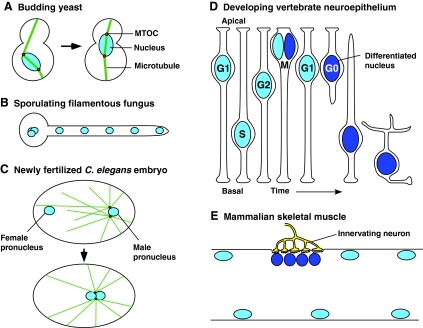
Fig. 1.
Fig. 1.
Selected examples of nuclear positioning are shown. Nuclei are light blue, differentiated nuclei are dark blue, microtubule organizing centers (MTOCs) are red, and microtubules are green. Arrows represent development over time. (A) In budding yeast, the nucleus must be positioned to the bud neck prior to mitosis. (B) In sporulating filamentous fungi, nuclei are evenly spaced in the syncytia. (C) In a newly fertilized C. elegans embryo, the male (right) and female (left) pronuclei must migrate towards one another before the first mitotic event. (D) In the developing vertebrate neuroepithelium, nuclei migrate basally and then apically, to where they divide. Differentiated cells often leave the pseudostratified epithelium, which requires additional nuclear migration events. (E) In a mammalian skeletal muscle, nuclei are spaced out evenly, except for specialized nuclei at the neuromuscular junction (innervating neuron is yellow).
Fig. 2.
Fig. 2.
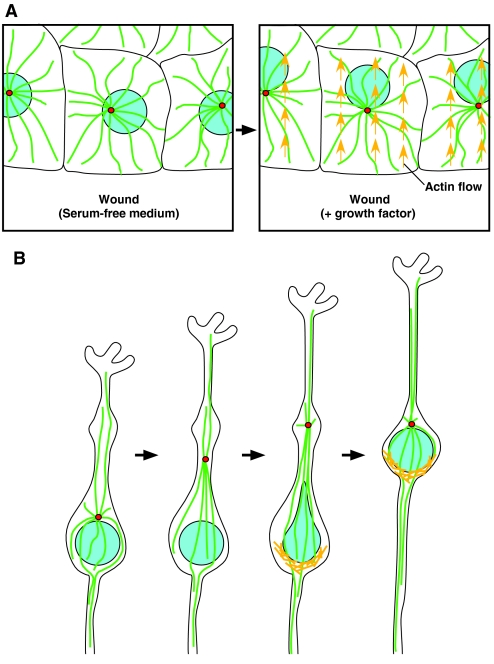
Mammalian cell-culture model systems for nuclear migration. (A) NIH-3T3 cells polarize towards a wound edge prior to migration. In response to the addition of a growth factor, the nucleus (blue) migrates away from the wound edge in conjunction with actin flow (yellow arrows), whereas the centrosomes (red) and microtubules (green) remain stationary in the center of the cell. (B) Migrating neuronal precursors in culture. The centrosome (red) migrates forwards at a constant rate into a swelling. The microtubules (green) begin to pull on the nucleus (blue) and the nucleus jumps forwards in large steps with the assistance of actin-myosin contraction (yellow bars) behind the nucleus.
Fig. 3.
Fig. 3.
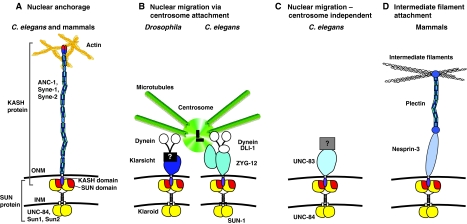
The nuclear-envelope bridge, and roles of KASH proteins connecting the ONM to the cytoskeleton. SUN proteins (yellow and red) dimerize at the INM and recruit KASH proteins (different shades of blue) to the ONM. The central link of the bridge occurs in the perinuclear space, where the KASH domain (purple) of KASH proteins directly interacts with two domains in the SUN protein, the SUN domain (red) and a less-conserved domain (yellow). The large cytoplasmic domains of KASH proteins (shades of blue) then extend away from the ONM into the cytoplasm to interact with the cytoskeleton. (A) One class of KASH proteins (including ANC-1, Syne-1 and Syne-2) connect the ONM to actin filaments (tan) to anchor nuclei. (B) Klarsicht and ZYG-12 connect the ONM to centrosomes (green). Both function through dynein (white). ZYG-12 in the ONM dimerizes with KASH-less ZYG-12 in the centrosome. (C) UNC-83 and UNC-84 mediate nuclear migration in a centrosome-independent mechanism that remains unknown. (D) Nesprin-3 links the ONM to intermediate filaments (gray) through plectin. See text for more details.
Fig. 4.
Fig. 4.
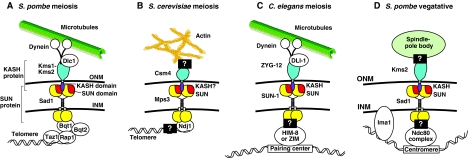
The KASH-SUN nuclear-envelope bridge transfers forces to move chromosomes. SUN proteins (yellow and red) at the INM interact with KASH proteins (blue and purple) at the ONM. The N-terminal nucleoplasmic domain of SUN proteins (bottom) interacts with chromosome-binding proteins. KASH proteins extend away from the ONM into the cytoplasm to interact with the cytoskeleton. (A) Kms1-Kms2 and Sad1 move telomeres along the INM by transferring forces that are generated by dynein on microtubules. (B) Csm4 and Mps3 move telomeres along the INM by transferring forces that are generated by the actin cytoskeleton. (C) ZYG-12 and SUN-1 target pairing centers of meiotic chromosomes to the INM and might move them to facilitate pairing by transferring forces from dynein and microtubules. (D) Kms2 and Sad1 connect the SPB to the nucleus. The forces generated by the SPB are then spread along the chromatin through the centromere and neighboring Ima1-heterochromatin complexes. See text for details.

References

    1. Akhtar, A. and Gasser, S. M. (2007). The nuclear envelope and transcriptional control. Nat. Rev. Genet. 8, 507-517. - PubMed
    1. Apel, E. D., Lewis, R. M., Grady, R. M. and Sanes, J. R. (2000). Syne-1, a dystrophin- and Klarsicht-related protein associated with synaptic nuclei at the neuromuscular junction. J. Biol. Chem. 275, 31986-31995. - PubMed
    1. Baye, L. M. and Link, B. A. (2008). Nuclear migration during retinal development. Brain Res. 1192, 29-36. - PMC - PubMed
    1. Bellion, A., Baudoin, J. P., Alvarez, C., Bornens, M. and Metin, C. (2005). Nucleokinesis in tangentially migrating neurons comprises two alternating phases: forward migration of the Golgi/centrosome associated with centrosome splitting and myosin contraction at the rear. J. Neurosci. 25, 5691-5699. - PMC - PubMed
    1. Bhalla, N. and Dernburg, A. F. (2008). Prelude to a division. Annu. Rev. Cell Dev. Biol. 24, 397-424. - PMC - PubMed

Publication types

Substances