


Review
doi: 10.1038/emboj.2008.303.
Bypass specialists operate together
Affiliations
- PMID: 19225445
- PMCID: PMC2646159
- DOI: 10.1038/emboj.2008.303
Item in Clipboard
Review
Bypass specialists operate together
EMBO J.
.
Abstract
New experiments show that different combinations of translesion DNA polymerases act to bypass lesions in mammalian cells, depending on the type of DNA damage. Bypass of most lesions tested was dependent on REV3L (pol zeta) and at least one additional DNA polymerase. The data fit a model whereby DNA polymerases work sequentially to bypass adducts in DNA.
Figures
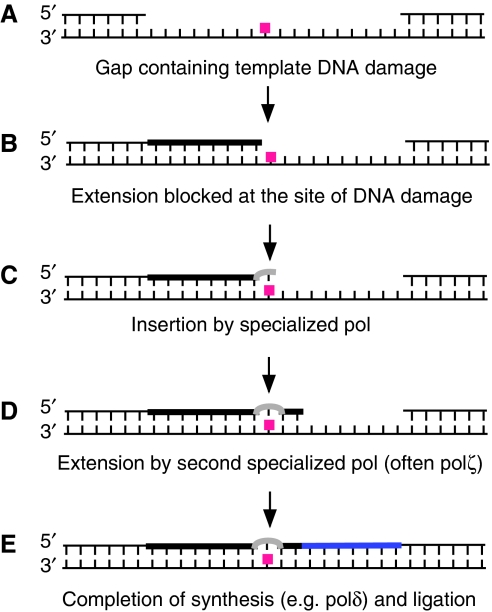
Working model for the bypass of a site of DNA damage by the action of multiple DNA polymerases. Shachar et al. (2009) constructed plasmids containing a gap, each with a different type of single DNA template lesion near the centre of the gap (A). In mammalian cells, several steps are necessary for complete gap filling. Replicative DNA polymerases are normally stalled at sites of damage (B), and a specialized DNA polymerase such as POLH, POLI, POLK or polζ inserts a base (or bases) opposite the adduct (C). The polymerase selected depends on the type of DNA lesion. Extension of this aberrant terminus may require another specialized DNA polymerase, often polζ. The length of tracts synthesized by polζ in vivo is not yet known (D). For the bypass of a TT CPD, polζ is not necessary. Some post-replication repair gap filling may occur in G2 phase, and some lesion bypass may take place during S phase. If bypass happens in S phase or for filling of long gaps in vivo, switching back to a replicative DNA polymerase is necessary (E).
Comment on
-
Two-polymerase mechanisms dictate error-free and error-prone translesion DNA synthesis in mammals.EMBO J. 2009 Feb 18;28(4):383-93. doi: 10.1038/emboj.2008.281. Epub 2009 Jan 15. EMBO J. 2009. PMID: 19153606 Free PMC article.
References
-
- Diaz M, Watson NB, Turkington G, Verkoczy LK, Klinman NR, McGregor WG (2003) Decreased frequency and highly aberrant spectrum of ultraviolet-induced mutations in the Hprt gene of mouse fibroblasts expressing antisense RNA to DNA polymerase zeta. Mol Cancer Res 1: 836–847 - PubMed
-
- Johnson RE, Washington MT, Haracska L, Prakash S, Prakash L (2000) Eukaryotic polymerases ι and ζ act sequentially to bypass DNA lesions. Nature 406: 1015–1019 - PubMed
-
- Kannouche PL, Lehmann AR (2004) Ubiquitination of PCNA and the polymerase switch in human cells. Cell Cycle 3: 1011–1013 - PubMed
Publication types
MeSH terms
Substances
LinkOut - more resources
Full Text Sources
Molecular Biology Databases
Miscellaneous
