


Correlation analysis of celiac sprue tissue transglutaminase and deamidated gliadin IgG/IgA
- PMID: 19230045
- PMCID: PMC2653384
- DOI: 10.3748/wjg.15.845
Correlation analysis of celiac sprue tissue transglutaminase and deamidated gliadin IgG/IgA
Abstract
Aim: To indirectly determine if tissue transglutaminase (tTG)-specific T cells play a crucial role in the propagation of celiac disease.
Methods: Anti-deamidated gliadin peptide (DGP) and anti-tTG IgA and IgG were measured in the sera of celiac patients (both untreated and treated). The correlations were determined by Spearman's rank correlation test.
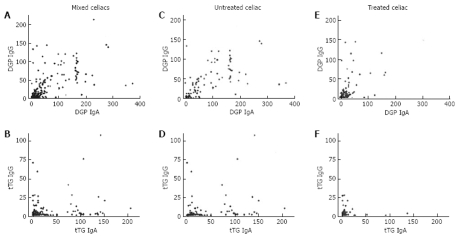
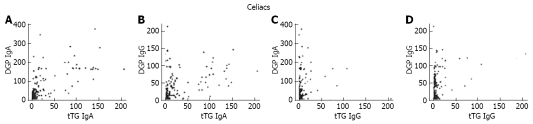
Results: In celiac patients, we found a very significant correlation between the production of DGP IgA and IgG (r = 0.75), indicating a simultaneous and ongoing production of these two isotypes reminiscent of oral vaccination studies. However, there was far less association between the production of tTG IgA and tTG IgG in celiac patients (r = 0.52). While tTG IgA was significantly correlated with DGP IgA (r = 0.80) and DGP IgG (r = 0.67), there was a weak correlation between production of anti-tTG IgG and the production of anti-DGP IgA (r = 0.38) and anti-DGP IgG (r = 0.43).
Conclusion: These data demonstrate that the production of anti-tTG IgA is directly correlated to the production of anti-DGP IgG and IgA, whereas anti-tTG IgG is only weakly correlated. This result therefore supports the hapten-carrier theory that in well-established celiac patients anti-tTG IgA is produced by a set of B cells that are reacting against the complex of tTG-DGP in the absence of a tTG-specific T cell.
Figures
References
-
- Farrell RJ, Kelly CP. Celiac sprue. N Engl J Med. 2002;346:180–188. - PubMed
-
- Trier JS. Diagnosis of celiac sprue. Gastroenterology. 1998;115:211–216. - PubMed
-
- Anderson RP. Coeliac disease. Aust Fam Physician. 2005;34:239–242. - PubMed
-
- Molberg O, Mcadam SN, Korner R, Quarsten H, Kristiansen C, Madsen L, Fugger L, Scott H, Noren O, Roepstorff P, et al. Tissue transglutaminase selectively modifies gliadin peptides that are recognized by gut-derived T cells in celiac disease. Nat Med. 1998;4:713–717. - PubMed
-
- Kotze LM, Utiyama SR, Nisihara RM, de Camargo VF, Ioshii SO. IgA class anti-endomysial and anti-tissue transglutaminase antibodies in relation to duodenal mucosa changes in coeliac disease. Pathology. 2003;35:56–60. - PubMed
Publication types
MeSH terms
Substances
Grants and funding
LinkOut - more resources
Full Text Sources
Medical
Miscellaneous
